Manufacturing is no longer simply a line of products, and a chain of suppliers. “Managing customer relationships as precisely as machines” is the key to winning in manufacturing in 2026. This is where Manufacturing CRM Software comes in handy. Especially for more complex sales processes, multiple locations, and CRM integration with other enterprise systems and resources, factories, plants and industrial teams are increasingly adopting CRM platforms designed specifically for them.
From discrete parts manufacturers to process-based chemical plants and hybrid OEM suppliers, picking the proper Manufacturing CRM can directly influence revenue, client retention and also the effectiveness of business procedures. This article introduces the 10 best tools of the day and tests and compares them to help you make the right choice in no time.
What Is Manufacturing CRM Software?
Manufacturing CRM Software is a CRM solution that is tailored for manufacturing companies, addressing their operational, sales and service requirements. Manufacturing CRMs are different from the retail or SaaS based generic options as they integrate seamlessly with the ERP systems, are capable of managing long B2B sales cycles, support dealer and distributor networks and keep track of order, warranty and after-sales service.
They are designed to connect the shop floor and the front office with customers, providing a common perspective of all customer accounts, quotes and contracts in real-time to both the sales and service and production teams.
Key Differences: Manufacturing CRM vs Standard CRM
| Feature | Manufacturing CRM | Standard CRM |
| ERP Integration | Deep, native or near-native | Limited or via third-party |
| Sales Cycle Support | Long B2B, multi-quote cycles | Short to medium cycles |
| Order Management | Built-in or tightly integrated | Usually absent |
| After-Sales Service | Warranty, spare parts, service | Basic ticketing only |
| Customer Type | Distributors, OEMs, dealers | End consumers, SMBs |
| Production Visibility | Real-time floor data access | Not available |
| Pricing Complexity | Volume, contract, tier-based | Standard pricing rules |
| Regulatory Compliance | Industry-specific | Generic |
Types of Manufacturing It Serves
| Manufacturing Type | Description | Example Industries |
| Discrete Manufacturing | Individual, countable units | Automotive, electronics, aerospace |
| Process Manufacturing | Batch or continuous production | Chemicals, food & beverage, pharma |
| Hybrid Manufacturing | Mix of discrete and process methods | Consumer goods, industrial equipment |
| OEM Manufacturing | Components built for other brands | Auto parts, tech hardware suppliers |
Why Do Manufacturers Need a Dedicated CRM in 2026?
- The complexity of the global supply chain requires the ability to keep customers and orders visible in real time, in multiple plants and in various geographic areas.
- Faster quotes, clear delivery dates and proactive after-sales service are the expectations of customers that are on the rise.
- Multi-tier pricing, contract manufacturing agreements and distributor channel management is not possible with a generic CRM.
- Demand forecasting in manufacturing CRMs powered by AI aids in synchronizing sales and production.
- In sectors such as food processing or pharma, compliance tracking has to be integrated into the customer’s workflow. In sectors like food processing or pharmacy, compliance tracking needs to be integrated into the customer’s workflow.
- Sales teams – remote and field need mobile first access to CRM, directly linked to inventory and ERP systems.
- The more competitive industrial markets are, the more important it becomes to retain customers. Customer data and account health monitoring is vital in a more competitive industrial market.
- As manufacturers are moving into new areas of the world such as India, Southeast Asia, and Latin America, they require scalable and cost-effective CRM solutions.
How We Evaluated These Manufacturing CRM Tools
- Evaluated the quality and extent of ERP integration with other systems like SAP, Oracle, Microsoft Dynamics, and Infor.
- Validated user-friendliness for non-technical manufacturing sales and service – across a range of digital skills
- Reviewed lead scoring, accuracy ratings and customer health monitoring solutions with AI and automation.
- Compared the cost of pricing structures – per user, module pricing and TCO analysis.
- Focussed on verified user reviews and reviewed ratings from G2 and Capterra of manufacturing businesses
- Reviewed the capabilities for the following key manufacturing processes: quotation, order tracking, warranty, dealer portals
- Rationalized the scalability of single plant SMBs all the way up to the global multi-site manufacturing enterprise
- Think about implementation timeframes, onboarding resources and templates to the industry.
Top 10 Manufacturing CRM Software Reviewed (2026)
1. Salesforce Manufacturing Cloud — Best for Large Enterprises
| Detail | Info |
| Founded | 1999 |
| HQ | San Francisco, CA, USA |
| ERP/Tech Integrations | SAP, Oracle, Microsoft Dynamics, MuleSoft |
| Pros | Industry-leading customization, AI-powered Einstein features, massive ecosystem |
| Cons | High cost, steep learning curve, heavy implementation effort |
| Pricing | From $225/user/month (Manufacturing Cloud edition) |
| Best For | Large global manufacturers with complex account structures |
| G2/Capterra Rating | 4.4/5 (G2), 4.4/5 (Capterra) |
| Website | salesforce.com/manufacturing |
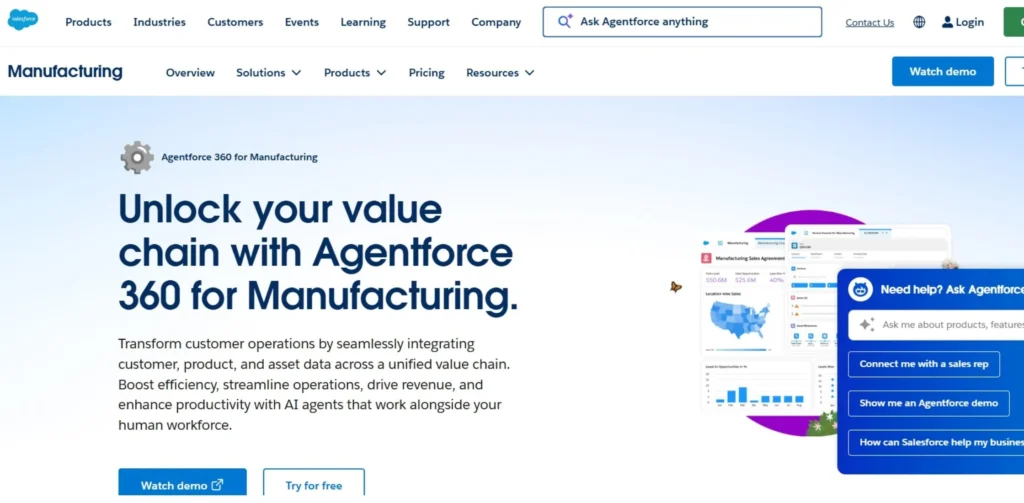
For large industrial companies seeking to streamline their sales agreements, account-based forecasts and service operations into one platform, Salesforce Manufacturing Cloud is the industry benchmark. Built with input from manufacturing leaders, it provides a run-rate agreement management system which matches production commitments with real-world customer demands in real-time.
Its built-in support for account-based forecasting, rebate management and partner portal specifically for distributor and dealer networks are what sets it apart from the common Salesforce products. The Einstein AI layer features predictive lead scoring, intelligent opportunity guidance and anomaly detection for those accounts with churn tendencies. This Manufacturing CRM Software offers unprecedented depth for companies with hundreds of Sales Reps in various regions and plants.
Key Features:
- Run-rate agreement management
- Einstein AI sales forecasting
- Distributor and dealer portals
- Warranty and service lifecycle tracking
- Real-time account health dashboards
2. Microsoft Dynamics 365 — Best All-in-One CRM + ERP Suite
| Detail | Info |
| Founded | 2016 |
| HQ | Redmond, WA, USA |
| ERP/Tech Integrations | Native ERP, Azure, Teams, Power BI, SAP via connectors |
| Pros | Seamless CRM + ERP in one platform, deep Microsoft 365 integration |
| Cons | Module complexity, licensing can be confusing, customization requires developers |
| Pricing | From $65/user/month (Sales Professional) |
| Best For | Manufacturers already using Microsoft ecosystem |
| G2/Capterra Rating | 4.3/5 (G2), 4.4/5 (Capterra) |
| Website | microsoft.com/dynamics365 |
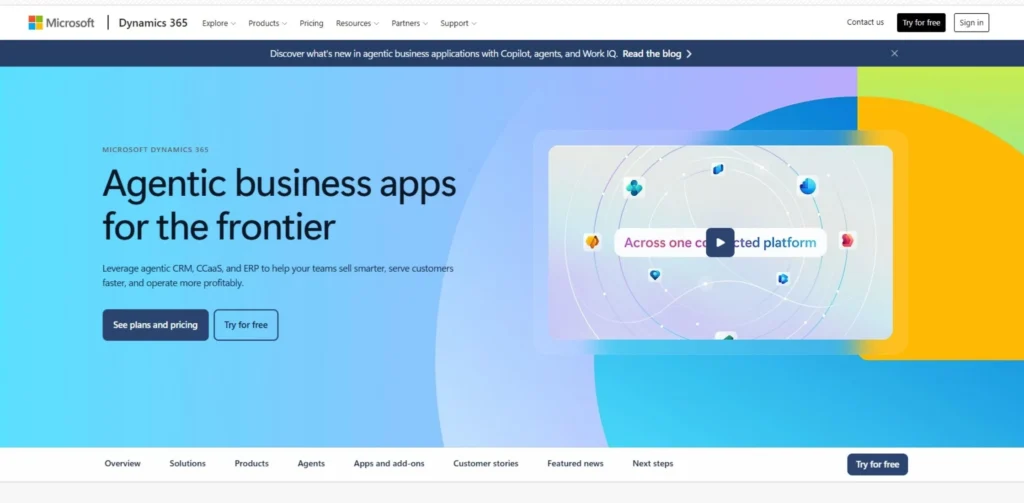
Microsoft Dynamics 365 is a manufacturer’s dream come true for companies seeking CRM and ERP functionality in one. It removes the third party integration friction by tightly integrating data from sales with finance, inventory, supply chain and field service modules, natively. For factories that are already integrated into the Microsoft world, the transition to Dynamics 365 as their Manufacturing CRM Software appears to be a logical next step for the tools that they have already come to rely on, every day.
Sales teams can use the platform’s Copilot AI, powered by Azure OpenAI, to help them summarize meetings, write emails, gain insights on accounts, and receive alerts about potential deal risks. It offers live production dashboards integrated with sales pipeline information through its Power BI integration, allowing manufacturing leaders to keep their finger on the pulse when it comes to inventory or production schedules. Power Apps also has the flexibility of being able to create customized workflows without the strain of heavy coding resources by the manufacturers.
Key Features:
- Unified CRM and ERP on one platform
- Copilot AI for sales productivity
- Power BI live manufacturing dashboards
- Field service and warranty management
- Configurable product catalog and pricing
3. HubSpot CRM — Best for Mid-Market Manufacturers
| Detail | Info |
| Founded | 2006 |
| HQ | Cambridge, MA, USA |
| ERP/Tech Integrations | SAP (via third-party), NetSuite, Shopify, 1,500+ app integrations |
| Pros | Easy to use, strong marketing automation, generous free tier |
| Cons | ERP integration requires add-ons, limited manufacturing-specific features natively |
| Pricing | Free tier available; paid from $15/user/month |
| Best For | Mid-market and growth-stage manufacturers |
| G2/Capterra Rating | 4.4/5 (G2), 4.5/5 (Capterra) |
| Website | hubspot.com |
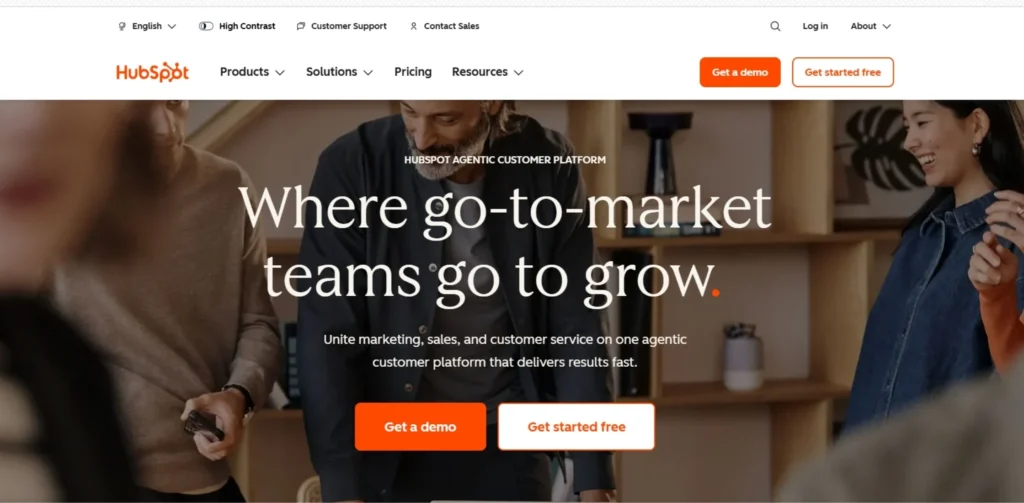
With its sleeker modern and intuitive design and without the enterprise price tag, HubSpot CRM is one of the best Manufacturing CRM Software options for the mid-market industrial companies. It doesn’t have some of the more manufacturing native features that come out of the box, but it has an extensive integration marketplace and is very intuitive to use that makes it one of the quickest platforms to deploy and use throughout a manufacturing sales team.
HubSpot is especially useful for manufacturers who are implementing an inbound marketing strategy in conjunction with a direct marketing strategy. Its Marketing Hub integrates with the CRM, enabling teams to send email campaigns, segment their visitors by website usage from industrial buyers and automatically score leads to the appropriate sales rep. With integration through middleware tools with ERP like NetSuite, HubSpot can be a powerful option for manufacturers expanding their revenue operations.
Key Features:
- Visual deal pipeline with drag-and-drop interface
- Marketing automation for industrial buyers
- Contact and company activity timelines
- Sequences for long B2B sales cycles
- 1,500+ app integrations including ERP connectors
4. Creatio — Best for Process Automation in Manufacturing
| Detail | Info |
| Founded | 2011 |
| HQ | Boston, MA, USA |
| ERP/Tech Integrations | SAP, Oracle, Microsoft Dynamics, REST API |
| Pros | No-code process automation, highly customizable, strong workflow builder |
| Cons | Smaller community than Salesforce or HubSpot, UI can feel dense |
| Pricing | From $25/user/month |
| Best For | Manufacturers focused on automating complex workflows |
| G2/Capterra Rating | 4.7/5 (G2), 4.8/5 (Capterra) |
| Website | creatio.com |
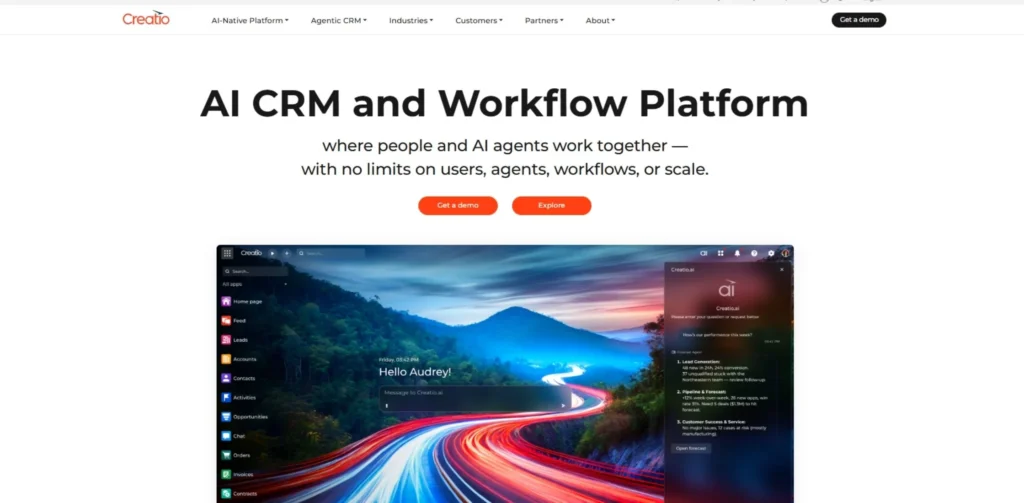
Creatio is an extremely feature-rich Manufacturing CRM Software solution with a no-code platform and unique blending of CRM and business process management capabilities. Compliance checkpoints, cross-department handoffs and dozens of approval stages in the sales and service processes of manufacturers can be created and customized without a single line of code using Creatio’s Studio No-Code Designer.
It has manufacturing-related capabilities, such as CPQ (Configure, Price, Quote) tools, the opportunity management for long sales cycles and service management with SLA tracking. Creatio also has a specific partner portal to enable the management of distributors and dealers. It has one of the best G2 scores in this list and is particularly popular with mid-sized manufacturers in Europe and North America who want to offer deep customisation options but don’t want to be locked in to a particular developer.
Key Features:
- No-code workflow and process automation
- CPQ (Configure, Price, Quote) module
- Partner and dealer portal management
- SLA-driven service case management
- AI-powered lead and opportunity scoring
5. Infor CRM — Best for Global Manufacturers with Infor ERP
| Detail | Info |
| Founded | 2002 |
| HQ | New York, NY, USA |
| ERP/Tech Integrations | Native Infor ERP (CloudSuite Industrial), Infor OS |
| Pros | Seamless Infor ERP sync, industry-specific templates, strong mobile app |
| Cons | Best suited for existing Infor customers, limited appeal outside ecosystem |
| Pricing | Custom pricing |
| Best For | Global manufacturers running Infor ERP environments |
| G2/Capterra Rating | 3.9/5 (G2), 4.0/5 (Capterra) |
| Website | infor.com/products/crm |
One of the most integrated Manufacturing CRM Software packages in the market for manufacturers and distributors of products is Infor CRM. It integrates directly with Infor CloudSuite Industrial (SyteLine) and other Infor ERP modules, which eliminates needing to switch between systems, providing sales teams with immediate access to order history, inventory availability, shipment status and account financials.
Infor CRM natively supports multi-language, multi-currency for global manufacturers with customers in various regions and time zones. It’s mobile app is designed for field sales, enabling sales reps when they visit plant customers to access account information, track calls and update opportunities directly from their cell phone. If it’s not the most comprehensive feature breadth when compared to Salesforce or Dynamics, it’s the workflow continuity that it offers for Infor ERP users.
Key Features:
- Native Infor ERP real-time data sync
- Multi-language and multi-currency support
- Mobile-first field sales interface
- Quote and order management from CRM
- Customer activity and interaction history
6. SugarCRM — Best for No-Touch CRM & Account Health Monitoring
| Detail | Info |
| Founded | 2004 |
| HQ | Cupertino, CA, USA |
| ERP/Tech Integrations | SAP, Oracle, Microsoft Dynamics, Zapier |
| Pros | Unique “no-touch” data entry via AI, strong customer health insights |
| Cons | Less polished UI than Salesforce or HubSpot, smaller partner network |
| Pricing | From $19/user/month |
| Best For | Manufacturers focused on customer retention and churn prevention |
| G2/Capterra Rating | 3.8/5 (G2), 3.8/5 (Capterra) |
| Website | sugarcrm.com |
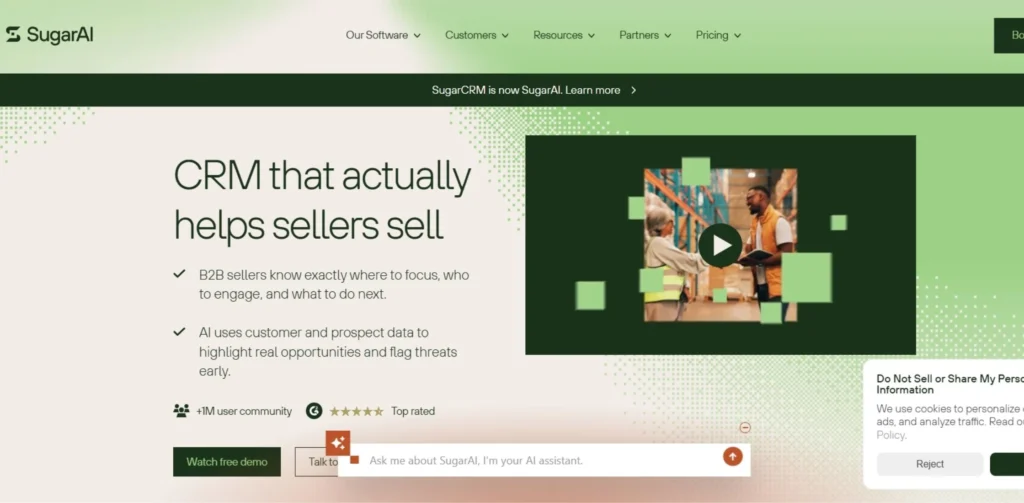
SugarCRM’s approach to Manufacturing CRM Software is unique in that it takes a philosophy of minimizing manual data entry to almost nothing, whilst increasing the intelligence of the CRM for its customers’ account health. The SugarPredict AI engine automatically enriches contact and account records with external data, saving sales reps from tedious time-consuming manual CRM updates, particularly in manufacturing environments where sales representatives may spend a considerable amount of time on the road or working on the plant floor.
Its Customer Health feature provides a real-time score on each account, alerting users of accounts that might churn and identifying upsell opportunities based on account behaviour patterns. Proactive intelligence can have a direct impact on protecting recurring revenue for manufacturers with a significant installed base of equipment and/or service contracts. For manufacturers requiring custom integration, SugarCRM also has good CPQ features and an open-source platform.
Key Features:
- SugarPredict AI for automatic data enrichment
- Customer health scoring and churn alerts
- CPQ module for complex product quoting
- Activity intelligence from email and calendar
- Open-source flexibility for custom integrations
7. Pipedrive — Best Budget CRM for Small Manufacturers
| Detail | Info |
| Founded | 2010 |
| HQ | New York, NY, USA |
| ERP/Tech Integrations | QuickBooks, Xero, Zapier (for ERP), 400+ integrations |
| Pros | Very affordable, easy setup, intuitive visual pipeline |
| Cons | Limited ERP integration depth, not built for complex manufacturing workflows |
| Pricing | From $14/user/month |
| Best For | Small manufacturers and job shops with simple sales processes |
| G2/Capterra Rating | 4.3/5 (G2), 4.5/5 (Capterra) |
| Website | pipedrive.com |
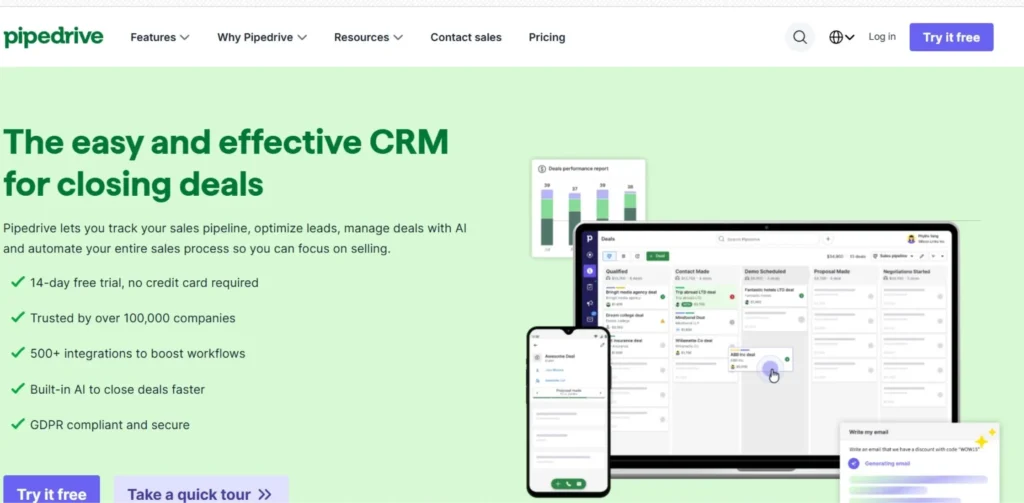
Pipedrive’s best budget choice in the Manufacturing CRM Software category is because it provides a super-clean, visual sales pipeline tool that any rep can get up to speed on in a day, and it’s perfect for small manufacturers and job shops. Pipedrive’s no-code CRM platform provides essential functionalities like tracking your quota, nurturing leads and managing a few accounts while eliminating the complexity and cost of enterprise platforms.
Its automation builder enables small manufacturing groups to establish automated follow-up e-mail messages, task reminders and deal stage triggers with no technical skills. It isn’t built-in with a large ERP suite but by making some configuration adjustments, it can be integrated with accounting software such as QuickBooks or light ERP systems thanks to the use of Zapier and the expanding marketplace. It is a great option for cost-conscious manufacturers.
Key Features:
- Visual drag-and-drop sales pipeline
- Email and activity automation builder
- Customizable deal stages and fields
- Mobile app for field sales reps
- Revenue forecasting and reporting dashboards
8. Oracle NetSuite CRM — Best for Multi-Site Manufacturing Ops
| Detail | Info |
| Founded | 1998 |
| HQ | Austin, TX, USA |
| ERP/Tech Integrations | Native Oracle NetSuite ERP, Oracle Cloud suite |
| Pros | Unified CRM and ERP, excellent multi-site visibility, strong financial integration |
| Cons | High cost, complex implementation, requires NetSuite ERP for best results |
| Pricing | From $99/user/month + platform license |
| Best For | Multi-site manufacturers running or considering NetSuite ERP |
| G2/Capterra Rating | 4.0/5 (G2), 4.1/5 (Capterra) |
| Website | netsuite.com |
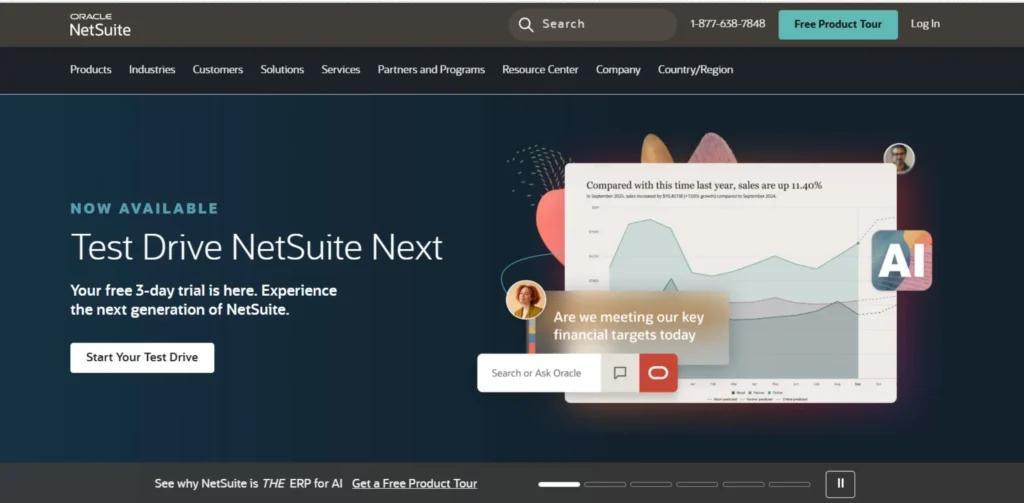
Oracle NetSuite CRM isn’t an independent product – it is part of the NetSuite cloud ERP suite and that’s why it is so powerful for multi-site manufacturing operations. By consolidating CRM and ERP into a single database, sales teams can access key data such as inventory levels, production schedules, shipment tracking, and customer payment history in real-time, without needing to make any API calls or wait for any data to sync. This degree of transparency is an absolute godsend for manufacturers with a number of plants in varied geographies.
It offers the complete lifecycle of the customer from lead generation all the way to order fulfillment, invoicing and renewal, and is a 100% end-to-end solution for manufacturers fed up with data silos. The incentive compensation management module is especially beneficial for manufacturers who have intricate incentive compensation systems for their regional sales teams and independent reps. NetSuite CRM effortlessly increases in size as the mid-size manufacturer grows.
Key Features:
- Native NetSuite ERP real-time data unification
- Incentive compensation and quota management
- Multi-site and multi-currency sales visibility
- Customer portal for order and service tracking
- Sales forecasting tied to production capacity
9. Zoho CRM — Best Value for Indian & Emerging Market Manufacturers
| Detail | Info |
| Founded | 1996 |
| HQ | Chennai, India |
| ERP/Tech Integrations | Zoho ERP, SAP (via Zoho Flow), Tally, 500+ integrations |
| Pros | Exceptional value, strong AI (Zia), extensive module ecosystem, India-specific features |
| Cons | UI can feel overwhelming with too many modules, enterprise support slow |
| Pricing | From $14/user/month; free tier available |
| Best For | Indian and emerging market manufacturers seeking value-packed CRM |
| G2/Capterra Rating | 4.1/5 (G2), 4.3/5 (Capterra) |
| Website | zoho.com/crm |
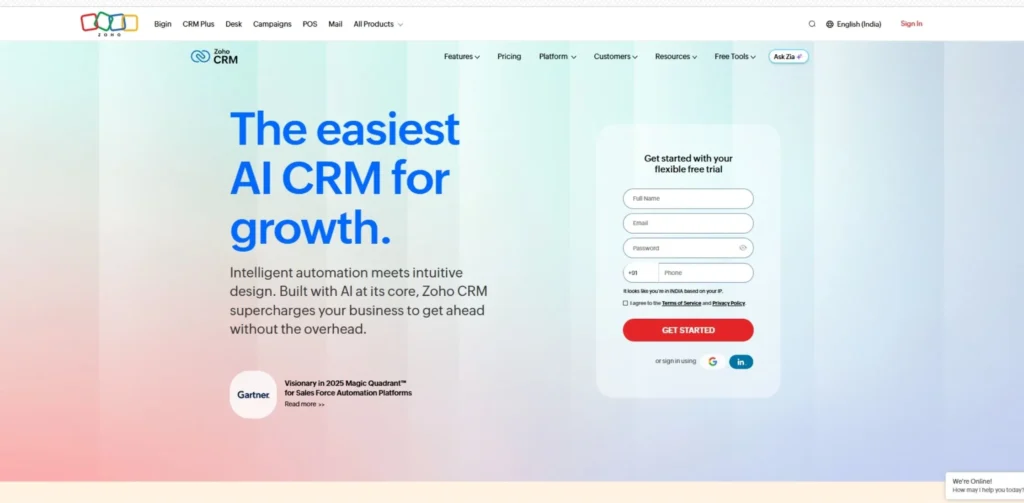
Zoho CRM is perhaps the most compelling manufacturing CRM Software offering for manufacturers in 2026, as it is in India, Southeast Asia and other emerging markets. It’s competitively priced in all tiers, has Zia AI engine providing intelligent lead scoring, anomaly detection and sales predictions that can cost three times more on enterprise platforms, and its seamless integration with Zoho’s suite of 45++ business applications makes it almost a business platform in itself.
For Indian manufacturers, Zoho provides a range of features that are tailored to their specific needs, such as invoicing capability that integrates with the Goods and Services Tax (GST) system in India, the ability to integrate with the Tally ERP system, and local customer support teams equipped with a deep understanding of the Indian business landscape. The platform works in multiple languages, supports territory management for big field sales teams and lists complex pricing rules for industrial buyers. Its Blueprint workflow automation tool comes especially handy for businesses that have long manufacturing sales cycles and need to convert them into a structured and automated CRM workflow to ensure that deals don’t stall.
Key Features:
- Zia AI for predictive sales intelligence
- Blueprint workflow automation for complex approval cycles
- Tally and Zoho ERP integration
- Territory management for large field teams
- GST-compliant invoicing for Indian businesses
10. Monday.com CRM — Best for Visual Sales Pipeline Management
| Detail | Info |
| Founded | 2012 |
| HQ | Tel Aviv, Israel |
| ERP/Tech Integrations | SAP (via Zapier), QuickBooks, HubSpot, 200+ integrations |
| Pros | Highly visual, very easy to use, flexible boards for any workflow |
| Cons | Not a true deep CRM, limited native manufacturing features, ERP integration shallow |
| Pricing | From $15/user/month |
| Best For | Manufacturing teams wanting visual pipeline and project tracking |
| G2/Capterra Rating | 4.6/5 (G2), 4.7/5 (Capterra) |
| Website | monday.com/crm |
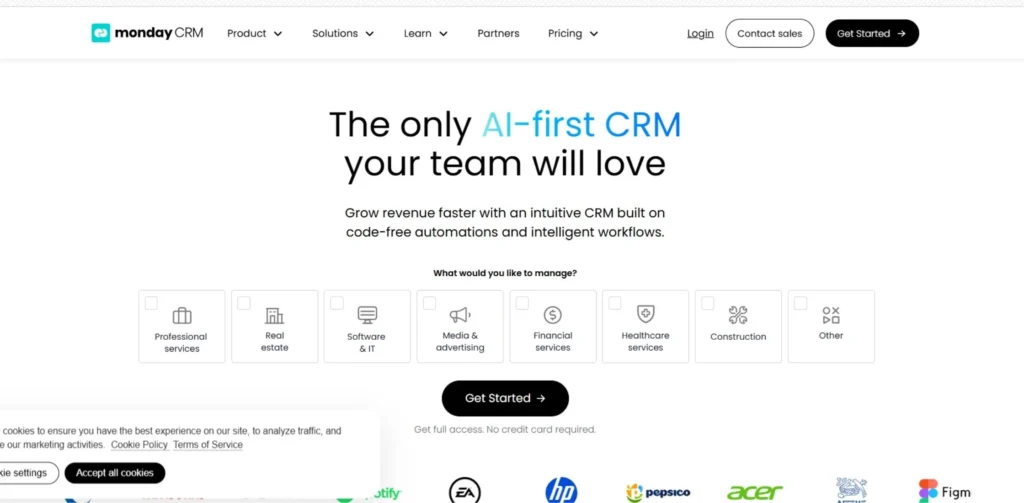
Finally, Monday.com CRM is a Manufacturing CRM Software that’s ideal for manufacturing teams that value cross-functional collaboration and ease of use over comprehensive ERP integration. It doesn’t have the manufacturing depth that Salesforce or NetSuite has, but with a board-based system, sales, operations and customer service teams can create a custom manufacturing workflow that is very similar to their actual manufacturing sales workflow.
In smaller, project-based manufacturers, or even custom fabrication shops where each sale is a project, Monday.com CRM will link the sales pipeline management and follow-up tracking for that project. The automation tools, kanban and Gantt views, and real-time collaboration make it a favourite among younger manufacturing teams that seek a modern and easy-to-navigate interface that isn’t overwhelming as compared to traditional enterprise CRM systems.
Key Features:
- Highly customizable visual pipeline boards
- Kanban and Gantt views for project tracking
- Automation recipes for follow-ups and notifications
- Contact and deal management with custom fields
- Cross-team collaboration with shared dashboards
Side-by-Side Comparison: Manufacturing CRM Software 2026
| Tool | Pricing (From) | ERP Integration | AI Features | Free Trial | Best For | G2 Rating |
| Salesforce Manufacturing Cloud | $225/user/month | SAP, Oracle, Dynamics | Einstein AI | 30 days | Large enterprises | 4.4/5 |
| Microsoft Dynamics 365 | $65/user/month | Native ERP, Azure | Copilot AI | 30 days | Microsoft ecosystem users | 4.3/5 |
| HubSpot CRM | $15/user/month | NetSuite, SAP (add-on) | AI prospecting tools | Free tier | Mid-market manufacturers | 4.4/5 |
| Creatio | $25/user/month | SAP, Oracle, Dynamics | AI lead scoring | 14 days | Process automation | 4.7/5 |
| Infor CRM | Custom pricing | Native Infor ERP | Infor AI features | On request | Infor ERP customers | 3.9/5 |
| SugarCRM | $19/user/month | SAP, Oracle, Zapier | SugarPredict AI | 7 days | Customer retention | 3.8/5 |
| Pipedrive | $14/user/month | QuickBooks, Zapier | AI sales assistant | 14 days | Small manufacturers | 4.3/5 |
| Oracle NetSuite CRM | $99/user/month | Native NetSuite ERP | AI forecasting | On request | Multi-site operations | 4.0/5 |
| Zoho CRM | $14/user/month | Zoho ERP, Tally, SAP | Zia AI | 15 days | Indian/emerging markets | 4.1/5 |
| Monday.com CRM | $15/user/month | SAP (Zapier), QuickBooks | AI automation | 14 days | Visual pipeline management | 4.6/5 |
How to Choose the Right Manufacturing CRM: Step-by-Step Guide
- First, chart out your current sales process from start to finish, from quote to order, after-sales to distributors and everything in between.
- What are your biggest pain points? Is it lack of ERP visibility, slow quoting, weak customer retention, not being able to accurately predict sales?
- Decide if a standalone or integrated CRM and ERP system is necessary for your current system.
- Determine a realistic budget per user (for implementation, training, and support) as well as a license fee.
- Use manufacturing industry templates and limit the number of platforms that you are considering to 2-3 that have free trials or demos.
- Include your sales team, service managers and IT staff in the process — your users will be the ones who have to use it to have it adopted
- Try implementing integration with your current ERP system (in a trial period), rather than in a demo environment.
- Research vendor references with manufacturers in your industry before entering into a contract.
Manufacturing CRM Implementation Tips (Avoid Common Mistakes)
- Avoid any shortcuts in data cleansing, which means do not import the data from spreadsheets or legacy systems if it is unclean — problems will multiply in the new CRM. Don’t fall for any quick fixes when it comes to data cleansing before migration, meaning don’t import unclean data from spreadsheets or legacy systems — it creates compounding problems within the new CRM.
- Designate a focus or champion within the organisation, preferably a senior sales or operations manager, to oversee the rollout and champion adoption of the CRM system.
- Don’t attempt to implement all of the modules at once, but rather implement the core pipeline management in the first phase, and then integrate ERP systems, service modules, and automation in later phases.
- Purchase industry-specific training to your workflows, not just generic training of the platform offered by the vendor.
- Delineate transparent KPIs before go-live, like quote turnaround time, pipeline conversion rate or customer response time, to track ROI from day one.
- Don’t over-customize the platform in year one — build basic workflows first, and then develop custom ones later when teams are familiar with the basics.
- Make sure that your ERP and CRM integration will not only push data but also update it in CRM in real time, like when you add an order or adjust your inventory.
- Outline a long-term management strategy by assigning user management, data governance and software update responsibilities to a new user after implementation if necessary
Conclusion
In 2026, manufacturers are left with one of the highest leverage technology choices – selecting the right Manufacturing CRM Software. The ten platforms in this guide represent all industry segments, ranging from small job shops looking for an easy visual pipeline to large enterprises with robust AI capabilities and integration with their ERP systems. If you’re dealing with a large operation, Salesforce and Dynamics 365 are the choices to make. If you’re a smaller manufacturer, Zoho and Pipedrive make great value.
Creatio and SugarCRM are great when it comes to automation and customer health monitoring. No single ideal platform for each factory or plant, but the right one for your operation. With the help of the comparison table, step by step selection guide, and the implementation tips provided in this article, you can make an informed decision and choose a Manufacturing CRM tool that doesn’t require a lot of time to pay for itself.
FAQs
What is Manufacturing CRM Software?
Manufacturing CRM Software is a solution designed specifically for the manufacturing industry. It is a CRM system that’s created specifically to the requirements of manufacturing organizations, such as after-sales service monitoring, ERP integration, long sales cycles in B2B and managing distributors.
Which is the best CRM for manufacturing in 2026?
For larger companies, Salesforce Manufacturing Cloud is the ideal option and for mid-size and emerging market manufacturers, Zoho CRM is a solid choice. It will depend upon your size, budget, and ERP environment.
Is there integration between a manufacturing CRM and SAP / Oracle ERP?
Yes. Salesforce, Microsoft Dynamics 365, Creatio and SugarCRM are all platforms that integrate with SAP and Oracle ERP systems either as native or middleware systems.
What is the price of Manufacturing CRM Software?
The cost of using a CRM can vary from $14/user/month for Pipedrive and Zoho CRM up to $225/user/month for Salesforce Manufacturing Cloud. Custom pricing is utilized on enterprise platforms, such as Infor CRM and NetSuite CRM.
Is it worth small manufacturers to use a CRM?
Absolutely. These are all great alternatives to CRM for small manufacturing companies whose sales are simple, and who don’t have a lot of resources for IT.
What’s the timeframe of a manufacturer’s CRM implementation?
If you’re looking for a simpler platform such as HubSpot or Pipedrive, you can deploy it in two to four weeks. It can take three to nine months to implement enterprise platforms such as Salesforce or NetSuite, depending on the platform used and how often you need them to be integrated with ERP.
What is the difference between Manufacturing CRM and ERP?
ERP controls the internal operation such as production, inventory and finance. CRM handles customer interactions with the outside world, sales funnels, and customer service. Many manufacturers use both of them in combination for complete visibility of their businesses.
Is Zoho CRM the ideal CRM option for Indian manufacturers?
Yes. One of the most convenient options for Indian manufacturers is Zoho CRM, which is headquartered in India, provides local support, is GST compliant, and integrates with Tally ERP.