
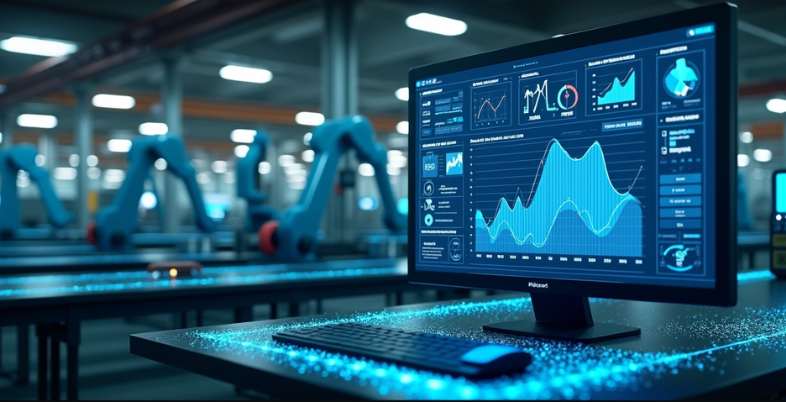
In 2026, blind spots on the shop floor would be unaffordable to the manufacturers. With the increasing complexity of global supply chains and the increase in customer demands, real-time monitoring of production is now emerging as the foundation of competitive production. The figures are self-explanatory: the manufacturing execution system (MES) market is estimated to reach 23.6 billion dollars in 2026, with the CAGR of 9.2. In the meantime, manufacturers that took advantage of the real-time monitoring report have reduced up to 25 percent of unexpected failures, as reported in a 2026 report by Deloitte Smart Factory.
Most powerfully, however, 82 percent of industrial organizations currently refer to real-time visibility as one of the three most operationally critical, and this is a significant increase of 61 percent in 2023. Being a small job shop or a big car plant, the correct production monitoring software is capable of turning reactive firefighting into proactive and data-driven decision-making.
What Is Real-Time Production Monitoring Software?
A digital solution is the real-time production monitoring software which constantly captures, analyses, and shows live machine, production line, and shop floor operational data. It allows manufacturers to trace output, equipment performance, quality measurements and resource use as events are occurring, allowing them to make decisions faster, reduce waste, and enhance the overall equipment effectiveness (OEE).
How Real-Time Production Monitoring Works
- IoT Sensor Data Collection: Sensors and PLCs are used to record machine signals, cycle times and count of output at any given time.
- Aggregation of Data Centrally: Data streams are all directed into a single cloud or on-premise platform in real-time.
- Automated Analysis and Alerts: Inbuilt algorithms identify anomaly and give alert to operators automatically.
- Dashboard Visualization: Live dashboard use of KPIs, OEE scores and production trends is available as well.
- Feedbacks and Corrective Measures: Insights go back to the operators and ERP systems to allow fast corrective actions.
Key Features of Production Monitoring Software
- OEE Tracking: The availability, performance, and quality are used to compare production efficiency.
- Predictive Maintenance Alerts: AI notifies wear and tear on equipment before the equipment triggers expensive production downtimes.
- Personalized Real-Time Dashboards: Role-based views display the most important metrics in real-time.
- ERP and MES Integration: It integrates smoothly with the existing enterprise systems to realize data flow.
- Downtime Reason Coding: Operators code and identify stoppages, identifying patterns of losses.
Benefits of Real-Time Monitoring in Manufacturing
- Minimized Unplanned Downtime: Instant notifications enable the teams to fix the equipment problems before the production can be stopped.
- Higher OEE Scores: When visibility is constant, micro-stoppages and performance gap can be identified fast.
- Improved Quality Control: Live defect tracking ensures that out of spec products do not find their way into the customer.
- Improved Labor Usage: The managers automatically distribute labor according to the real-time throughput information.
- Data-Driven Decision Making: Data-driven operational choices are smarter and empirically supported by historical data and real-time data.
10 Real-Time Production Monitoring Software in 2026
1. Sight Machine
Sight Machine is a manufacturing analytics solution used by the enterprise level and uses AI and machine learning to provide profound insights on production. It is designed to absorb data of large-scale manufacturers and converts raw signals into intelligent actions. It has a semantic data model that automatically organizes plant data, which takes a lot of time to integrate. Fortune 500 manufacturers in automotive, consumer goods and chemicals have placed their trust with Sight machine.
In 2026, it will have an extended AI copilot, where floor managers can ask production information in a conversational format. It is still one of the best options in the case of organizations that focus on advanced analytics and scalability.
Key Features:
- Semantic data modelling
- Real time OEE and throughput analytics dashboard.
- Engine predictive quality and process optimization.
Pros:
- Profound AI analytics
- Superb multi-plant enterprise scalability.
- Elastic interconnection.
Cons:
- Small manufacturers are not able to implement
- Long steep learning curve
- Formatted discrete job shops
Best for: Large company manufacturers with complex and multi-site operations.
2. Rockwell Automation FactoryTalk
Rockwell Automation has a whole factory software, FactoryTalk, that is strongly connected with all Allen-Bradley PLCs and control systems. It offers real time monitoring of production performance, equipment health and power consumption within the plant. Its modular architecture enables manufacturers to only use the components that are required. Its revised FactoryTalk Optix interface provides current cloud-ready HMI/SCADA in 2026.
Key Features:
- Allen-Bradley PLC and SCADA
- Monitoring of real-time energy performance
- Cloud-based factory talk optix HMI system.
Pros:
- Full support of the Rockwell hardware ecosystem.
- Strong security and control over controlled industries.
- Very well developed platform that has wide global coverage.
Cons:
- Best value in Rockwell hardware only.
- Increased cost of licensing as opposed to independent platforms.
- The customization needs expertise that is Rockwell-certified.
Best For: Manufacturers that are already on Allen-Bradley/Rockwell Automation infrastructure.
3. Tulip Interfaces
Tulip is a no-code/low code frontline operations platform enabling manufacturers to create custom production monitoring applications without involving IT. Its drag and drop application developer can connect to machines, sensors and manual inputs without any difference. In 2025–2026, the Tulip was particularly popular as manufacturers wanted to find digital tools that were agile and fast to deploy in the shop floor. The platform is also best suited in discrete production zones that have a high level of product variability.
Key Features:
- No code, custom shop floor surveillance builder.
- OPC-UA and APIs Native machine connectivity.
- Inbuilt quality monitoring with on-site defects capture.
Pros:
- Very quick implementation
- Extremely adaptable
- Powerful community
Cons:
- Not so much adapted to highly automated
- High-level analytics
- At large facilities
Best for: Discrete manufactures that wish to deploy fast, flexible, with low-IT-load.
4. Plex Smart Manufacturing Platform
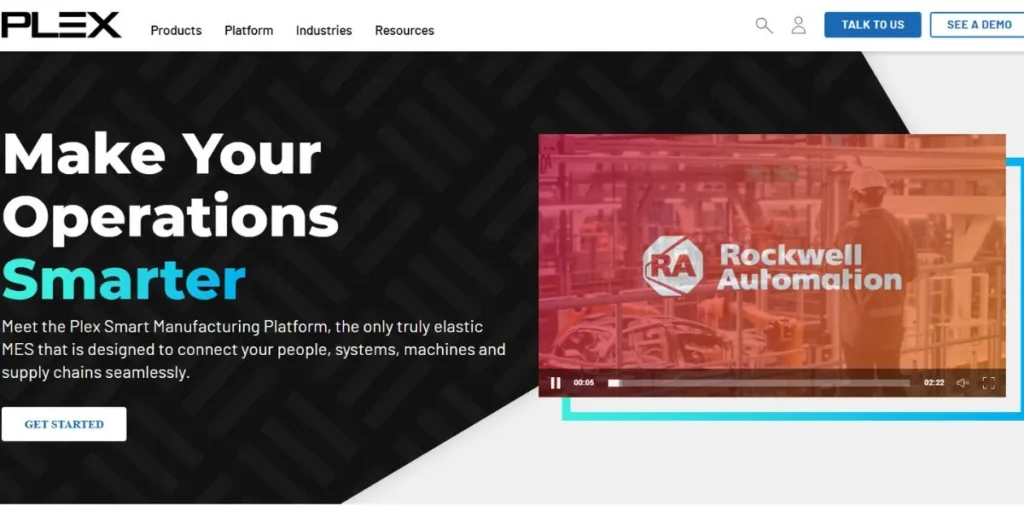
Plex, which is currently under Rockwell Automation, is a cloud-based smart manufacturing solution that integrates ERP, MES, and real-time production monitoring into one platform. It is also manufacturer-oriented, and it does not require the complexity of integrating individual systems together. Plex offers real time OEE, genealogy tracking, quality management and supply chain visibility on a single platform. Its improved AI-driven analytics layer will be incorporated in 2026, which will incorporate predictive quality and demand-based scheduling.
Key Features:
- Integrated cloud ERP, MES and real-time monitoring system.
- Live OEE and automated downtime cause tracking.
- Predictive quality and scheduling capabilities that are AI-driven.
Pros:
- The single platform
- Well-developed manufacturing
- Cloud native design
Cons:
- Over-featured in case of small or simple operation.
- Migration of ERP
- Less customization
Best for: Medium and large-scale manufacturers in need of an ERP and MES as well as a monitoring solution.
5. MachineMetrics
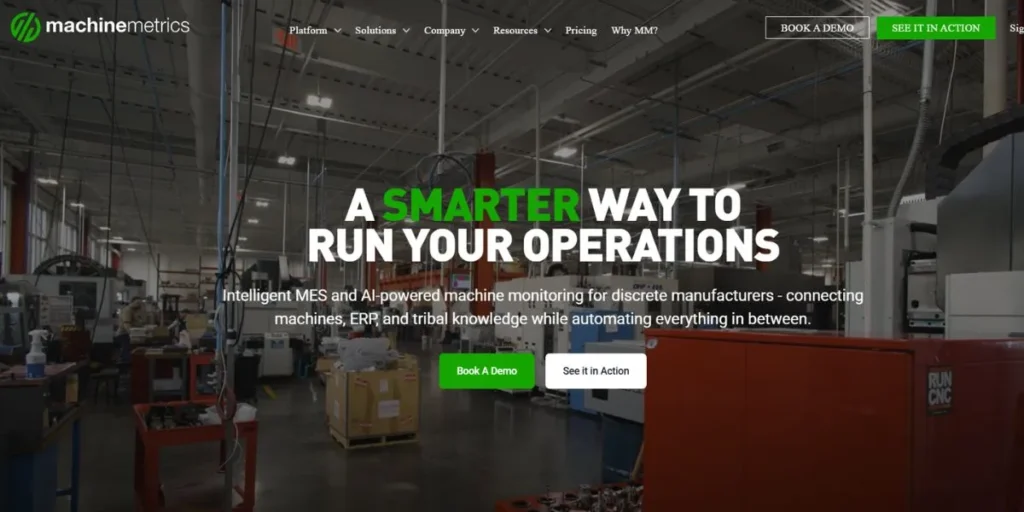
MachineMetrics is a machine-specific industrial IoT system that aims to monitor machines and provide analytics on production to discrete manufacturers. It has direct integrations or edge devices with virtually any CNC machine, robot or production asset. Best strengths include real-time OEE, cycle time analysis and job tracking. MachineMetrics developed a great reputation in the field of precision machining, metal fabrication and electronics production.
Key Features:
- Connectivity of 7,000+ models of CNC machines
- Job level and real time cycle time OEE monitoring.
- Artificial Intelligence anomaly detection
Pros:
- Quickest time to value of machine monitoring platforms.
- Superb level of CNC and machining specific analytics.
- The interface of the operators and managers
Cons:
- Not process industries, mostly discrete machining.
- Low native ERP integration lacks middleware.
- Advanced reporting needs the advanced subscription plans.
Best for: Job shops, CNC machining centers and discrete parts manufacturers.
6. Aveva (AVEVA MES)
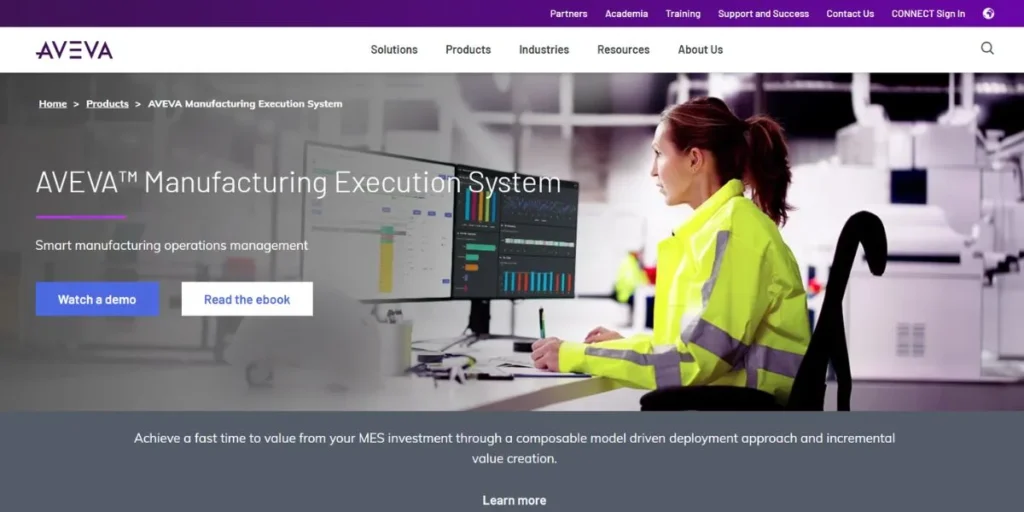
AVEVA MES (previously Wonderware) is an international leader in the industrial software that provides a complete manufacturing execution and real-time monitoring system. The AVEVA platform covers both process and discrete industries with intensive scheduling, performance tracking, genealogy and regulations compliance capabilities enhanced by AI in 2026. The platform enables global deployment having centralized controls. AVEVA has a history of industrial automation that offers unparalleled process industries.
Key Features:
- Live production performance monitoring
- Genealogy and deep compliance solutions
- Process optimization
Pros:
- Unrivaled process
- Very flexible to meet highly-regulatory-compliant needs.
- Good world wide partner
Cons:
- Complicated implementation
- Expensive total cost of ownership
- Some repealed UI being gradually modernized.
Best for: Pharmaceutical, food and beverage, and chemical producers of processes.
7. Domo for Manufacturing
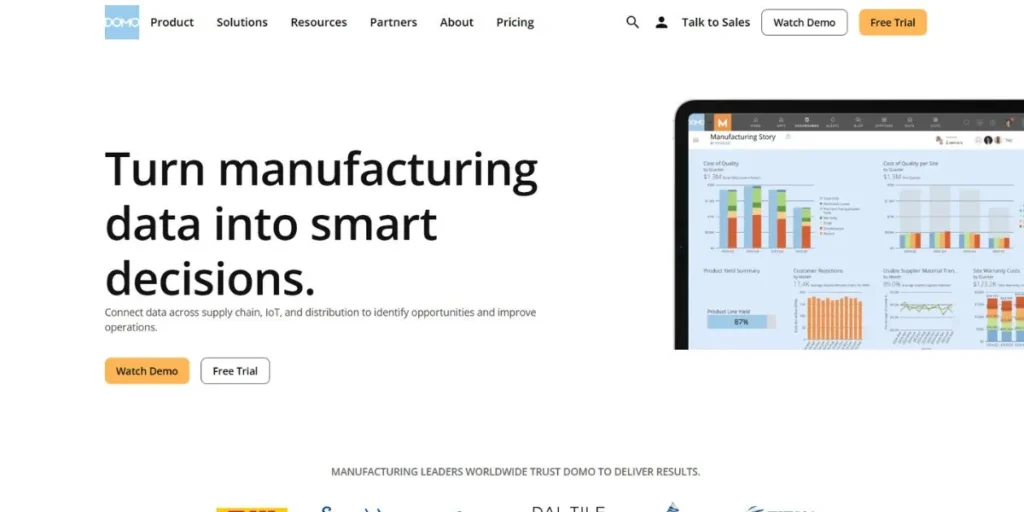
Domo is a business intelligence cloud solution that has emerged with robust manufacturing specific features in the real time production monitoring and the operational analytics. It links to any data source virtually ERP, MES, IoT sensors, spreadsheets, etc, and consolidates them in real-time dashboards. The best feature of Domo is its capability to tell a data story and enhance cross-departmental visibility; this allows the managers of all plants and the executives to track the production KPIs.
Key Features:
- Data connector library of 1,000+ data sources
- Live manufacturing KPI dashboards
- Openness across departments
Pros:
- Best in class data visualization
- Quick access to already existing ERP, MES, and IoT data.
- Powerful mobile application towards real-time production checking.
Cons:
- Not an in-house MES
- May be costly when large scale
- Optimal when applied throughout the entire organization
Best for: Best fits manufacturers that require single production and business intelligence reporting.
8. Symbio (by BMW Group)

Symbio is an artificial intelligence based manufacturing platform that already had its roots in BMW Group internal activities of digital transformation, made nowadays commercial and available to the wider industry. It deals with intelligent production planning, real-time monitoring and machine-learning-based autonomous optimization. Symbio targets high complex, high volume manufacturing support in a high volume manufacturing facility whereby the MES tools cannot keep up.
Key Features:
- Collective AI-based production monitoring and optimization engine.
- High complexity line reinforcement-learning scheduling.
- Introduction of digital twins to predictive scenario planning.
Pros:
- State-of-the-art artificial intelligence
- Specialized to support high complexity
- Powerful Industry 4.0 architecture with digital twin.
Cons:
- Poor track record in other sectors
- Much investment and change management
- Immaturity in commercial support
Best for: Automotive OEMs, and tier-1 suppliers that have complex operations, which are AI-ready.
9. Epicor Advanced MES
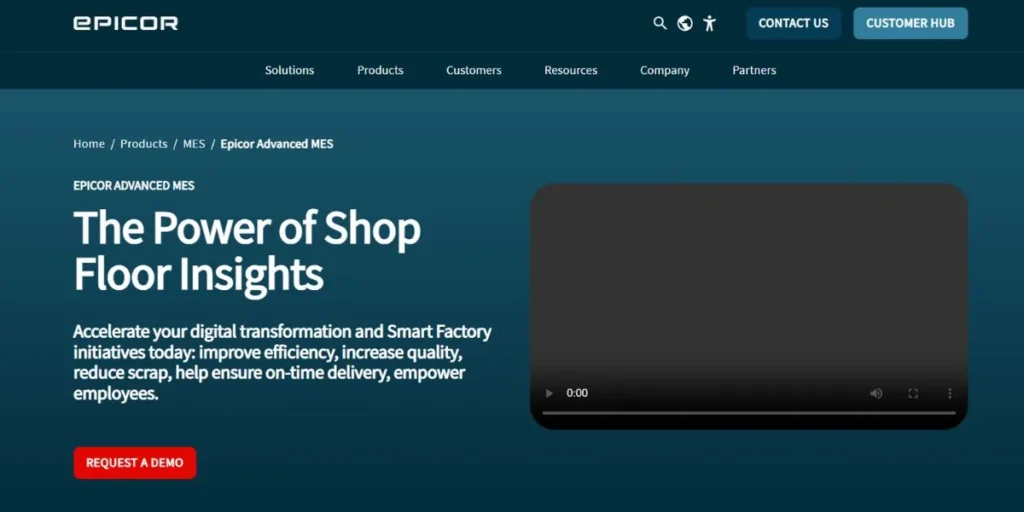
The Epicor Advanced MES is a powerful manufacturing execution solution that is closely coupled with Epicor ERP solutions to enable real-time access to shop floor processes. It also addresses production scheduling, labor tracking, machine monitoring, quality management as well as traceability in a single platform. Epicor especially performs well with the mid-market manufactures in the metal fabrication, industrial equipment, and electronic sectors.
Key Features:
- Close ERP-MES collaboration
- Shop floor labor, machine
- Live data interface of mobile operators.
Pros:
- Outstanding prices to middle-end manufacturers
- Robust out-of-box capabilities
- Vibrant user base and presence
Cons:
- Little value to non-Epicor
- UI modernization
- A lot of professional
Best for: Mid-level discrete manufacturers consuming or utilizing Epicor ERP.
10. Intouch Monitoring (OEE Software)
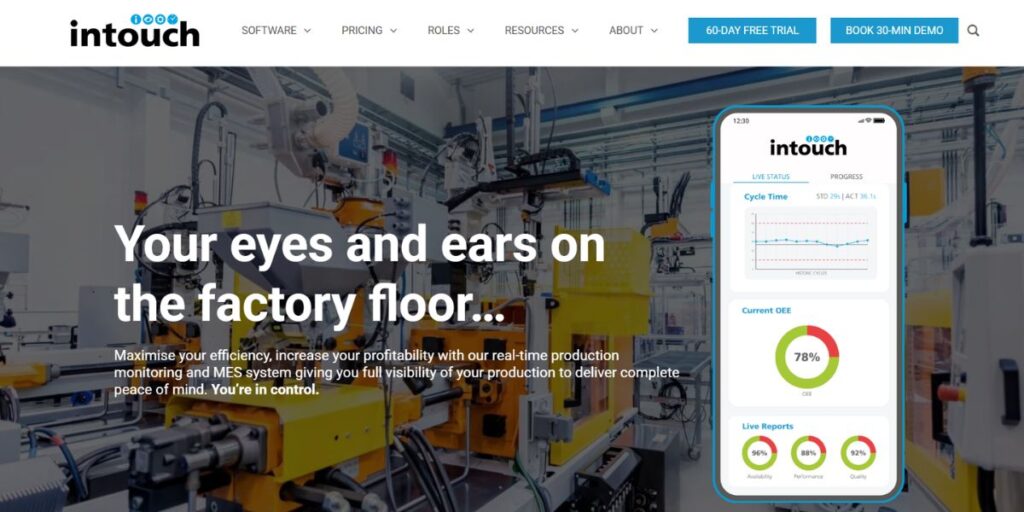
Intouch Monitoring is a specialized inexpensive real-time OEE and production monitoring system that is targeted at small to mid-sized manufacturers. It provides simple live machine status, shift performance, downtime tracking and quality reporting on a user-friendly, web-based interface. Intouch has developed a competent customer base in plastics, packaging and food manufactures where simplicity and rapid deployment are the key factors.
Key Features:
- Live machine status boards and OEE tracking.
- Automated identification of time outages
- Comparison and shift performance
Pros:
- Low-cost and open prices
- Quick implementation
- Easy to use interface
Cons:
- Poor advanced analytics relative to enterprise.
- Not well suited to the multi process
- Smaller competitor platforms than those of larger competitors.
Best for: SME manufacturers who are looking at cost-effective and quick to implement OEE monitoring.
Real-Time Production Monitoring vs Traditional Monitoring
| Aspect | Real-Time Monitoring | Traditional Monitoring |
| Data Collection | Continuous, automated via IoT sensors | Periodic, often manual data entry |
| Response Time | Immediate alerts and notifications | Delayed — issues found after the fact |
| Visibility | Live dashboards accessible anywhere | Paper reports or end-of-shift summaries |
| Downtime Detection | Automatic, within seconds of stoppage | Manual logging; often underreported |
| Decision Making | Data-driven, proactive, and predictive | Reactive, based on historical reports |
| Quality Control | Real-time defect detection and alerts | Inspection-based, post-production detection |
| OEE Calculation | Automated and continuous | Manual calculations, prone to errors |
| Scalability | Cloud-enabled multi-site visibility | Difficult to scale across multiple plants |
| Cost of Errors | Minimized through early intervention | Higher due to delayed issue discovery |
| Integration | Connects to ERP, MES, SCADA in real time | Limited or no system integration |
Industries Using Production Monitoring Software
- Automobile Manufacturing: Tracked takt time, robot uptime, and assembly quality of high volume production plants.
- Food & Beverage: Observes hygienic standards, fill rates, and batch traceability in line with laws.
- Pharmaceuticals: Makes sure of GMP compliance, serialization, and real time quality control of key production lines.
- Electronics & Semiconductors: Deals with high mix and low volume production that has accurate cycle time and yield tracking.
- Metal Fabrication and Machining: maximizes CNC utilization, spindle uptime and job level OEE in job shops.
- Plastics & Packaging: Tracks model cycles, scrap rates as well as shift output on continuous production lines.
- Aerospace & Defense: End-to-end traceability and compliance monitoring of safety-critical components.
- Consumer Goods: Responsible to change SKUs, line efficiency and on-demand production scheduling.
How to Choose the Best Production Monitoring Software
- Define Your Main Use Case: Determine what you want to focus on with either OEE, predictive maintenance, quality or with the entire MES functionality.
- Evaluate Integration Limitations: Confirm compatibility with the current ERP, SCADA, and PLCs, and data historian systems.
- Test Scalability Requirements: Select platforms that can be scaled to pilot projects to a production enterprise.
- Take into Account Total Cost of Ownership: Include licensing, implementation, training and maintenance costs as one.
- Make it User-Friendly: Systems that have user-friendly operator interfaces deliver ROI more quickly and greater involvement in the shop floor.
Implementation Steps for Manufacturers
- Shop Floor Audit: Before any platform is chosen, map all machines, data sources and connection options.
- Specify KPIs and Success Measures: Set baseline OEE, down time and quality goals to be able to quantify improvement.
- Begin with a Pilot Line: Roll out on a single production line to confirm integration and operator procedures that are effective.
- Train Operators and Managers: Training role-specific: Investment is necessary to guarantee adoption at all levels of the organization.
- Test and Optimize Progressively: Pilot learnings to optimize settings and then implement in the department-wide.
Future of Production Monitoring (Industry 4.0 & AI)
Artificial intelligence and edge computing combined with the Industrial Internet of Things (IIoT) are the powers that will define the future of production monitoring. Some of the ground-breaking trends that are setting the expectations of manufacturers with respect to monitoring technology can be witnessed in 2026 and beyond.
- AI-Based Predictive Operations: Going beyond threshold alerts. The machine learning models currently consider thousands of variables at once to forecast failures in equipment several days before they happen.
- Digital Twins: A new standard in high technology manufacturing.
- Edge Computing: This will allow real-time machine-level intelligence, minimizing response time and time to connect to the cloud.
- Natural Language Interfaces: Are liberalising data on production. In 2026, conversational AI assistants on a number of platforms such as Domo and MachineMetrics have been introduced enabling operators.
- Monitoring Sustainability: Is a new crucial dimension coming about. Manufacturers have an increasing pressure to monitor the energy use, carbon emissions, and application of resources in addition to the conventional production KPIs.
Conclusion
It has been noted that real-time production monitoring software is not only a competitive strength of manufacturers in 2026 but also a necessity. By eliminating unplanned downtime, they can also be used to optimize industries of any size with AI, which has a quantifiable ROI. Be it an enterprise platform such as Sight machine or a specialized OEE platform such as Intouch Monitoring, the proper platform that matches your operations requirements will result in sustainable efficiency improvements and will place your facility in the intelligent manufacturing age to come.
FAQs
How much would the average ROI of real-time production monitoring software be?
OEE improvements of 10-25% and massive decline in unplanned down-time costs are all reported by most manufacturers in a 6-18 months period.
Are small manufacturers able to afford real time production monitoring software?
Yes – inexpensive systems such as Intouch Monitoring and MachineMetrics provide affordable pricing in the form of a few hundred dollars a year per machine.
What is the duration of installation of production monitoring software?
Single line deployments can be put into service within days, and complex enterprise deployments (depending on complexity) can be deployed in 3 to 12 months.
Does it have real-time monitoring software, which can be integrated with the existing ERP systems?
Nationwide, most of the major platforms have native connections to major ERP systems such as SAP, Oracle, Epicor and Plex, allowing the smooth flow of data between systems.