
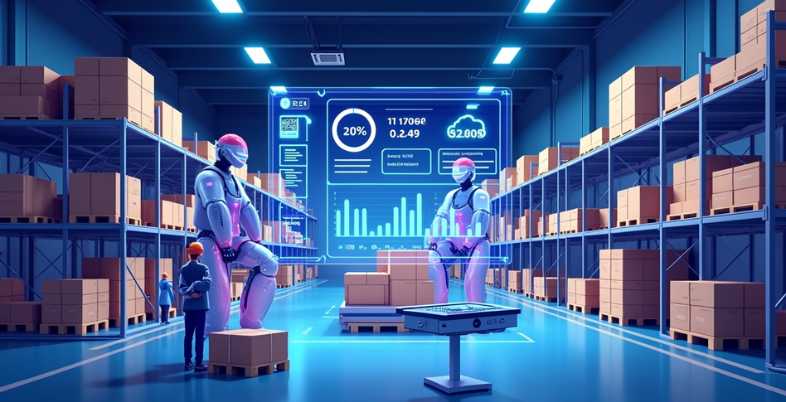
The seismic transformation in the warehouse sector is in 2026. As the global market in warehouse automation is expected to continue to grow to a high of over $41.4 billion in 2026 (compared to only 28.6 billion in 2020) companies are scrambling to update their supply chain operations. Fortune 500 logistics firms have increased adoption rate of automated warehouse solutions to 68% and the error rates in order fulfilment have reduced by 34 percent in those companies where full-stack WMS solutions are now deployed. Warehouse automation is no longer a luxury due to AI-significant inventory projections, robotic pickers, etc.
The seismic transformation in the warehouse sector is in 2026. As the global market in warehouse automation is expected to continue to grow to a high of over $41.4 billion in 2026 (compared to only 28.6 billion in 2020) companies are scrambling to update their supply chain operations. Fortune 500 logistics firms have increased adoption rate of automated warehouse solutions to 68% and the error rates in order fulfilment have reduced by 34 percent in those companies where full-stack WMS solutions are now deployed. Warehouse automation is no longer a luxury due to AI-significant inventory projections, robotic pickers, etc.
That is the key to competitive, resilient, and scalable operations. This guide will include all the details you need to know: what warehouse automation is, what tools it is based on, what challenges to expect, and how to select the appropriate solution to your business.
What Is Warehouse Automation?
Warehouse automation refers to the application of technology to warehouse functions (via software, robotics, artificial intelligence) or to warehouse functions that have historically been carried out by humans (via IoT sensors). It automates operations like inventory tracking, picking, packing, sorting and shipping with very little human involvement and it enhances the speed, accuracy and operational efficiency of all supply chain operations.
Key Components
- Warehouse Management System (WMS): It is fundamental software platform that manages inventory, orders, and workflows.
- Automated Storage and Retrieval Systems (AS/RS): Automated ways of storing and retrieving goods.
- Conveyor & Sortation Systems: Belts and sorters that carry products within the facility are automated.
- Robotic Picking Systems: Are autonomous robots that find, pick and carry products.
- Barcode / RFID Scanning: Inventory tracking technology.
- IoT Sensors and Edge Devices: These devices are connected to sensor the conditions and status of equipment.
- Artificial Intelligence and Machine Learning Engines: Demand forecasting and route optimization.
Types of Warehouse Management Systems (WMS) & Their Role in Automation
| Type | Description | Role in Automation |
| Standalone WMS | Independent software dedicated solely to warehouse operations. | Automates inventory tracking, slotting, and order fulfillment workflows. |
| Integrated ERP-WMS | WMS built into or tightly coupled with an ERP system (e.g., SAP, Oracle). | Enables end-to-end automation from procurement to shipment within one ecosystem. |
| Cloud-Based WMS | SaaS WMS hosted on cloud infrastructure, accessible anywhere. | Supports real-time data sync, remote monitoring, and scalable automation integrations. |
| Supply Chain Management (SCM) Suite | Broader platform covering warehousing, transportation, and procurement. | Automates cross-functional workflows across the entire supply chain. |
| Tier 1 Enterprise WMS | High-complexity systems for large 3PL and enterprise operations. | Powers advanced automation including robotics orchestration and AI-driven slotting. |
| Tier 2 / Mid-Market WMS | Feature-rich systems tailored for mid-sized businesses. | Automates core warehouse tasks with modular robotics and conveyor integrations. |
| Open-Source WMS | Community-driven, customizable warehouse software. | Enables custom automation workflows with developer-built integrations. |
Benefits of Warehouse Management System
- High Operational Efficiency: Manual bottlenecks are removed through automation which speeds up the processing of orders as well as throughput through the entire warehouse areas.
- Less Human Error: Automated scanning, verification and routing reduce the occurrences of picking and packing errors, enhancing the accuracy of shipment rates.
- Reduced Long-Term Labor Costs: Robotic systems and intelligent conveyors eliminate the use of manual labor, reducing costs of operation in the long-term.
- Live Inventory: The IoT and WMS connections will offer real-time inventory information, avoiding inventory shortages and making smarter replenishment choices.
- Scalability: With automated systems, volume peaks associated with peak seasons do not correlate with scaling changes in staff and infrastructure.
Top 10 Warehouse Management System Tools
1. Manhattan Associates WMS
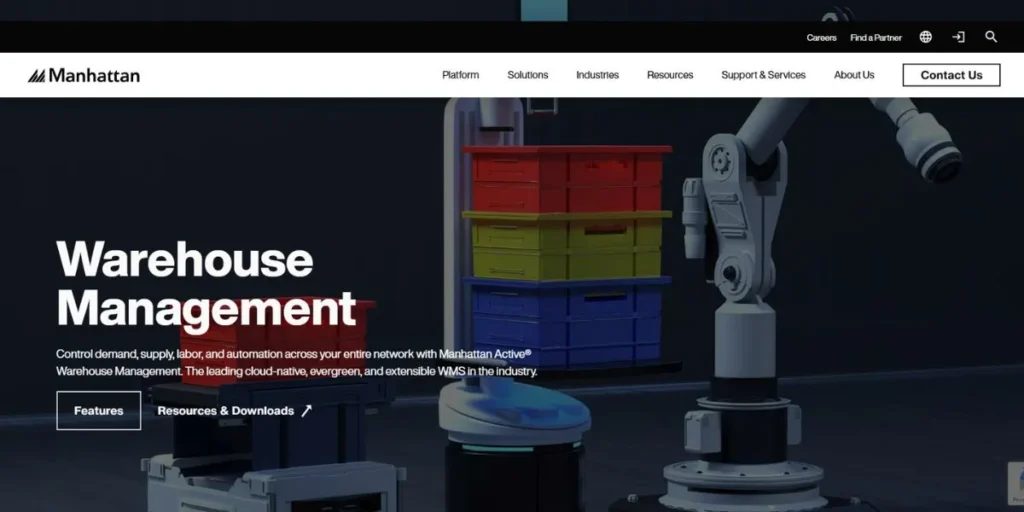
The Manhattan Associates WMS is a Tier 1 enterprise warehouse management system that is capable of supporting some of the largest retailers, 3PLs and manufacturers in the world. It provides a control aspect of the warehouse, including end-to-end warehouse control, receiving to last-mile dispatch. The system uses AI and machine learning to maximize slotting, workforce and task interleaving. It has a cloud-native design, which makes it continuously updated, but not offline. Manhattan is also native integrated with robotics and MHE. It is also known to be a leader in the Gartner Magic Quadrant of WMS.
Key Features:
- Task optimization and AI-assisted labor management.
- Indigenous robotics and MHE (Material Handling Equipment) coordination.
- Order and inventory lifecycle visibility in real time.
Best In: Large companies and outsourcing companies.
Link: https://www.manh.com/
2. SAP Extended Warehouse Management (EWM)
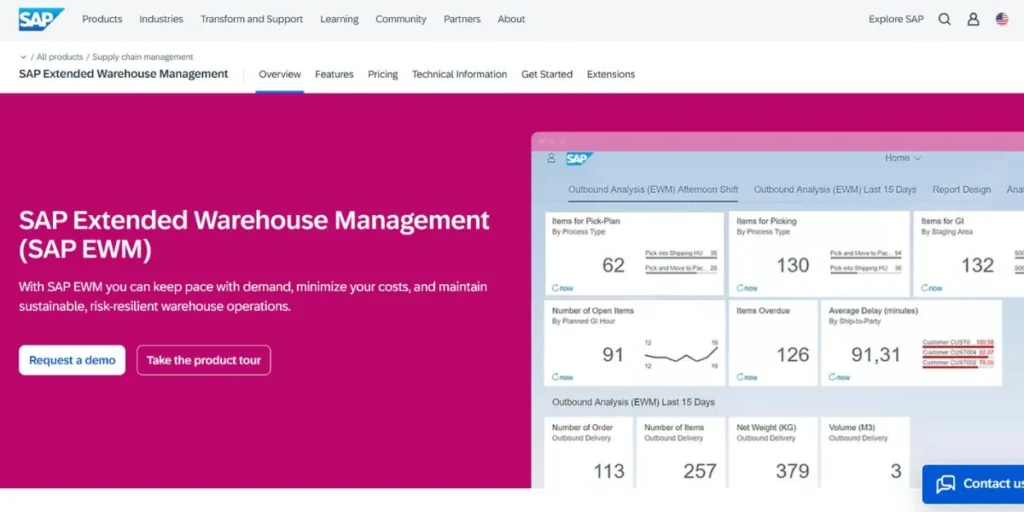
SAP EWM is the highly developed warehousing system of the SAP system that is applicable in a company that requires both ERP and warehouse operations to be closely interwoven. It is compatible with sophisticated warehouse arrangements such as multi-client, multi-warehouse, and cross docking. The system offers granular process control of the inbound, outbound, and internal movements.
Warehouse automation is also facilitated by SAP EWM through robotics, AS/RS, and conveyor systems. It perfectly fits those organizations that are already operating with SAP S/4HANA. The inbuilt analytics will deliver actionable KPIs to the continuous improvement of the process.
Key Features:
- Intensive integration SAP S/4HANA ERP.
- State-of-the-art slotting and yard handling.
- In-store real-time warehouse analytics.
Best On: SAP-intensive manufacturing and retail businesses.
Link: https://www.sap.com/products/scm/extended-warehouse-management.html
3. Oracle Warehouse Management Cloud (WMS Cloud)
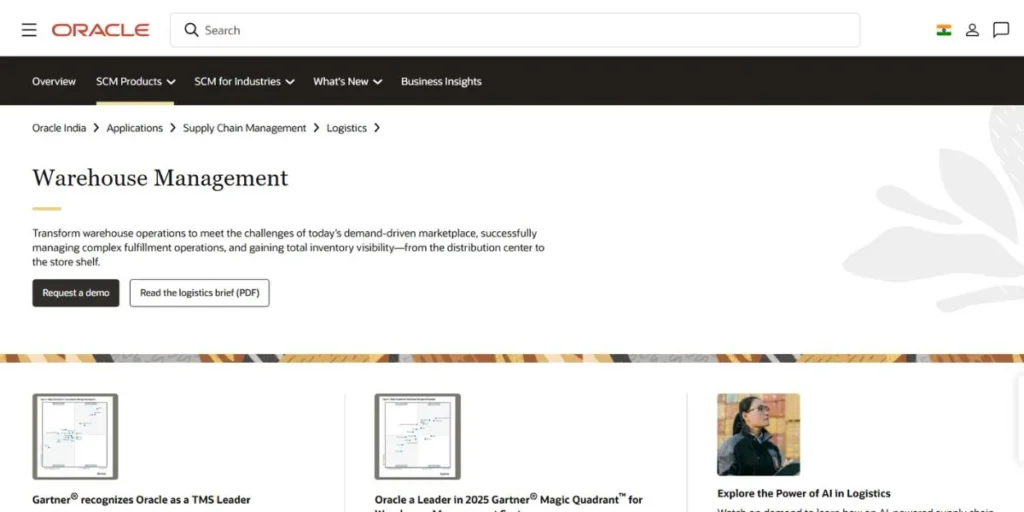
Oracle WMS Cloud is a scalable and flexible cloud-based warehouse management tool with great strength in any industry. It provides strong multi-site warehouse features of receiving, putaway, replenishment, and shipping. The platform has integrated RF, voice and vision-directed workflow support. Oracle WMS Cloud has a built-in connection with Oracle SCM and third-party ERPs through built connectors. Its mobile-first system assists employees in the warehouse with instructions in real time. The system also upholds the cartonization, labor tracking and carrier management.
Key Features:
- Multi-site and multi-client architecture based on the cloud.
- Voice work support, RF, and vision work support.
- Ready-made integrations with carriers and 3PL.
Best Suited: Mid to large multi-sited companies.
Link: https://www.oracle.com/scm/warehouse-management
4. Blue Yonder (JDA) WMS

Blue Yonder WMS is a platform that is developed to be at the head of the market, which integrates high-technology warehouse management with AI-driven supply chain intelligence. It assists warehouses in dynamically optimizing labor, space and automation assets. The system provides a microservice based architecture that facilitates quick deployment and expansion. The Luminate platform of Blue Yonder incorporates the prescriptive analytics and autonomous decision-making capabilities.
It facilitates in omnichannel fulfillment, direct-to-consumer and B2B applications. Blue Yonder, as well, is providing native integration of robotics with major automation suppliers.
Key Features:
- Luminate autonomous decision engine powered by AI.
- Modular deployment in the form of microservices.
- Omnichannel fulfillment and robotization.
Best Among: Retailers and 3PLs with complicated omnichannel requirements.
Link: https://blueyonder.com/
5. Körber WMS (formerly HighJump)
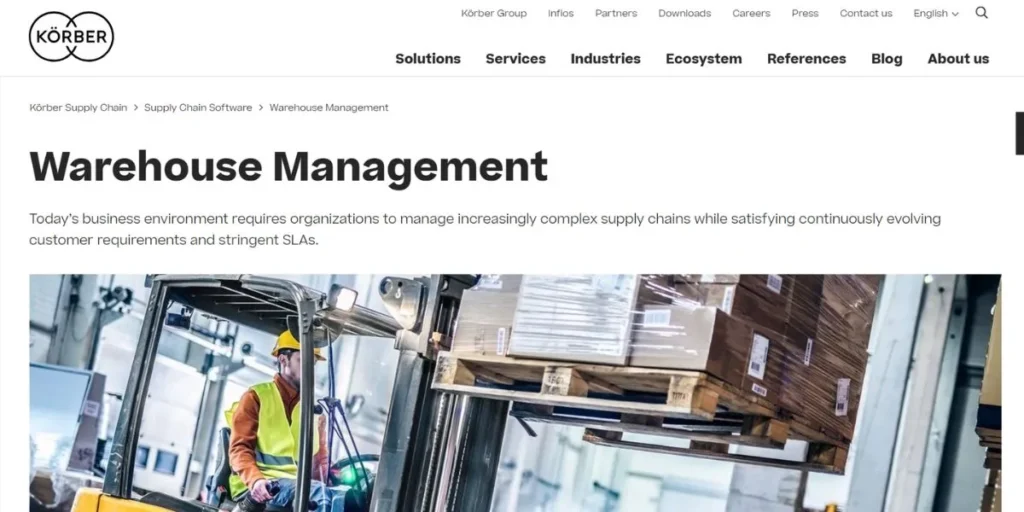
Körber WMS is a highly configurable and flexible warehouse management system that is appropriate to the business that requires quick customization without overly involving IT. Its no-code/low-code configuration engine enables the warehouse managers to modify workflows without coding. The platform promotes discrete and process manufacturing atmosphere. Körber is a part of a broad ecosystem of robotics, sorters and automation devices.
It ranges between single-site operations to the complicated multi-node networks. The system supports the larger Körber supply chain portfolio such as transportation and analytics solutions.
Key Features:
- No-code/low-code workflow architecture engine.
- Extensive automation equipment integrations.
- Scales to Enterprise down to SMB deployments.
Best Use: Middle and larger enterprises in need of fast customization of warehouses.
Link: https://www.koerber-supplychain-software.com/
6. Infor WMS
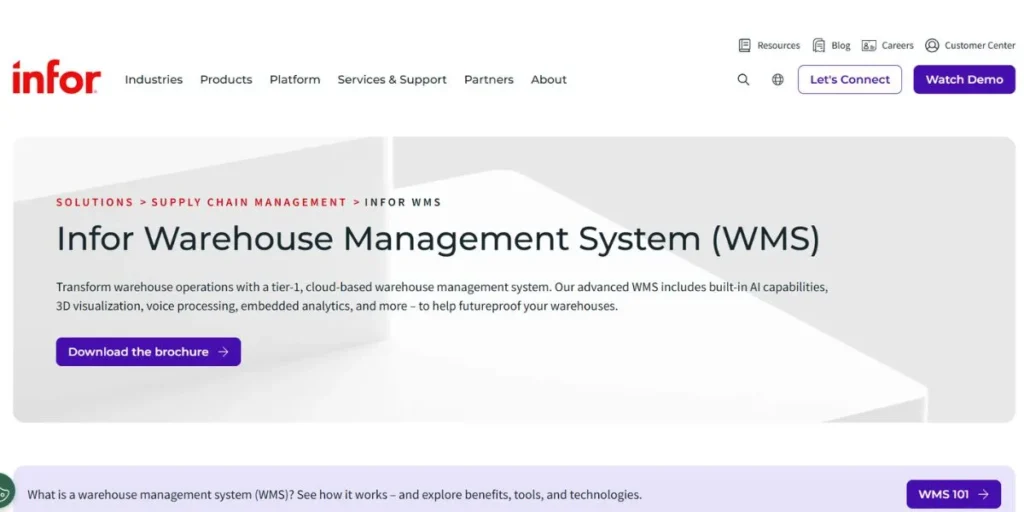
Infor WMS is an effective warehouse management system which is developed on the platform of Infor CloudSuite which is offered in food and beverage industry, healthcare industry and distribution business. It is compatible with high-level warehouse operations such as wave planning, cross-docking and value added services. The system is provided with industry templates, which makes it fast to deploy and the time to configure is minimized. The use of AI and IoT data by Infor Coleman AI engine to provide predictive insights is exploited in Infor WMS.
It has a native integration with Infor ERP modules and third-party ERP connections. The role-based dashboards on the platform offer the managers and floor staff real time awareness of operations happening on the floor.
Key Features:
- Premade templates in the industry.
- Predictive warehouse insights in Infor Coleman AI.
- Real time operational dashboards which are role based.
Best Fit: Food, health, and distribution related industry operations.
Link: https://www.infor.com/products/wms
7. Zebra Technologies (Warehouse Solutions)
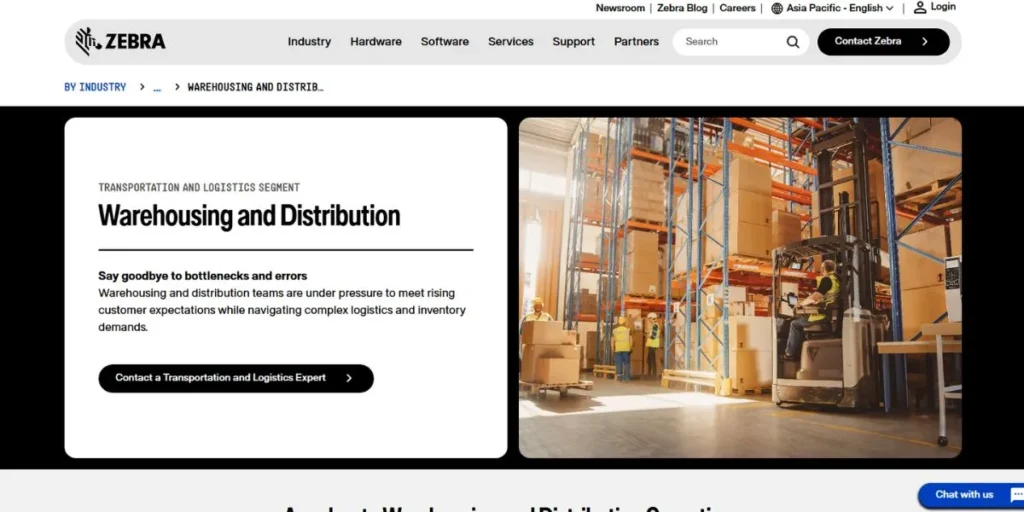
Zebra Technologies offers an end-to-end warehouse automation hardware and software platform, which includes handheld scanners, mobile computers, RFID, and Zebra Warehouse Intelligence platform. The solutions offered by Zebra fill the gap between the physical operations and the digital visibility with the help of connected devices. Its MotionWorks Warehouse platform lets track the location of the assets, workers, and inventory in real-time.
The devices by Zebra are compatible with almost all the major WMS systems through open APIs. The Reflexis platform by the company introduces AI-supported workforce management in the warehouse setting. More than 80 percent of Fortune 500 companies rely on Zebra as a source of operational technology.
Key Features:
- Real-time worker and asset tracking (RTLS).
- Reflexis workforce management using Artificial Intelligence.
- Open API integration into WMS.
Best Fit: Warehouses that have invested in device-based automation and RFID.
Link: https://www.zebra.com/warehouse
8. 6 River Systems (Shopify Logistics)
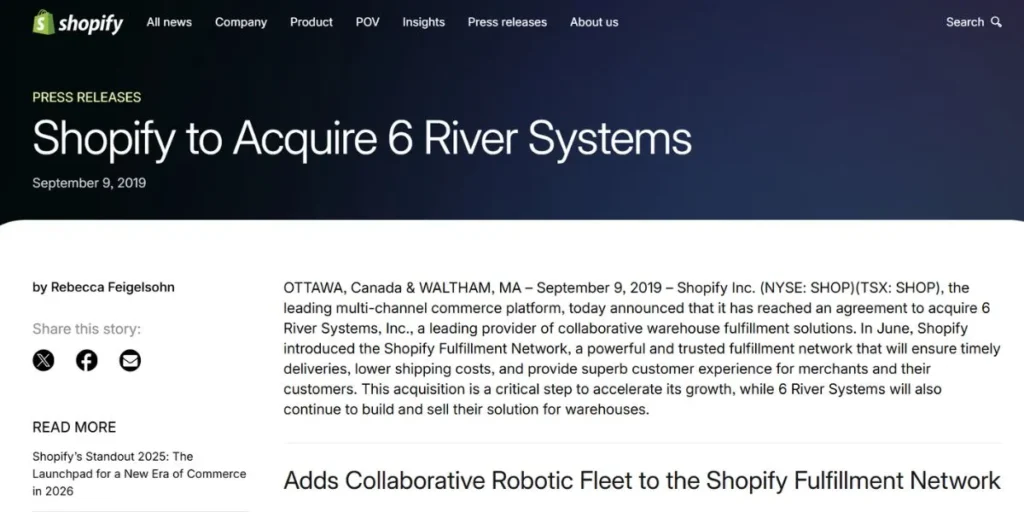
Currently serving as a member of the logistics system of Shopify, 6 River Systems provides collaborative mobile robots (CMRs) rebranded as “Chuck” which are used in conjunction with human pickers to process goods-to-person fulfillment. The service platform is conceptualized to be fast to deploy – a typical deployment will take several days – and it is best suited to businesses that require quick automation with no significant change in infrastructure. Chuck robots direct associates along optimal pick routes, minimizing the time and error.
The system is compatible with the installed WMS systems and ERP. 6 River Systems provides dynamic batching and zone skipping of high-velocity active operations. It is especially appropriate in the case of e-commerce and omnichannel fulfillment settings.
Key Features:
- Quickly deployable mobile collaborative robots (CMRs).
- On demand batching and pick path routing.
- Ready-to-use WMS/ERP integration.
Best Applicability: E-commerce and omnichannel fulfillment processes.
Link: https://6river.com/
9. Fishbowl Warehouse

Fishbowl Warehouse is a major inventory and warehouse management software that is focused in small to medium-sized businesses, particularly those that work with QuickBooks. It offers the WMS features such as multi-location inventory, order management, barcode scanning, and integration of manufacturing. The popularity of Fishbowl among growing enterprises that are taking a first step into organized WMS is due to its relative low price and the presence of integration with QuickBooks.
The platform facilitates pick, pack and ship processes that are updated with real time inventory. Also available in Fishbowl are manufacturing order management and Bill of materials tracking. Its online version, Fishbowl Online, makes its access available to remote and mobile users.
Key Features:
- Premeditative QuickBooks and Xero accounting integration.
- Multi-location inventory and barcode scanning.
- Order and BOM management in manufacturing.
Best Suited: SMBs and QuickBooks users who are venturing into WMS.
Link: https://www.fishbowlinventory.com/
10. Logiwa WMS
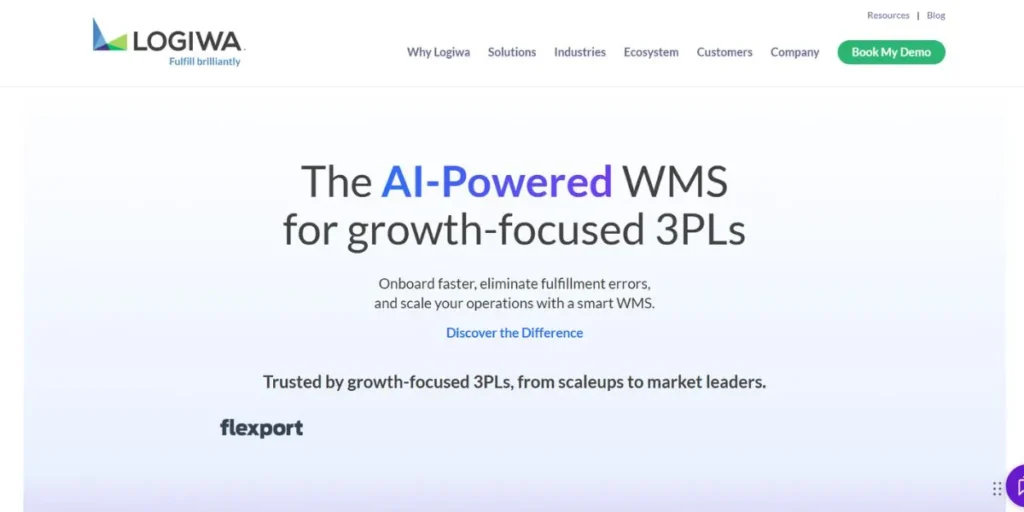
Logiwa is an AI-based, cloud-native WMS designed uniquely to support large-scale DTC (direct-to-consumer) fulfillment and 3PL operations. The structure is made capable of processing thousands of orders in an hour with real time inventory synchronization and dynamic order routing. Logiwa is integrable with more than 200 marketplaces, e-commerce providers, and shipping companies as default. The AI engine of the platform automatically batches orders, plans waves, and slotting.
Logiwa does not have any on-premise hardware requirements thus it can be deployed within a limited time. It is specifically designed to the contemporary e-commerce warehouse and order pick-up facility.
Key Features:
- Automated AI-generated wave planning and batching of order.
- More than 200 inbuilt e-commerce and carrier integrations.
- Live cloud stock synchronization in every channel.
Best Suited: DTC brands, 3PLs and e-commerce fulfilment centre.
Link: https://www.logiwa.com/
Challenges & Considerations When Automating the Warehouse
Automation of a warehouse is not that simple as it is transformative. Organizations should be keen to address a number of challenges during and prior to implementation:
- Extensive Start-Up Capital Cost: Robotics, AS/RS, conveyor systems, and enterprise WMS systems are highly expensive with full cost amounts reaching millions of dollars. The typical ROI periods are 3-5 years, and in this case, solid financial planning and executive buy-in are necessary prior to making any commitment.
- Complexity of Integration: It is rare that a new WMS or automation solution can be easily integrated with the ERP, TMS, and OMS systems. Problems with data mapping, API interoperability, and real-time synchronization often add to the schedule and budget of projects.
- Workforce Change Management: It is through automation that job roles are changed considerably. The employees will fear displacement, and without clear communication and retraining programs, there is the risk that organizations will be characterized by low adoption, cultural resistance and productivity decline when undergoing transitions.
- Scalability vs. Rigidity Trade-Off: Not all automation systems – particularly fixed conveyor or AS/RS systems are easy to reconfigure once installed. The design of automation architecture by businesses should take into account future expansions, intricacy of the SKUs, and the increase in quantity during seasons.
- Cybersecurity and System Resilience: IoT devices and cloud WMS platforms also increase the attack point of cyber threats since they are connected to warehouses. Experience in identifying any vulnerabilities and security breach may completely stop operations; hence redundancy planning and security procedures are mission-critical issues.
- Vendor Lock-In Risks: A proprietary automation ecosystem will probably reduce flexibility. When a vendor stops, increases prices or ceases innovating, the migration to a new platform may be expensive and disruptive.
How to Select the Right Automation Tools
- Evaluate Your Existing Operational Loopholes: Before evaluating any tool map the current workflows to see bottlenecks, high error rates, slow throughput, or other labor-intensive operations.
- Set Specific Automation Objectives and KPIs: Develop specific metrics like accuracy rate of orders, pick speed or inventory reduction objectives before determining a solution.
- Test Compatibility to Integration: Check that any WMS or robots can integrate with the existing ERP, e-commerce and carrier systems without expensive middleware.
- Select the Tool that is Right for Your Business Scale: Tier 1 enterprise WMS solutions are too powerful to use with SMBs; mid-market tools cannot handle high volume operations of 3PLs at scale – match complexity with real scale.
- Focus on Vendors: Select vendors that have a proven track record of deployment in your industry, e.g. retail, food and beverage, pharma or e-commerce and minimize implementation risk.
Conclusion & Recommendations
The automation of warehouses in 2026 is no longer a competitive advantage — it is soon becoming the standard. This situation, coupled with the increase in labor costs, the growth of e-commerce, and the demands of the customers to get their goods within a day or even a few days, has rendered the manual operations used in a large-scale warehouse unsustainable.
The platforms such as Manhattan Associates, SAP EWM, or Blue Yonder provide for large enterprises the level of depth, scalability, and robotics orchestration to operate more complex, multi-site operations efficiently. Amid mid-market companies, Körber, Infor WMS, or Oracle WMS Cloud have a good balance between the ability and the flexibility. In the case of SMBs and e-commerce businesses, Fishbowl Warehouse and Logiwa WMS provide affordable cloud-first automation, but at an affordable enterprise price.
The advice above applies irrespective of the size of the company, but it is simple: first, conduct a comprehensive audit of the operations, set the automation objectives with quantifiable KPIs, focus on integrating compatibility, and select a vendor that has an established record in your sector. Automation is a process – begin with high impact, lower risk such as inventory visibility, and order management before diversifying to robotics and sophisticated MHE.
FAQs
What is the distinction between the ERP system and a WMS?
The WMS specializes in operations of a warehouse, such as inventory, picking, and shipping whereas the ERP oversees the operations in a wider business scope, with finance, HR, and procurement being the main functions of the organization.
What is the average time required to install a warehouse automation system?
The implementation schedules are diverse, a cloud-based WMS can be implemented in 4–12 weeks, and a full robotics and AS/RS installation can be implemented in 6–18 months, depending on the complexity of the facility.
Would warehouse automation work with small and medium businesses?
Yes, now there are numerous cheap cloud-based WMS software and Robot-as-a-Service (RaaS) frameworks that enable the automation of warehouses among SMBs without involving huge capital expenditures initially.
What business could reasonably expect when it comes to ROI on warehouse automation?
Majority of businesses report ROI being measurable within the 2-4 years, with reported benefits being 25-40% labor cost reduction and 99.9% accuracy in orders following full system implementation.