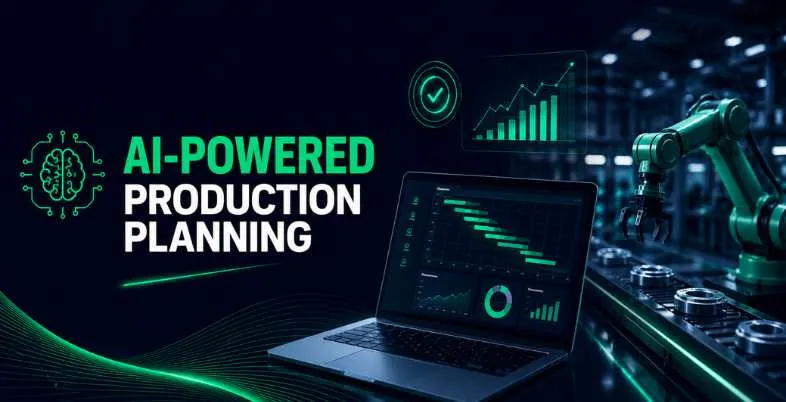
There has been more change in the two-year period after 1956 than had occurred in 20 preceding years. Today smart AI-powered production planning software has become integral to smart factories, supporting making better decisions in real time for plant managers, production and supply chain teams and operations leaders.
Advanced planning and scheduling (APS) software is valued globally at $1.47 billion by 2026, and is expected to hit $2.11 billion by 2030, rising at a steady 9.5% CAGR. Much of that growth is being seen as manufacturers switch existing MRP over to an AI-first platform.
While the business case is clear, IDC predicts more than 40% of manufacturers will be using AI tools for scheduling and production planning by 2026. AI-based production planning software can save up to 30%, lead to quicker order times and allow businesses to avoid as many as 30% of stock-outs. This guide offers you a comparison of the best AI-powered production planning software, insight into what to expect, and the choice of the best tool for a particular business.
What is AI-Powered Production Planning Software?
AI-powered production planning software is a digital solution that leverages artificial intelligence, predictive analytics, and real-time data to automate production planning, scheduling, and optimization.
While traditional systems depend on pre-programmed rules and manual interventions, AI-driven systems gain insights from past production knowledge, adjust to dynamic demand shifts and propose optimal production sequences, all in real-time. Manufacturers’ push toward intelligent planning is growing rapidly, and the APS software market is projected to have a value of $1.47 billion by 2026.
The platforms will generally include demand forecasting, capacity planning, materials requirements and shop-floor scheduling in a single, integrated system, which can cut planning times by up to 50% compared to traditional predictive planning solutions.
How AI Differs from Traditional MRP/APS
MRP and APS methods are based on a set of rules that are hard-coded and do not change. AI-powered production planning software does more – adapts, learns and optimizes on a constant basis. According to IDC, over 40% of manufacturers are projected to switch or upgrade their legacy planning systems to AI planning systems in 2026.IDC predicts that by 2026, more than 40% of manufacturers will replace or improve their legacy planning systems with AI systems.
- Self-learning models: Self-learning models make use of AI systems that learn from demand patterns and improve their forecast accuracy over time.
- Real-time replanning: When a machine breaks down or a supplier is late, AI instantly recalculates the entire schedule – traditional APS requires manual intervention.
- AI simulations: AI platforms simulate hundreds of what-if scenarios in mere seconds for planners with which they can choose the best option before investing resources.
- Demand sensing: AI software decodes real-time retail insights, including POS data, weather conditions and social trends, to dynamically modify short term forecasts, which is not possible with MRP.
- Constraint optimization: Using AI, you can impose more than one constraint on an objective (space, material, man, energy) at the same time… legacy tools work one constraint at a time.
Key Features to Look For (Buyer’s Checklist)
The main part of selecting an AI-powered production planning software is complex as it involves matching features with your particular manufacturing context. Based on the industry best practices from 2026, gaining the return on investment would take as little time as 1.2 years for companies choosing tools that are aligned to their use cases.
- AI demand forecasting: Reduces greatly forecast error across your production forecasting by automatically generating and updating forecasts using machine learning models that are trained on your historical data.
- Real-time Scheduling: Dynamically creates and optimises a shop floor schedule taking into account live machine status, labour available and material readiness.
- What-if scenario planning: Allows planners to conduct ‘what if’ planning, such as testing scenarios of increasing capacity or demand and evaluating results.
- ERP/MES integration: Native and open integration capabilities with SAP or Oracle/ Microsoft Dynamics integration and without custom coding with MES and IoT systems on the shop floor.
- Explainable AI dashboards: AI recommendations with reasoning, enabling planners to trust, override or approve with full context.
Comparison Table
| Name | Best For | AI Features | Pricing | Integrations | Rating |
| SAP IBP | Large enterprises | Demand sensing, ML forecasting, scenario simulation | Custom / Enterprise | SAP S/4HANA, ERP, MES | 4.3/5 |
| Kinaxis RapidResponse | Complex supply chains | Concurrent planning, Demand.AI, what-if agents | $500–$1,000+/user/mo | ERP, MES, IoT platforms | 4.0/5 |
| o9 Solutions | Mid-large manufacturers | Digital Brain Knowledge Graph, ML demand/supply | Custom / Enterprise | SAP, Oracle, Salesforce | 4.2/5 |
| Blue Yonder | Retail & manufacturing | AI-driven demand planning, autonomous ordering | Custom / Enterprise | SAP, JDA legacy, MES | 4.1/5 |
| Anaplan | Cross-functional planning | Connected planning, AI scenario modeling | Custom / Enterprise | SAP, Oracle, Workday | 4.2/5 |
| Siemens Opcenter APS | Discrete manufacturers | Constraint-based AI scheduling, digital twin | Mid-market / Custom | Siemens PLM, SAP, ERP | 4.4/5 |
| Flowlity | AI-first mid-market | Autonomous replenishment, deep ML planning | SaaS / Modular | SAP, ERPs, WMS | 4.9/5 |
| Katana MRP | Small manufacturers | AI reorder points, real-time inventory planning | From $179/mo | Shopify, QuickBooks, Xero | 4.4/5 |
| Delfoi Planner | Job shop & make-to-order | AI-assisted finite capacity scheduling | Mid-market / Custom | SAP, Microsoft Dynamics | 4.3/5 |
| RELEX Solutions | Retail & food manufacturing | ML demand forecasting, AI replenishment | Custom / Enterprise | SAP, Oracle, MES, WMS | 4.5/5 |
Top 10 AI Production Planning Software in 2026
1. SAP IBP (Integrated Business Planning)
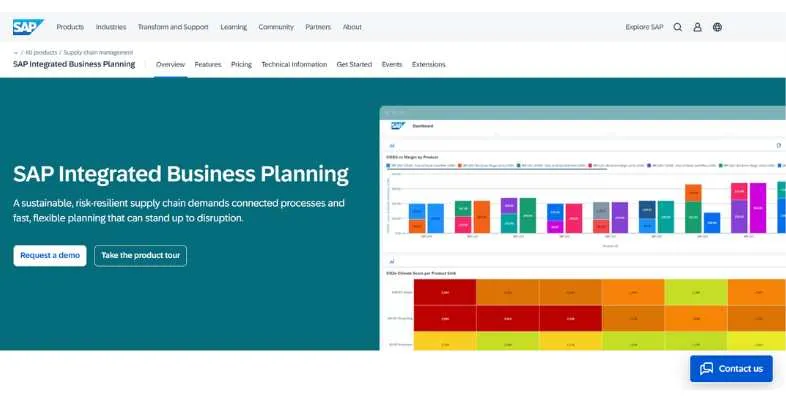
SAP IBP is an SAP HANA in-memory database-based solution that is deployed on the cloud for supply chain and production planning. Connects with demand forecasting and inventory planning, supply planning, and sales & operations planning (S&OP) within a single, integrated solution. SAP IBP is a tool mainly developed for large enterprises and is integrated mainly with SAP S/4HANA and SAP ECC.
Many organizations, such as Microsoft, have taken it upon themselves to upgrade their planning processes by using SAP IBP. By 2026, SAP had enhanced its cloud suite, and it was one of the most comprehensive AI-powered production planning software today.
Best for: Large enterprises
AI Features:
- ML demand sensing
- Predictive forecasting
- Scenario simulation
- Automated alerts
- Real-time rebalancing
Deployment: Cloud (SaaS)
Integrations: SAP S/4HANA, ECC, MES, IoT
Pricing Model: Custom pricing
Free Trial: No (demo available)
Website: https://www.sap.com/india/products/scm/integrated-business-planning.html
2. Kinaxis RapidResponse
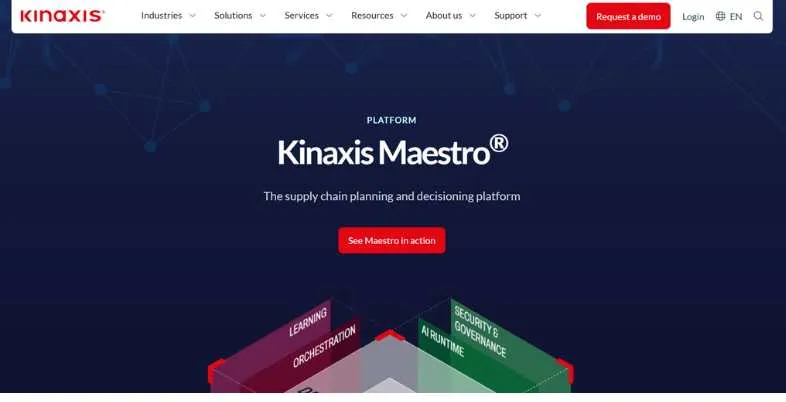
Kinaxis is one of the most mature in the field of advanced supply chain and production planning platforms. It features patented “concurrent planning” technology to allow it to instantly recalculate the effects of any change: machine downtime, supplier delays, demand surge, and so on – across inventory, orders, capacity, logistics, and everything in between. To meet this challenge, Kinaxis created Maestro Agent Studio in 2026, the capability to build no-code AI agents for planners.
It also published a Tariff Response tool for fast model of alternative trade policy scenarios. Kinaxis is prevalent in the aerospace, defense, high-tech and automotive manufacturing industries where planning speed gives competitive advantage. It’s a top AI-powered production planning software for multi-site operations throughout the world.
Best for: Complex supply chains
AI Features:
- Concurrent planning
- Demand.AI ML forecasting
- What-if agents
- Scenario modeling
- Replenishment AI
Deployment: Cloud (SaaS)
Integrations: SAP, Oracle, Microsoft Dynamics, MES
Pricing Model: Custom pricing
Free Trial: No (demo available)
Website: https://www.kinaxis.com/en/solutions/platform
3. o9 Solutions
Based in Dallas, o9 Solutions is an AI planning platform with an artificial intelligence brain called “Digital Brain” that is an enterprise knowledge graph that connects supply chain, commercial, and financial data into a single decision-making engine. O9 is founded in 2009 and has raised more than $300 million investment with top investors and achieved $150 million ARR.
The platform spans the areas of Demand Forecasting, Supply Planning, Inventory Optimization, Revenue Management and Integrated business planning (IBP) and is used across all industries of Consumer Goods, Retails, Pharma and Manufacturing. As o9 is highly connected and powered by AI, it is a great fit for companies with multiple business functions who require a robust production planning solution.
Best for: Mid-to-large manufacturers
AI Features:
- Knowledge Graph AI
- ML demand planning
- Digital twin simulation
- Inventory optimization
- Revenue management AI
Deployment: Cloud (SaaS)
Integrations: SAP, Oracle, Salesforce, Workday
Pricing Model: Quote-based pricing model
Free Trial: No (demo available)
Website: https://o9solutions.com/
4. Blue Yonder Manufacturing Planning
Built by former JDA Software, the Blue Yonder solution is a supply chain and manufacturing planning platform that is currently used by some of the world’s leading retailers and manufacturers. The AI-powered demand planning engine is a powerful machine learning tool for highly accurate forecasting, and its intuitive ordering and replenishment functionality minimizes manual effort.
Blue Yonder’s platform includes the entire spectrum of demand, supply, manufacturing, logistics, and workforce planning into a single solution. AI and automation technology continues to be a key focus of investment for Blue Yonder in 2026, and the software is an excellent choice for companies in the retail, food & beverage, and discrete manufacturing industries.
Best for: Retail & discrete manufacturing
AI Features:
- ML demand forecasting
- Autonomous ordering
- Supply optimization AI
- Capacity planning
- Real-time alerts
Deployment: Cloud (SaaS)
Integrations: SAP, Oracle, MES, WMS, IoT
Pricing Model: Custom pricing
Free Trial: No (demo available)
Website: https://blueyonder.com/solutions/supply-chain-planning/production-planning
5. Anaplan
Anaplan has pioneered connected planning with a extremely flexible, model-driven answer course a cross a number of finance, supply chain, sales and operations. Companies that need to make finance decisions in real-time to go hand-in-hand with production planning will tell you Anaplan is a standout for them among supply-chain only tools.
Carter and Ajinomoto are among several brands that achieved a 4-10 day reduction in inventory across their supply chain using Anaplan. In 2026, Anaplan’s AI scenario modeling and automated what-if analysis help businesses planning across functions, offering them versatile AI-powered production planning software.
Best for: Cross-functional enterprise planning
AI Features:
- Connected AI planning
- Scenario modeling
- Automated forecasting
- Demand-supply balancing
- Finance-integrated AI
Deployment: Cloud (SaaS)
Integrations: SAP, Oracle, Workday, Salesforce
Pricing Model: Custom pricing
Free Trial: No (demo available)
Website: https://www.anaplan.com/
6. Siemens Opcenter APS
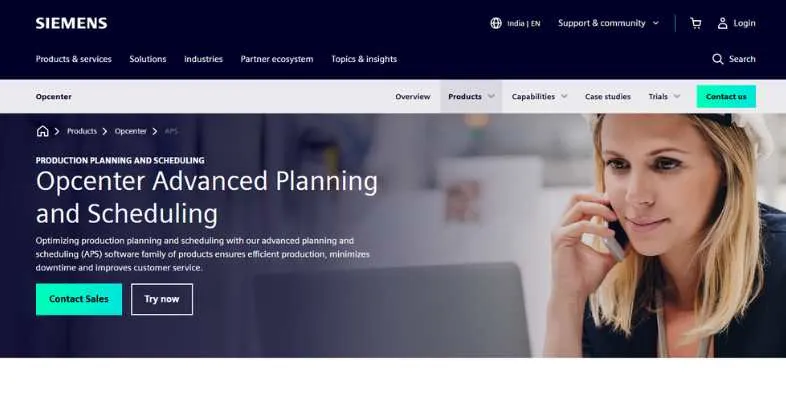
Siemens Opcenter APS (Preactor) is a constraint-based advanced planning and scheduling solution, which caters to discrete, process and mixed-mode manufacturers. It is a component in the larger Siemens Opcenter manufacturing process suite that connects manufacturing execution with manufacturing process planning. Optimizing sequences on the shop floor, with the ability to accommodate the machine, material and man power constraints as well, with AI-supported finite capacity scheduling.
Siemens has implemented predictive scheduling capabilities through artificial intelligence in the production scheduling module of its cloud-based production planning suite in February 2026, to further optimize production processes. It is an effective AI-powered production planning software for Mid-market and enterprise manufacturers requiring deep scheduling capacities.
Best for: Discrete & process manufacturers
AI Features:
- Finite capacity scheduling AI
- Constraint optimization
- Digital twin
- Predictive scheduling
- Scenario planning
Deployment: Cloud & On-Premise
Integrations: SAP, Oracle, Siemens PLM, MES, ERP
Pricing Model: approximately $1,200 per month
Free Trial: No (demo available)
Website: https://www.siemens.com/en-us/products/opcenter/
7. Flowlity
In 2026, Flowlity is poised to become a leading, AI-powered supply chain and production planning solution, thanks to its extensive implementation of AI capabilities and high level of user satisfaction. Classified G2 4.9, best in class for autonomous replenishment, deep machine learning nutrition and AI-driven planning decisions, Flowlity is distinguished from others.
Flowlity is priced on a modular SaaS pricing structure, ideal for mid-market manufacturers and distributors and is plug and play with some of the key ERP systems out there. If you’re a manufacturer seeking the latest and greatest in AI-powered production planning software with enterprise-level features without the hassle,Flowlity is a great choice.
Best for: AI-first mid-market manufacturers
AI Features:
- Autonomous replenishment
- Deep ML forecasting
- AI inventory optimization
- Demand sensing
- Automated purchasing
Deployment: Cloud (SaaS)
Integrations: SAP, Oracle, Microsoft Dynamics, WMS
Pricing Model: Custom pricing
Free Trial: Yes
Website: https://www.flowlity.com/
8. Katana MRP
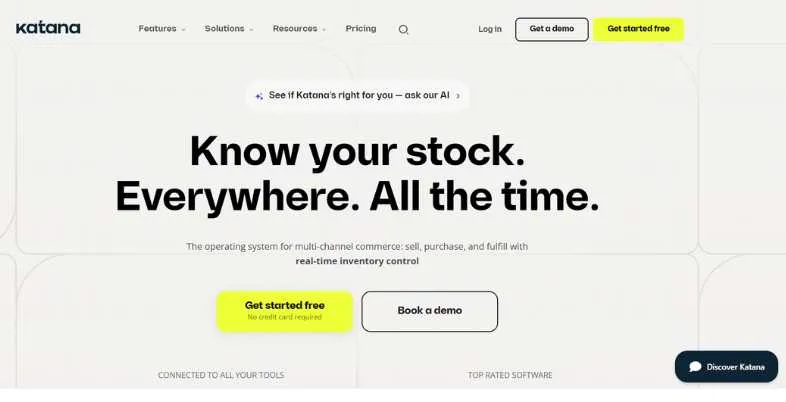
Katana MRP is a cloud ERP solution geared to growing and small manufacturers for manufacturing resource planning. It provides live inventory tracking, production scheduling, AI-generated reorder suggestions, and much more in a simple-to-use interface. Many manufacturers who are connected to ecommerce platforms via Shopify love Katana, because it enables them to sync up orders to the shop floor instantly.
It can be used with as little as $179/month, and is among the most user-friendly AI-based production planning software (PCs) available for SMEs who are outgrowing spreadsheet methods but not a full range of enterprise platforms. It encompasses make-to-order, make-to-stock and mixed production models, all in a single system.
Best for: Small manufacturers & e-commerce brands
AI Features:
- AI reorder points
- Live inventory tracking
- Auto scheduling
- Demand-driven MRP
- Low-stock alerts
Deployment: Cloud (SaaS)
Integrations: Shopify, QuickBooks, Xero, WooCommerce
Pricing Model: starts at $299/month
Free Trial: Yes (14-day free trial)
Website: https://katanamrp.com/
9. Delfoi Planner
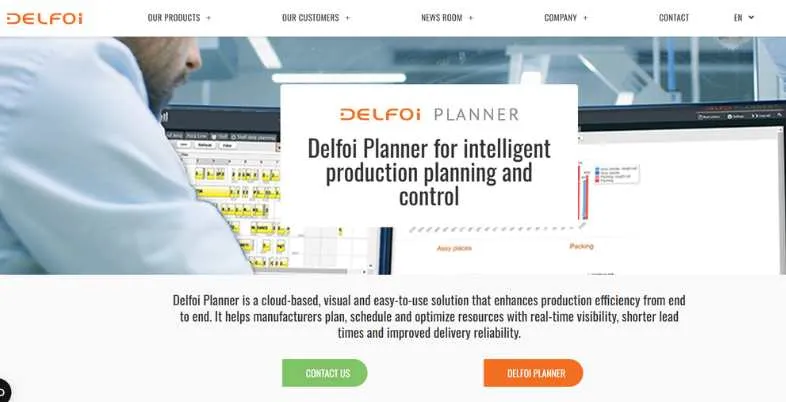
Delfoi Planner is a specialized Advanced Planning and Scheduling (APS) solution that was developed to serve job shop, make-to-order and engineer-to-order manufacturers. It offers AI-powered finite capacity scheduling, with a great practical shop-floor usability focus. In Europe and elsewhere, Delfoi is employed in all industrial fields involving sheet metal bending, sheet metal cutting and fabrication or special incorporate in custom manufacturing.
The system integrates with SAP and Microsoft Dynamics and provides a groundbreakingly easy-to-use visual scheduling board that planners can interact with directly. Delfoi Planner is a production planning solution for mid-market manufacturers that have complex and variable production volumes, providing a significant amount of APs without the enterprise price tag.
Best for: Job shop & make-to-order manufacturers
AI Features:
- AI-assisted finite scheduling
- Capacity optimization
- What-if planning
- Bottleneck detection
- Real-time rescheduling
Deployment: Cloud & On-Premise
Integrations: SAP, Microsoft Dynamics, ERP systems
Pricing Model: roughly €600 per user, per month
Free Trial: Demo available
Website: https://delfoi.com/en/delfoi-planner-production-planning/
10. RELEX Solutions
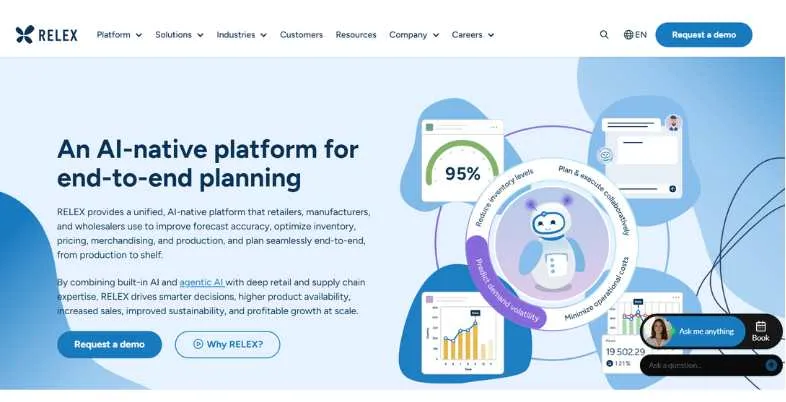
RELEX Solutions is a leader in the AI-powered planning software market, developed for and used by retailers and grocers, but adapted to food manufacturing, consumer goods and supply-chain heavy production lines. Its machine learning Based demand forecasting engine easily copes with products that have high accuracy of short shelf life and extreme seasonality even when there is a promotion. AI replenishment and production planning modules at store level and on the factory floor become automated thanks to RELEX.
In the manufacturing sector, where AI-powered production planning is vital, particularly for operations in consumer goods and retail neighboring businesses with high uptime expectations, RELEX stands out as a leading production planning software engineered with a G2 rating and a proven track record in Europe and North America.
Best for: Food, retail & consumer goods manufacturers
AI Features:
- ML demand forecasting
- AI replenishment
- Automated production plans
- Promotion AI
- Waste reduction engine
Deployment: Cloud (SaaS)
Integrations: SAP, Oracle, MES, WMS, ERP systems
Pricing Model: Custom pricing
Free Trial: No (demo available)
Website: https://www.relexsolutions.com/
SME vs Enterprise: Which Tool Is Right for You?
| Factor | SME (Small & Mid-Size) | Enterprise (Large) |
| Budget | $100–$1,500/month | $50,000–$500,000+/year |
| Implementation Time | 2–8 weeks | 6–18 months |
| IT Resources Needed | Minimal | Dedicated team required |
| ERP Integration | Shopify, QuickBooks, Xero | SAP, Oracle, Microsoft Dynamics |
| Best Tools | Katana MRP, Flowlity, Delfoi Planner | SAP IBP, Kinaxis, o9 Solutions, Blue Yonder |
| AI Complexity | Pre-built AI, easy setup | Configurable AI models, custom ML |
| Scalability | Grows with business | Built for multi-site, global scale |
| Support Model | Self-serve + live chat | Dedicated CSM + implementation partner |
| Free Trial Available | Yes (most tools) | No (demo/POC only) |
| Key Use Case | Single-site production, e-commerce fulfilment | Multi-site, multi-BU supply chain planning |
ROI of AI in Production Planning – Data & Case Studies
ROI on AI-powered production planning software is no longer a theory, but something a reality with real evidence from various industries.
Deloitte reports that those embracing the planning transformation with AI achieve an average ROI of 10:1 in two years. AI planning tools are one of the quickest payback technology investments, coming back to manufacturers in just 1.2 years on average.
When implemented in real-world setups, AI-driven production planning solutions have been proven to save operational costs by 20–30%, reduce unplanned downtime by 30–50%, and enhance Overall Equipment Effectiveness (OEE) by 15–25%.
For supply chain-specific use cases, a company such as Carter had a 4-6 day reduction in their inventory following the implementation of AI planning platforms whilst another company, Ajinomoto, reduced their inventory by 10 days.
The cost of not “migrating” to cloud MRP or moving to a newer SaaS solution is increasing steadily by the quarter for manufacturers still on spreadsheets or legacy MRP.
Integration Guide – ERP, MES & IoT Compatibility
The most important part of a successful deployment is integrating AI-powered production planning software with your technology stack. By 2026, more than 40 percent of operational data will be gathered from IoT sensors and pre-processed with edge computing and self-contained apps – which will make integration a becoming a major buying criterion, IDC says.
- ERP integration: ERP integration connectors like those for SAP S/4HANA, Oracle ERP Cloud, and Microsoft Dynamics 365 are provided by most enterprise AI planning tools, which helps with syncing data from ERP tools, such as orders, BOMs, and inventory levels.
- Native MES integration: AI planners get real-time information about machines, production quantities and quality from the shop floor and update schedules dynamically during the day in real time.
- IoT data ingestion: Some of the most popular provide real-time sensor data (energy consumption, machine OEE, equipment state, etc.) for ingesting and automatically triggering replanning events, such as Siemens Opcenter and Kinaxis.
- API-first architecture: Powerful AI planning solutions provide REST APIs and webhook support to ensure seamless integration without re-implementing legacy systems or in-house databases.
- Cloud data warehouses: AI planning engines can be integrated with other sources of enterprise data like CRM, finance and supplier portals.
Implementation Roadmap for AI Production Planning
To reap the benefits of AI-powered production planning software efficiently, it is crucial to implement it in a structured way. The majority of manufacturers moving in the direction of a phased implementation say they’re live on core planning tools within 8-16 weeks and enterprise planning tools in 6-12 months.
- Discovery & data audit: Identify existing planning workflows, map existing planning data gaps in BOMs, routings, and demand history and establish clear KPIs including forecast accuracy, schedule adherence, etc., and inventory turns.
- Selecting a platform & Scoping: Make a shortlist of 2-3 products according to your company size, ERP requirement, and use-case. Conduct a structured demo/run with your real data to prove that your AI power is willing to forecast with accuracy if you give it a shot.
- Pilot deployment: Purchase, install and prove value of each pilot (one product line, one plant or planning function such as demand forecasting).
- ERP & MES integration: Connect the AI planning platform to ERP to synchronize master data and to connect to MES or IoT to feed live data from the shop floor – this enables a real-time replanning capability.
- Full rollout & change management: Take it site-to-site and planning function-wide, train planning teams on AI-generated recommendations and put in place a governance process to accept or reject the AI decision.
FAQs
What is AI-powered production planning software?
AI-powered production planning software is a platform which replaces manual and rule-based planning tools using real-time data and machine-learning to optimize manufacturing operations: Plan, schedule & Optimize.
What is the difference between MRP and AI production planning?
MRP operates on batch processing cycles—with fixed rules, static lead times and historical data. Continuous, adaptive optimization with AI planning, call it with ML models, demand signals via NLP, real time data.
Which AI production planning software is best for small manufacturers?
If you are an SME looking for the best options in 2026, you can’t go wrong with Katana MRP or Flowlity, these both come with their own SaaS pricing, easy setup and already have AI built-in, simply pay and start using it as opposed to having to dedicate a large IT team to create one or make it work with your ERP systems.
How long does it take to implement AI production planning software?
With some of the SME tools such as Katana, this can be only 2–4 weeks quite soon. Usually, enterprise platforms such as SAP IBP or Kinaxis take 6-12 months to deploy completely with ERP integration and model training with LLM (e.g., ChatGPT).