
India is at a historic phase in its energy transition. The nation has hit the E20 blending target ahead of schedule, with 20% ethanol being blended into petrol, a shift in thinking around fuel consumption, farming and industry for the country. The key in this shift is the ethanol production companies that have emerged quietly to become some of the most strategically significant businesses in the country.
Not just because these Ethanol Manufacturing Companies in India are making India a cleaner and more self-reliant country, but also because the potential demand for sugar, which is expected to rise in the future, is being met by sugarcane production in the states of Maharashtra and Uttar Pradesh, while the areas of Punjab and Haryana are expected to be the primary contributors to the production of grain.
The ethanol industry in 2026 is much more than an energy industry — it is an enormous investment opportunity and an economic opportunity that should not be overlooked by investors, policy makers and entrepreneurs.
Also Read – Manufacturing Companies in Gurgaon
India’s Ethanol Revolution: E20 Achievement & the Road to E100
- With the current average ethanol blending of 15%, India has met the 15% target for ethanol blending in petrol ahead of the original target date of 2025-26 and is expected to reach the E20 milestone by 2025-26.
- In terms of saving of foreign exchange, with ethanol blending in petrol, India has saved around $10 billion in crude oil imports.
- The current total ethanol production capacity in India has gone beyond 1,700 crore litres per year by 2026.
- The government is now going after E100 (pure ethanol vehicles) and developing a longer-term plan on flex-fuel penetration.
- Today, over 700 distilleries are running in India, making it among India’s fastest growing ethanol economy in the world.
- Fuels and Vehicles (Flex Fuel) have been introduced by Maruti Suzuki, Toyota and TVS, thereby driving demand for higher ethanol blends.Maruti Suzuki, Toyota and TVS have introduced flex fuel vehicles, keeping demand for higher fuel ethanol blends.
- More than 5 lakh farmers directly depend upon the ethanol industry and millions of people in rural India are employed in it.
What Is the Ethanol Blending Programme (EBP)?
Ethanol Blending Programme (EBP) is a Government of India initiative which has made it compulsory for the oil marketing companies (OMCs) so that ethanol, a biofuel that is made from agricultural produce, is blended into petrol. The EBP was launched initially in 2003 and scaled up significantly under the National Biofuel Policy of 2018, to ensure a reduction in dependence on imported crude oil, decrease the emission from vehicles, improve farm productivity and boost a circular economy.
The EBP has evolved to become one of the world’s most successful biofuel programmes by 2026. The government has widened the scope of feedstock from sugarcane molasses to grains such as maize and rice, damaged food grains and even agricultural residues of second-generation (2G) ethanol. This growth has added ethanol producing companies across various industries such as sugar, distillery and agri-processing, thus diversifying the ethanol industry and opening up multi-crore investment corridors.
India Achieves E20 Ahead of Schedule — What It Means in 2026
- Direct air quality improvement due to the reduction in carbon monoxide emissions when using E20 blending, as compared to pure petrol; up to 50% less carbon monoxide emitted.
- The ethanol blending initiative saved around ₹35,000 crore in import expenses in just 2025-26. Ethanol blending saved India around ₹35,000 crore in import costs in the year 2025-26 alone.
- Rather, this is being made the standard rather than optional feature for auto manufacturers to produce E20-compatible engines.
- Since 2022, more than ₹50,000 crore has been allocated for the addition of new distillery capacity in India due to the achievement of E20.
- The government has notified the ethanol price at ₹71.86/litre (C-heavy molasses), ₹74.48/litre (B-heavy molasses) and ₹89.02/litre (sugarcane juice) for 2025-26.
- India’s success has been compared with the country’s long standing programme called Proalcool in Brazil, which is making India a world leader in blending of biofuels.
- Further investment in 2G ethanol technology, logistics infrastructure and engine technology will be needed on the road to E100.
Government Policy: NBP 2018, EBP, and ₹30,000 Crore Investment
| Policy / Scheme | Year Launched | Key Feature | Financial Outlay |
| Ethanol Blending Programme (EBP) | 2003 (revised 2018) | Mandates ethanol blending in petrol | Demand guarantee via OMCs |
| National Biofuel Policy (NBP) | 2018 | Expanded feedstock list, 2G ethanol push | Policy framework |
| PMJIVAN Yojana | 2019 | Support for 2G bioethanol plants | ₹1,969.50 crore viability gap funding |
| Interest Subvention Scheme | 2018 onwards | Soft loans for new distilleries | ₹30,000+ crore total channelled |
| Flex Fuel Vehicle Policy | 2022-23 | Mandatory flex-fuel engine production | Industry-driven investment |
| E20 Fuel Standards | 2023 | Standardised E20-compatible fuel | OMC infrastructure upgrade |
Types of Ethanol Manufacturers in India
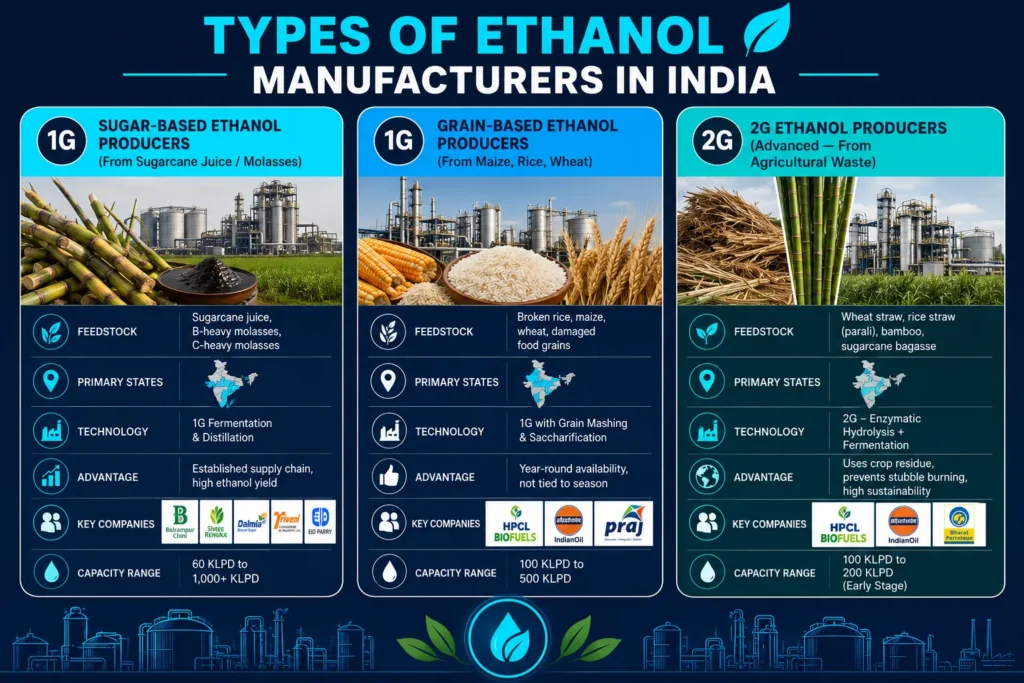
Sugar-Based Ethanol Producers (1G — from Sugarcane Juice/Molasses)
| Parameter | Details |
| Feedstock | Sugarcane juice, B-heavy molasses, C-heavy molasses |
| Primary States | Uttar Pradesh, Maharashtra, Karnataka, Tamil Nadu, Gujarat |
| Technology | First Generation (1G) fermentation and distillation |
| Advantage | Established supply chain, high ethanol yield from sugarcane |
| Key Companies | Balrampur Chini, Shree Renuka Sugars, Dalmia Bharat Sugar, Triveni Engineering, EID Parry |
| Capacity Range | 60 KLPD to 1,000+ KLPD per company |
Grain-Based Ethanol Producers (from Maize, Rice, Wheat)
| Parameter | Details |
| Feedstock | Broken rice, maize, wheat, damaged food grains |
| Primary States | Punjab, Haryana, Madhya Pradesh, Bihar, Uttar Pradesh |
| Technology | First Generation (1G) with grain mashing and saccharification |
| Advantage | Year-round availability, not tied to sugarcane season |
| Key Companies | HPCL Biofuels, Indian Oil (BPCL JV), Praj Industries clients |
| Capacity Range | 100 KLPD to 500 KLPD |
2G Ethanol Producers (Advanced — from Agricultural Waste)
| Parameter | Details |
| Feedstock | Wheat straw, rice straw (parali), bamboo, sugarcane bagasse |
| Primary States | Punjab, Haryana, Odisha, Maharashtra |
| Technology | Second Generation (2G) — enzymatic hydrolysis + fermentation |
| Advantage | Uses crop residue, prevents stubble burning, high sustainability |
| Key Companies | HPCL Biofuels (Bathinda), IOCL 2G Panipat, Bharat Petroleum (Bargarh) |
| Capacity Range | 100 KLPD to 200 KLPD (early stage) |
Table of Comparison: Top Ethanol Companies
| Company | Capacity (KLPD) | Feedstock Type | No. of Plants | Stock Listed | Key Strength |
| Balrampur Chini Mills | 1,100 | Sugarcane/Molasses | 10 | BSE/NSE | Largest integrated sugar-ethanol player |
| Triveni Engineering | 660 | Sugarcane/Molasses | 8 | BSE/NSE | Fastest capacity expansion |
| Shree Renuka Sugars | 750 | Sugarcane/Molasses | 6 | BSE/NSE | Pan-India + global sugar link |
| Dalmia Bharat Sugar | 520 | Sugarcane/Molasses | 4 | BSE/NSE | Strong UP presence |
| EID Parry | 340 | Sugarcane | 5 | BSE/NSE | South India leader |
| Praj Industries | Technology provider | Multiple | 30+ (built) | BSE/NSE | Technology & engineering |
| HPCL Biofuels | 400 (grain+2G) | Grain + Parali | 3 | Subsidiary of HPCL | PSU biofuel pioneer |
| Uttam Sugar Mills | 320 | Sugarcane | 4 | BSE | Integrated UP mill |
| Bannari Amman Sugars | 200 | Sugarcane | 3 | BSE/NSE | Strong TN/Karnataka base |
| Magadh Sugar & Energy | 300 | Sugarcane | 3 | BSE | Bihar growth story |
| Globus Spirits | 500+ | Grain | 5 | BSE/NSE | Grain ethanol specialists |
| India Glycols | 250 | Molasses/Grain | 3 | BSE/NSE | Diversified chemical-ethanol |
| DCM Shriram | 250 | Sugarcane | 3 | BSE/NSE | Strong North India play |
| Avadh Sugar & Energy | 200 | Sugarcane | 3 | BSE | Emerging UP player |
| IOCL 2G Panipat | 100 | Rice Straw | 1 | Subsidiary of IOCL | Flagship 2G plant |
Top 15 Ethanol Manufacturing Companies in India (2026)
1. Balrampur Chini Mills Ltd
| Parameter | Details |
| Founded | 1975 |
| HQ/State | Kolkata / Uttar Pradesh |
| Production Capacity (KLPD) | 1,100 KLPD |
| Feedstock | Sugarcane juice, B-heavy & C-heavy molasses |
| No. of Distilleries | 10 |
| Stock Symbol | BALRAMCHIN |
| Key Highlights | Largest sugar-ethanol company in India; strong EBP beneficiary |
| Website | www.balrampurchini.com |
Balrampur Chini Mills is the no.1 brand of ethanol manufacturing firms in India. It has been at the forefront, with a combined distillation capacity of 1,100 KLPD from 10 plants in Uttar Pradesh, in the ethanol revolution of India. The company’s capacity to produce ethanol increased by threefold between 2018 and 2024, with significant capacity expansion efforts. The all-in-one system—where sugarcane is procured, sugar is produced and ethanol is distilled in the same premises—is the most cost-efficient in the industry, setting the standard for all.
2. Triveni Engineering & Industries Ltd

| Parameter | Details |
| Founded | 1932 |
| HQ/State | Noida / Uttar Pradesh |
| Production Capacity (KLPD) | 660 KLPD |
| Feedstock | Sugarcane juice, molasses |
| No. of Distilleries | 8 |
| Stock Symbol | TRIVENI |
| Key Highlights | Fastest growing ethanol capacity in UP; strong balance sheet |
| Website | www.triveniengineering.com |
Triveni Engineering is one of the fastest growing ethanol production firms in India and is widely recognized among the top ethanol manufacturing companies in India. It is operating 8 distilleries all within the sugarcane heartland of Uttar Pradesh and is scaling up its capacity from less than 200 KLPD in 2019 to 660 KLPD in 2026. The company’s stated target of 1000KLPD by 2027 is supported by a strong balance sheet which is almost debt free. Triveni’s strong track record of managing assets transparently and its decision to invest its capital in a very rational manner continues to earn high marks from institutional investors on the stock exchanges of India.
3. Shree Renuka Sugars Ltd
| Parameter | Details |
| Founded | 1995 |
| HQ/State | Belagavi / Karnataka, Maharashtra |
| Production Capacity (KLPD) | 750 KLPD |
| Feedstock | Sugarcane juice, molasses |
| No. of Distilleries | 6 |
| Stock Symbol | RENUKA |
| Key Highlights | Wilmar International-backed; major South & West India presence |
| Website | www.renukasugars.com |
Shree Renuka Sugars is one of the most globalised ethanol manufacturing companies in India today. It has world-class distillation technology and working capital management with the support of Singapore based agri-giant Wilmar International in its six plants spread across Karnataka and Maharashtra. Renuka taps two of the most productive sugarcane belts in India with its combined capacity of 750 KLPD. This has been made possible by its Wilmar partnership, which has helped to accelerate technology upgrades and put in place more financial discipline, ensuring it becomes an extremely competitive long-term supplier in India’s Ethanol Blending Programme.
4. Dalmia Bharat Sugar & Industries Ltd
| Parameter | Details |
| Founded | 1994 |
| HQ/State | New Delhi / Uttar Pradesh |
| Production Capacity (KLPD) | 520 KLPD |
| Feedstock | Sugarcane molasses, juice |
| No. of Distilleries | 4 |
| Stock Symbol | DALMIASUG (BSE/NSE) |
| Key Highlights | Part of Dalmia Group; rapid distillery expansion in eastern UP |
| Website | www.dalmiabharat.com |
With the strength of Dalmia Group, Dalmia Bharat Sugar is fast emerging as one of the top ethanol manufacturing companies of India and is often featured in the list of ethanol manufacturing companies in India. It has four big distilleries in eastern Uttar Pradesh located in one of India’s most dense sugarcane growing areas which guarantees a steady supply of feedstock.
The company has expanded its ethanol production to 520 KLPD and has a definite ethanol capacity expansion path of 800 KLPD in the next five years. The smaller standalone distillery competitors have no real speed uplift because they do not have access to low cost group capital like Dalmia Bharat Sugar.
5. EID Parry (India) Ltd
| Parameter | Details |
| Founded | 1788 |
| HQ/State | Chennai / Tamil Nadu |
| Production Capacity (KLPD) | 340 KLPD |
| Feedstock | Sugarcane juice, molasses |
| No. of Distilleries | 5 |
| Stock Symbol | EIDPARRY (BSE/NSE) |
| Key Highlights | Murugappa Group company; South India’s oldest ethanol producer |
| Website | www.eidparry.com |
EID Parry is one of the Indian oldest and most reputed ethanol manufacturers, which started its work in 1788 under Murugappa Group. It has five distilleries in Tamilnadu, AP and Karnataka and has a total capacity of 340 KLPD in south India. In addition to its production scale, EID Parry is recognized for its comprehensive farmer involvement programmes, sustainable farming practices and process efficiency. It has a long track record of paying dividends and a culture of strong governance, making it a trusted way for long-term investors to become investors.
6. Praj Industries Ltd

| Parameter | Details |
| Founded | 1985 |
| HQ/State | Pune / Maharashtra |
| Production Capacity (KLPD) | Technology company (built 30+ plants) |
| Feedstock | All types (technology provider) |
| No. of Distilleries | 30+ built for clients |
| Stock Symbol | PRAJIND (BSE/NSE) |
| Key Highlights | India’s leading biofuel technology & engineering company |
| Website | www.praj.net |
Praj Industries is actually holding a special place and a unique precedence among the ethanol manufacturing companies in India and is considered as the engineering as well as technology core of the entire biofuel sector of India. Instead, Praj has been working on the design and setting up of more than 30 distilleries in India and has exported its biofuel technology to over 100 countries.
It uses its proprietary ethanol technology ‘Enfinity 2G’ in a number of government-backed advanced biofuel projects. Praj’s debt balance sheet will be near zero, its order book is global and the company has a commanding presence in the domestic market in 2026.
7. HPCL Biofuels Ltd
| Parameter | Details |
| Founded | 2009 |
| HQ/State | Patna / Bihar, Punjab |
| Production Capacity (KLPD) | 400 KLPD |
| Feedstock | Grain, sugarcane, rice straw (2G) |
| No. of Distilleries | 3 |
| Stock Symbol | Subsidiary of HPCL |
| Key Highlights | PSU pioneer in 2G ethanol; grain-based production leader |
| Website | www.hpclbiofuels.in |
HPCL Biofuels is the most strategically important public sector company in India for ethanol manufacturing. It is a wholly owned subsidiary of Hindustan Petroleum Corporation and has grain-based plants in Bihar and India’s pioneering 2G ethanol plant, Bathinda, Punjab that converts parali (rice straw) into clean fuel. This is one of the most diversified models of a grain based and agricultural waste based production, which helps HPCL Biofuels in producing its Biofuels. It directly mitigates the issue of stubble burning in Punjab and generates sustainable ethanol, thus helping develop the country’s energy and environmental security.
8. Globus Spirits Ltd
| Parameter | Details |
| Founded | 1992 |
| HQ/State | Gurugram / Haryana, Rajasthan, MP, WB |
| Production Capacity (KLPD) | 500+ KLPD |
| Feedstock | Grain (broken rice, maize, wheat) |
| No. of Distilleries | 5 |
| Stock Symbol | GLOBUSSPR (BSE/NSE) |
| Key Highlights | India’s leading grain-based ethanol producer outside sugar sector |
| Website | www.globusspirits.com |
Globus Spirits is India’s biggest independent Grain Based Ethanol Producer (GBEP) and is counted among the top ethanol manufacturing companies in India, with 5 distilleries in Haryana, Rajasthan, MP and West Bengal. Its total capacity is more than 500 KLPD, capable of processing broken rice, maize and wheat which are available throughout the year as compared to seasonal sugarcane.
This continuous production cycle provides Globus with a great operational advantage. It provides bulk fuel ethanol to OMCs through long term EBP contracts. It is also spread out geographically and as far as feeds are concerned, making it immune from price volatility of a single crop and to regional disruptions of feed supplies.
9. India Glycols Ltd

| Parameter | Details |
| Founded | 1983 |
| HQ/State | Noida / Uttar Pradesh |
| Production Capacity (KLPD) | 250 KLPD |
| Feedstock | Molasses, grain |
| No. of Distilleries | 3 |
| Stock Symbol | INDIAGLYCO (BSE/NSE) |
| Key Highlights | Specialty chemical leader with integrated ethanol production |
| Website | www.indiaglycols.com |
India Glycols has one of the most advanced ethanol production facilities in India at Kashipur, Uttar Pradesh with 250 KLPD capacity and is often included in the list of ethanol manufacturing companies in India. Unlike distilleries that are dedicated to ethanol generation, the key differentiator is its downstream integration – ethanol produced here is used in a high value specialty chemicals chain such as ethylene oxide, glycols and surfactants.
This becomes a dual use system, as India Glycols gets better realisations on ethanol production than others who sell ethanol only to OMCs. Being a combination of a biofuels and specialty chemicals firm, it is one of the most defensively structured ethanol companies in India.
10. DCM Shriram Ltd

| Parameter | Details |
| Founded | 1889 |
| HQ/State | New Delhi / Uttar Pradesh |
| Production Capacity (KLPD) | 250 KLPD |
| Feedstock | Sugarcane juice, molasses |
| No. of Distilleries | 3 |
| Stock Symbol | DCMSHRIRAM (BSE/NSE) |
| Key Highlights | Integrated sugar-chemical-ethanol group with strong UP roots |
| Website | www.dcmshriram.com |
DCM Shriram is amongst the oldest and diversified industrial conglomerates in India, having three integrated distilleries in Uttar Pradesh for producing 250 KLPD of fuel ethanol and industrial ethanol. Its sugar and ethanol businesses are very closely coupled, and the conversion of molasses to ethanol can be done at the same sites.
This generates value retention because the company produces ethanol for the oil marketing companies under EBP contracts and for its chemicals division. With its clean and green energy strategy, proven track record of profitability and disciplined deployment of capital, DCM Shriram is a trustworthy long-term player in the Indian biofuel market.
11. Uttam Sugar Mills Ltd

| Parameter | Details |
| Founded | 1993 |
| HQ/State | Muzaffarnagar / Uttar Pradesh |
| Production Capacity (KLPD) | 320 KLPD |
| Feedstock | Sugarcane, molasses |
| No. of Distilleries | 4 |
| Stock Symbol | UTTAMSUGAR |
| Key Highlights | Strong western UP footprint; growing ethanol share of revenue |
| Website | www.uttamsugar.in |
Uttam Sugar Mills is a consistent growth company in the field of ethanol production and is emerging among the ethanol manufacturing companies in India, based in western Uttar Pradesh’s sugar belt, with 4 ethanol distilleries with a total capacity of 320 KLPD. The interesting thing about Uttam Sugar in 2026 is that the pattern of revenues has changed drastically, ethanol has contributed to the company’s revenue much more than sugar, which has now made the margins more stable and predictable.
The company is aggressively making investments in additional capacity to take advantage of the government announced ethanol price increases and increase supply commitments under the EBP framework.
12. Bannari Amman Sugars Ltd
| Parameter | Details |
| Founded | 1983 |
| HQ/State | Coimbatore / Tamil Nadu, Karnataka |
| Production Capacity (KLPD) | 200 KLPD |
| Feedstock | Sugarcane juice, molasses |
| No. of Distilleries | 3 |
| Stock Symbol | BANARISUG (BSE/NSE) |
| Key Highlights | Leading South India integrated sugar-ethanol producer |
| Website | www.bannarisu.com |
Bannari Amman Sugars is the leading integrated ethanol manufacturer in South India’s Deccan sugarcane belt with three distilleries in Tamil Nadu and Karnataka with a capacity of 200 KLPD. Unlike the single-season North Indian mills, South Indian sugarcane varieties enable them to run their mills twice each year, resulting in more regular ethanol production for Bannari Amman.
Operational efficiency, good relationships with the farming communities and a long history of acceptable dividends are all hallmarks of the company’s reputation. It continues to be an integral part of the southern ethanol supply chain.
13. Magadh Sugar & Energy Ltd

| Parameter | Details |
| Founded | 2006 |
| HQ/State | Patna / Bihar |
| Production Capacity (KLPD) | 300 KLPD |
| Feedstock | Sugarcane, molasses |
| No. of Distilleries | 3 |
| Stock Symbol | MAGADSUGAR (BSE) |
| Key Highlights | Fastest growing ethanol company in Bihar; EBP beneficiary |
| Website | www.magadhsugar.com |
Magadh Sugar & Energy is an indigenous powerhouse of Bihar, which is quietly carving out its niche in the Indian biofuel market and is emerging among the top ethanol manufacturing companies in India. The company has been able to take advantage of the Bihar government’s proactive approach towards investment in distilleries and the historically underutilised sugarcane belt in the State with three distilleries and a total capacity of 300 KLPD. With favourable central EBP policies and a high feedstock base, Magadh Sugar has posted attractive revenue and profit growth since 2020.
Magadh Sugar has been performing well in terms of revenue and profit since 2020, supported by the favourable central EBP policies and a high feedstock base. It’s one of the most closely monitored emerging ethanol manufacturers with long-term growth potential among mid-cap investors monitoring the ethanol industry.
14. Avadh Sugar & Energy Ltd
| Parameter | Details |
| Founded | 2015 |
| HQ/State | Lucknow / Uttar Pradesh |
| Production Capacity (KLPD) | 200 KLPD |
| Feedstock | Sugarcane, molasses |
| No. of Distilleries | 3 |
| Stock Symbol | AVADHSUGAR (BSE) |
| Key Highlights | Youngest integrated sugar-ethanol company; strong growth trajectory |
| Website | www.avadhsugar.com |
Avadh Sugar & Energy is one of the youngest and most vibrant ethanol manufacturing companies of Uttar Pradesh which started operation in 2015 with a clear vision of “Integrated Sugar-Ethanol Operation”. It has already constructed three distilleries of 200 KLPD in central Uttar Pradesh and hopes to reach 400 KLPD by 2027 despite being a relatively young entity. Avadh Sugar has performed well and is one of the most exciting growth stories in the sugar industry with seasoned management, robust government support (under the EBP) and a lean cost structure.
15. IOCL 2G Ethanol Plant, Panipat

| Parameter | Details |
| Founded (Plant) | 2022 |
| HQ/State | Panipat / Haryana |
| Production Capacity (KLPD) | 100 KLPD |
| Feedstock | Rice straw (paddy residue / parali) |
| No. of Distilleries | 1 |
| Stock Symbol | Subsidiary of Indian Oil Corporation |
| Key Highlights | India’s first commercial 2G ethanol plant; landmark in clean energy |
| Website | www.iocl.com |
IOCL 2G Ethanol Plant, Panipat is not just an ethanol manufacturing firm but a symbol of clean energy in the country. It was commissioned by Indian Oil Corporation in 2022 with a scale of 100 KLPD of fuel grade ethanol and scaled up till 2026 using the paddy straw generated from the nearby farms in Punjab. This plant has the capability to convert parali, the major contributor of seasonal air pollution in Delhi, into clean fuel simultaneously addressing two major challenges in the country. It is the template for the next generation of advanced, waste-based ethanol production in India, which is sustainable.
State-wise Distribution of Ethanol Manufacturing in India
| Company | State | Capacity (KLPD) | Feedstock |
| Balrampur Chini Mills | Uttar Pradesh | 1,100 | Sugarcane/Molasses |
| Triveni Engineering | Uttar Pradesh | 660 | Sugarcane/Molasses |
| Dalmia Bharat Sugar | Uttar Pradesh | 520 | Sugarcane/Molasses |
| Shree Renuka Sugars | Maharashtra, Karnataka | 750 | Sugarcane/Molasses |
| EID Parry | Tamil Nadu, AP | 340 | Sugarcane |
| Globus Spirits | Haryana, Rajasthan, MP, WB | 500+ | Grain |
| HPCL Biofuels | Bihar, Punjab | 400 | Grain, 2G |
| India Glycols | Uttar Pradesh | 250 | Molasses, Grain |
| DCM Shriram | Uttar Pradesh | 250 | Sugarcane |
| Uttam Sugar Mills | Uttar Pradesh | 320 | Sugarcane |
| Bannari Amman Sugars | Tamil Nadu, Karnataka | 200 | Sugarcane |
| Magadh Sugar & Energy | Bihar | 300 | Sugarcane |
| Avadh Sugar & Energy | Uttar Pradesh | 200 | Sugarcane |
| IOCL 2G Panipat | Haryana | 100 | Rice Straw |
| Praj Industries | Maharashtra (HQ, pan-India) | Tech Provider | All types |
Comparison: Top Ethanol Companies by Key Metrics
| Company | Capacity (KLPD) | Feedstock | No. of Plants | Listed | Approx Revenue (FY25) | Sustainability Rating |
| Balrampur Chini | 1,100 | Sugarcane | 10 | Yes | ₹5,500 Cr+ | High |
| Triveni Engineering | 660 | Sugarcane | 8 | Yes | ₹4,200 Cr+ | High |
| Shree Renuka | 750 | Sugarcane | 6 | Yes | ₹9,000 Cr+ | Medium-High |
| Dalmia Bharat Sugar | 520 | Sugarcane | 4 | Yes | ₹1,800 Cr+ | Medium-High |
| EID Parry | 340 | Sugarcane | 5 | Yes | ₹5,200 Cr+ | High |
| Globus Spirits | 500+ | Grain | 5 | Yes | ₹2,500 Cr+ | Medium |
| HPCL Biofuels | 400 | Grain/2G | 3 | No (PSU sub) | N/A | Very High |
| India Glycols | 250 | Molasses/Grain | 3 | Yes | ₹3,800 Cr+ | Medium |
| Praj Industries | Tech | Multi | 30+ built | Yes | ₹2,200 Cr+ | Very High |
| IOCL 2G Panipat | 100 | Rice Straw | 1 | No (PSU sub) | N/A | Very High |
Investment Outlook: Top Ethanol Stocks to Watch in 2026
| Company | Stock Symbol | 52-Week Trend | EBP Revenue Share | Expansion Planned | Analyst View |
| Balrampur Chini | BALRAMCHIN | Uptrend | 45%+ of revenue | Yes — 1,400 KLPD target | Buy/Accumulate |
| Triveni Engineering | TRIVENI | Strong uptrend | 40%+ | Yes — 1,000 KLPD | Buy |
| Praj Industries | PRAJIND | Sideways-bullish | ~60% of order book | Global 2G expansion | Strong Buy |
| Globus Spirits | GLOBUSSPR | Recovery phase | 70%+ | Yes — grain capacity | Moderate Buy |
| EID Parry | EIDPARRY | Steady | 30%+ | Yes | Hold/Accumulate |
| India Glycols | INDIAGLYCO | Moderate | 35%+ | Moderate | Hold |
Key Financial Metrics: ROCE, ROE, Revenue Growth
- Since 2020, Balrampur Chini has maintained ROCE exceeding 15% and ROE exceeding 18% thanks to the revenue growth in ethanol.
- The ROCE of Triveni Engineering has risen from 8% for FY20 to more than 20% for FY25, mainly owing to additions in distillery capacity.
- Praj Industries has an almost zero debt balance sheet and ROE more than 22, which is one of the cleanest ethanol-related balance sheets in the market.
- In FY22, grain-based ethanol supply contracts led to strong revenue growth of 20%+ CAGR for Globus Spirits.
- Companies with higher revenue from ethanol are trading at a significant premium valuation as compared to pure sugar mills.
- For most ethanol producers listed on the stock exchanges, the price revisions to EBP in 2025-26 are positive by 200-400 Basis Point (BP) on EBITDA margin.
Risks: Feedstock Price Volatility, Policy Dependency
- The government fixes prices for sugarcane (FRP+SAP), but sometimes delay in remuneration to farmers can affect the availability of sugarcane for distilleries.
- Prices of maize and rice are market driven and can surge during monsoon failure and export policy changes and put pressure on the ethanol margin of maize based ethanol.
- The entire sector is highly sensitive towards the government notified ethanol procurement prices as any reduction in the price will have a significant effect on profitability of the sector.
- When prices for sugar are reached, the mills would like to divert sugar production to ethanol production and consequently result in shortage for the OMCs.
- Sugarcane requires a lot of water which is a long-term climate threat in drought-stricken areas such as Maharashtra and Karnataka.
- Grain-based producer policy changes (such as suspension of rice or wheat ethanol diversion in 2023) may affect producers in a blink of an eye.
- 2G ethanol is still in the early stages of commercialisation; companies with big investments in capex for advanced biofuels may be affected if commercialisation is delayed.
Conclusion
The ethanol industry is among the most interesting and promising industrial stories in India’s history in 2026. The ethanol-producing giants profiled here are a wide-ranging, rapidly evolving and even much more strategic industry, one that affects agricultural production, energy security, climate, and rural employment simultaneously. Ethanol plant manufacturers are laying the groundwork for a cleaner and more self-sufficient India, from the sugarcane rich plains of Uttar Pradesh, to the grain belts of Haryana, and the paddy fields of Bihar.
From multi-year investment opportunities to tracking industry progress for policy makers, or to researching the market to enter the business, this sector presents unparalleled opportunities. The best chapters of India’s ethanol story are yet to be written with E20 achieved and E100 around the corner.
FAQs
What is the name of India’s Largest ethanol production company?
Balrampur Chini Mills is the largest ethanol distilling company in India with 10 ethanol plants having a distillation capacity of more than 1100 KLPD in Uttar Pradesh.
India is currently at 8% blending rate for ethanol in 2026.
The government’s original target for India to become E20 (20% ethanol blending in petrol) is now 2025-26. The country is now trying to achieve increased blending rates and E100 flex-fuel introduction.
In India, ethanol is produced from which are the primary feedstocks?
The main feedstocks are 2G advanced (agricultural residues such as rice straw and wheat straw), 1G grain-based (maize and wheat), 1G sugar-based (B-heavy molasses, C-heavy molasses and sugarcane juice), and broken rice.
What is the difference between 2G ethanol and 1G ethanol in India?
Ethanol prepared by the traditional fermentation process using edible feedstocks, such as sugarcane and grains, is referred to as a first generation (1G) ethanol. Second Generation (2G) ethanol is produced using non-edible agricultural waste such as paddy straw and bagasse using more advanced enzymatic processes which are more sustainable and will not compete with food supplies.
Ethanol is produced in India by basically all the states except Gujarat.
Uttar Pradesh is the biggest ethanol producing state followed by Maharashtra, Karnataka, Bihar, Haryana, Tamilnadu and Madhya Pradesh respectively. India’s total ethanol production capacity is almost 40% with UP.