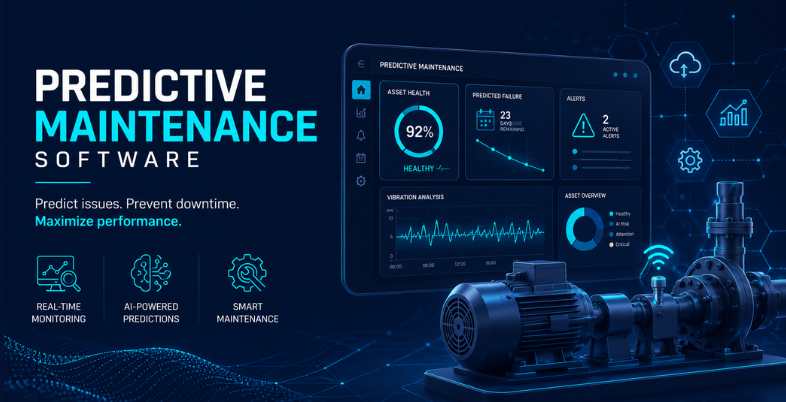
Manufacturing companies are evolving rapidly — as are the methods in which these companies care for their machines. Now, a breakdown will not come out of the blue. Smart companies in 2026 are switching to a predictive maintenance tool to be one step ahead of equipment failures. The AI platforms are able to predict failures based on real-time sensor readings, maintenance information and machine behavior patterns, all in the interest of saving money, time and headache. For every scale of factory, plant or growing small to medium business enterprise, there is a predictive maintenance solution that is built just for you.
The worldwide market for predictive maintenance is set to hit the rocket speed of $91 billion by 2033. It’s no surprise given that the cost of unplanned downtime to industrial manufacturers is estimated to be $50 billion per year. The correct predictive maintenance solution can reduce downtime by 30-50%, reduce maintenance costs by up to 25% and return an ROI of 10-30 times in the first 12-18 months.
Explore the 10 top predictive maintenance software solutions of 2026, including their functions, costs, AI capabilities and IoT integration, to help you choose the best option for your business.
What Is Predictive Maintenance Software?
Predictive maintenance software (PdM) is a technology-driven solution that leverages data analytics and AI to keep an eye on the actual condition of machines and equipment in real time through IoT sensors. Predictive maintenance tool, rather than waiting for a machine to fail or adhere to a strict schedule of maintenance, is always scanning for warning signs such as unusual vibrations, higher temperatures, electrical issues or performance loss and notifying your team to take action before the failure occurs. It’s like a doctor performing a health check regularly on your machines — but on a 24/7 basis.
Predictive maintenance tool is designed to gather data from sensors on the Internet of Things (IoT) attached to machinery, provide estimates of failure probabilities, predict failure timing, and offer the owner advice on actions to take to reduce future failures. The top platforms also connect with your current CMMS (Computerized Maintenance Management System) software to automatically trigger work orders when risk limits are exceeded, ensuring that predictions result in maintenance work — instead of some unpaid attention to the dashboard.
Why Predictive Maintenance Matters: ROI & Business Case
- Minimises unwanted downtime by 30-50% and maintains production lines and revenue.
- Saves up to 18-25% on maintenance expenses by eliminating unnecessary preventative maintenance tasks
- Avoids costly failures and extends asset life by diagnosing and fixing issues before they cause major problems
- One of the best investments in industrial technologies with a 10-30x return within 12-18 months.
- Enhances the worker’s safety by identifying unsafe machine conditions before the risk of injury to the worker can occur
- Lowers parts inventory expenses due to ordering parts as required rather than as if they were “just in case”
- Improves Overall Equipment Effectiveness (OEE) — some manufacturers saw the benefits of OEE improvements of 60-80%.
- Automates documentation of all maintenance activities, supports compliance and audit trails
- Supplies more intelligent capital planning, forecasting end-of-life months or years ahead of time
- Provides competitive edge — 65% of companies will have AI for maintenance by end of 2026
Key Features to Look for in Predictive Maintenance Software
- Condition monitoring at real time using IoT Sensors (Vibration, Temperature, Pressure, Current)
- Probability scores and time-to-failure predictions based on AI/ML-failure prediction.
- Anomaly detection which can detect abnormalities even if they have no failure record.
- Not only automatic work order input, but also automatic work order generation based on risk thresholds.
- When your CMMS system is integrated with predictions, it makes it easy to seamlessly connect them with maintenance tasks.Integrating your CMMS with predictions makes it easy to connect them with maintenance tasks.
- Mobile access to make sure techs are alerted and able to update tasks at the moment.
- Easy-to-understand asset health visualizations on customizable dashboards
- The digital twin features for simulation and scenario modelling.
- Enterprises that operate multiple sites – the multi-site management.
- ERP and SCADA integration for business and operational systems and maintenance integration.
- Scalable architecture that can expand as your organization grows larger and larger in terms of the amount of data and assets.
- Flexible deployment – cloud, on-premise or hybrid to fit your IT environment
Top 10 Predictive Maintenance Software Platforms — Comparison Table
| Tool | Best For | Key Features | AI/ML | IoT Support | Pricing | Free Trial | Deployment |
| IBM Maximo | Enterprise Asset Management | EAM, APM, digital twin, health scoring | Yes Advanced | Yes Full | From $3,150/mo | Yes Yes | Cloud/On-prem/Hybrid |
| Siemens MindSphere | Industrial IoT | Open IoT OS, edge AI, anomaly detection | Yes Advanced | Yes Full | Custom pricing | Yes Demo | Cloud/Edge |
| Augury | Machine Health Intelligence | Vibration + acoustics AI, fleet-wide insights | Yes Advanced | Yes Full | $50K+/year | Yes Demo | Cloud |
| Tractian | Manufacturing Plants | Smart Trac sensors + AI diagnostics + CMMS | Yes Advanced | Yes Full | From $60/user/mo | Yes Yes | Cloud |
| Limble CMMS | SMBs | Work orders, PM scheduling, AI resource planning | Yes Developing | Yes Partial | Free–$69/user/mo | Yes Yes | Cloud |
| Uptake | AI-Driven Analytics | Industrial AI for mining, energy, transport | Yes Advanced | Yes Full | Custom pricing | Yes Demo | Cloud |
| GE Predix | Energy & Utilities | Digital twin, APM, failure mode analysis | Yes Advanced | Yes Full | Custom pricing | Yes Demo | Cloud/Hybrid |
| UpKeep | Mobile-First Teams | Mobile CMMS, Nova AI, sensor integration | Yes Developing | Yes Partial | $35–$55/user/mo | Yes Yes | Cloud |
| Rockwell FactoryTalk | Discrete Manufacturing | PLC-native, DataMosaix, condition monitoring | Yes Developing | Yes Full | From $45/user/mo | Yes Demo | On-prem/Cloud |
| INSIA.ai | No-Code Users | No-code AI, real-time insights, easy setup | Yes AI-native | Yes Yes | Custom pricing | Yes Yes | Cloud |
Top 10 Predictive Maintenance Software Platforms 2026
1. IBM Maximo — Best for Enterprise Asset Management
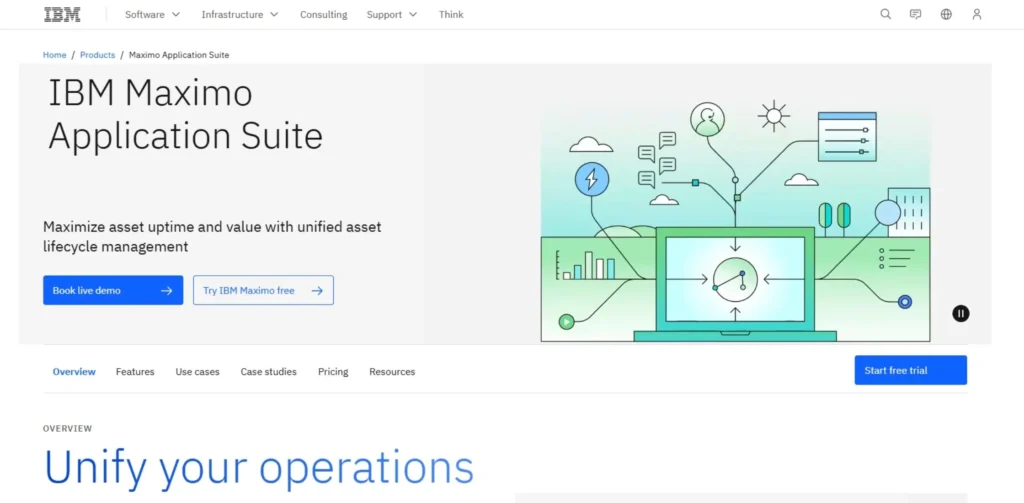
IBM Maximo Application Suite (MAS) is the benchmark solution in enterprise level predictive maintenance software. Designed for companies with thousands of critical assets from utilities to transportation, manufacturing to O&G, Maximo is one unified platform that combines enterprise asset management (EAM), asset performance management (APM) and predictive maintenance with AI.
It’s equipped with the Maximo Predict module that leverages AI and machine learning to determine health scores, estimate time-to-failure and identify anomaly trends at the individual asset level. One of the most flexible and comprehensive platforms available, it is offered on AWS, Azure, IBM Cloud or on-premise.
| Feature | Detail |
| Key Features | AI/ML health scoring, failure probability, digital twin, condition-based maintenance, lifecycle tracking |
| Pros | Extremely comprehensive; wide industry coverage; strong AI; flexible deployment |
| Cons | High cost; steep learning curve; requires technical expertise to customize |
| Pricing | From $3,150/month (Essentials); Standard from $7,272/month |
| Best For | Large enterprises in utilities, transportation, manufacturing, oil & gas |
| Website | ibm.com/products/maximo |
2. Siemens MindSphere — Best for Industrial IoT
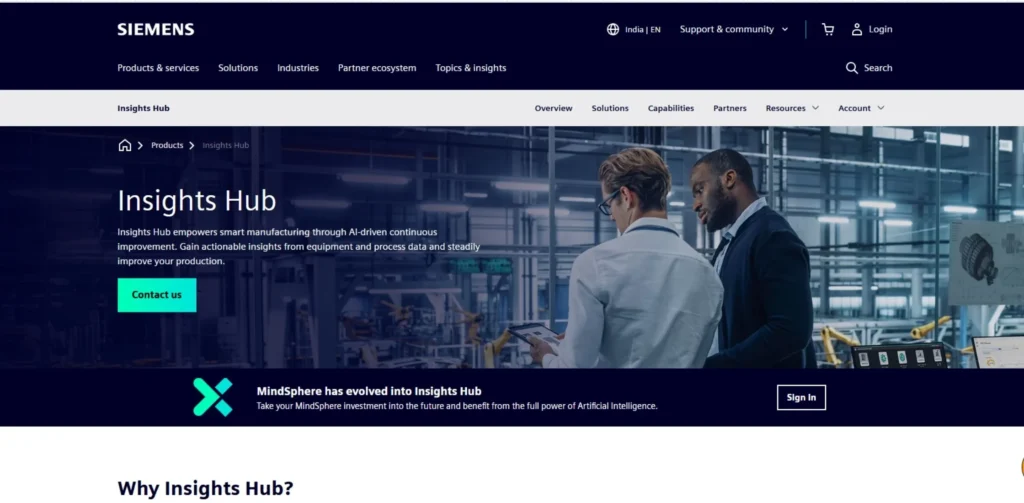
Siemens MindSphere is an open industrial IoT operating system that powers Siemens Xcelerator digital offering (digital products) in the cloud. It enables the machine, plant, system and product to be connected with the cloud and transforms raw operational data into predictive insights that act. The Predictive Service Assistance application of MindSphere is designed to identify anomalies in motors and equipment at an early stage of their life cycle, through the use of neural networks, detect patterns of faults (such as misalignment or bearing defect) and predict due dates for corrective action and recommend maintenance measures before unplanned downtime.
The ability to be integrated with Siemens SIMATIC hardware together with its edge AI capabilities, provides it with a distinctive edge in factory floor deployments. The ROI for customers is evident in as little as three months, thanks to fewer downtime issues and optimized maintenance activities.
| Feature | Detail |
| Key Features | Open IoT OS, edge AI, anomaly detection, unified data platform, proactive alerts |
| Pros | No additional sensors required; deep Siemens ecosystem integration; fast ROI |
| Cons | Best value within Siemens infrastructure; less flexible outside Siemens ecosystem |
| Pricing | Custom pricing (contact Siemens) |
| Best For | Smart factories, energy, and industrial companies using Siemens equipment |
| Website | siemens.com/mindsphere |
3. Augury — Best for Machine Health Intelligence
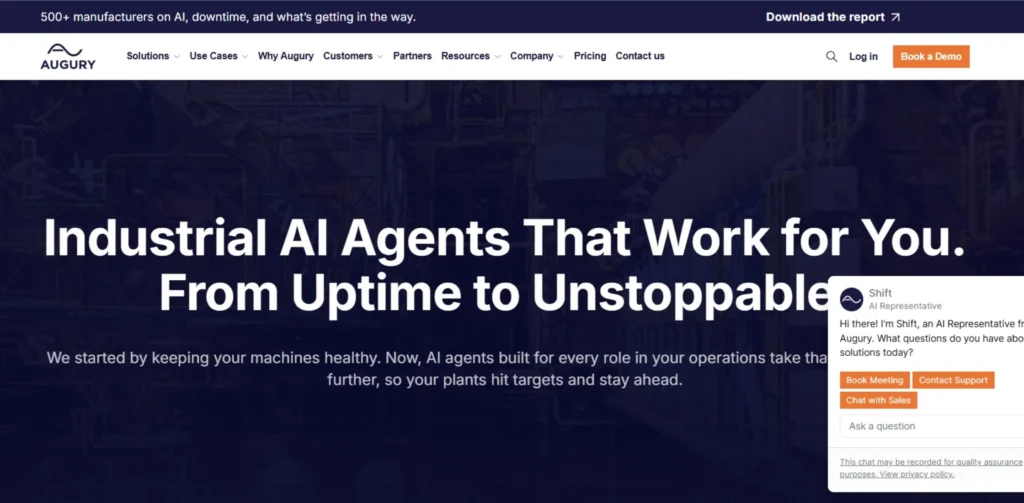
Augury’s purpose-built machine health platform, combines vibration analysis, acoustics and AI to provide deep insights into the health of rotating equipment. Unlike most CMMS software, Augury is specifically designed for machine diagnostics, providing asset maintenance teams with an overall view of pumps, motors, compressors, fans and conveyors across the entire fleet.
The AI models are based on millions of machine data points, making it possible to predict faults with high accuracy, such as bearing wear, imbalance, cavitation, lubrication problems and more. Another feature Augury has is “Reliability as a Service” which is where Augury’s own vibration experts take the time to review alerts and make their recommendations, which is an excellent choice for teams who don’t have their own vibration specialist. With its enterprise positioning, the price to begin with starts at $ 50,000 per annum.
| Feature | Detail |
| Key Features | Vibration + acoustic monitoring, AI diagnostics, fleet-wide health dashboard, expert review service |
| Pros | Extremely accurate fault detection; no PdM expertise needed in-house; strong ROI track record |
| Cons | High cost; best suited for large operations; limited CMMS capabilities natively |
| Pricing | $50,000+ per year (enterprise) |
| Best For | Large manufacturers needing deep machine health intelligence for rotating equipment |
| Website | augury.com |
4. Tractian — Best for Manufacturing Plants
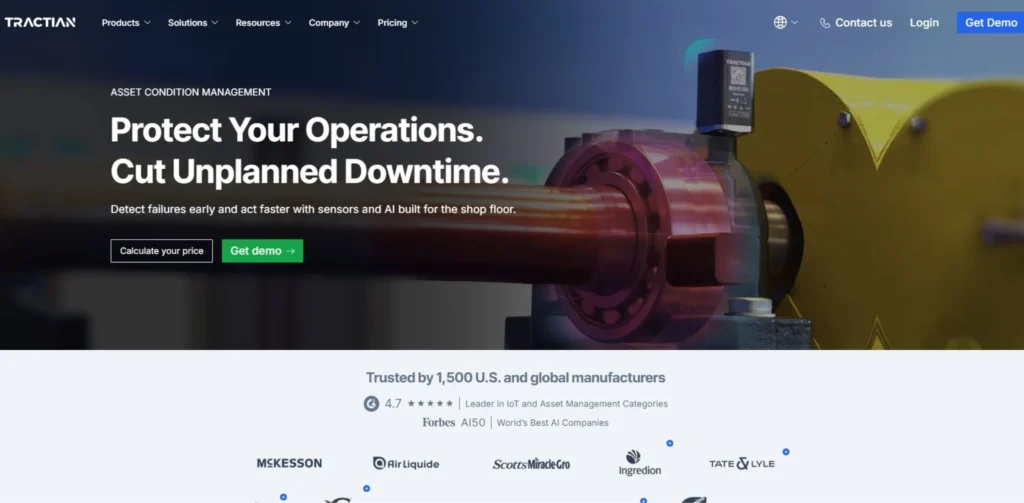
But Tractian is the only predictive maintenance software that is focused on industrial maintenance and brings together Tractian’s own Smart Trac IoT sensors with AI-powered diagnostics and a complete CMMS software system. The Smart Trac sensors measure vibration, temperature and RPMs on virtually any piece of machinery, and Tractian’s AI platform creates asset specific baselines, identifies changing faults and root causes — based on information from thousands of similar machines in its global database.
Tractian also monitors energy usage to identify mechanical problems and their resulting inefficiency. It’s December 2025 and it has partnered with Waites to provide machine health insights that are directly linked to automated predictive maintenance work orders, fully bridging the prediction-to-action gap.
| Feature | Detail |
| Key Features | Smart Trac IoT sensors, AI fault detection, root cause analysis, energy monitoring, CMMS integration |
| Pros | All-in-one hardware + software; no third-party sensors needed; strong AI accuracy |
| Cons | Premium pricing; best ROI at larger operations; requires sensor installation |
| Pricing | From $60/user/month (5-user minimum, billed annually) |
| Best For | Manufacturing plants with rotating equipment and multi-site operations |
| Website | tractian.com |
5. Limble CMMS — Best All-in-One for SMBs
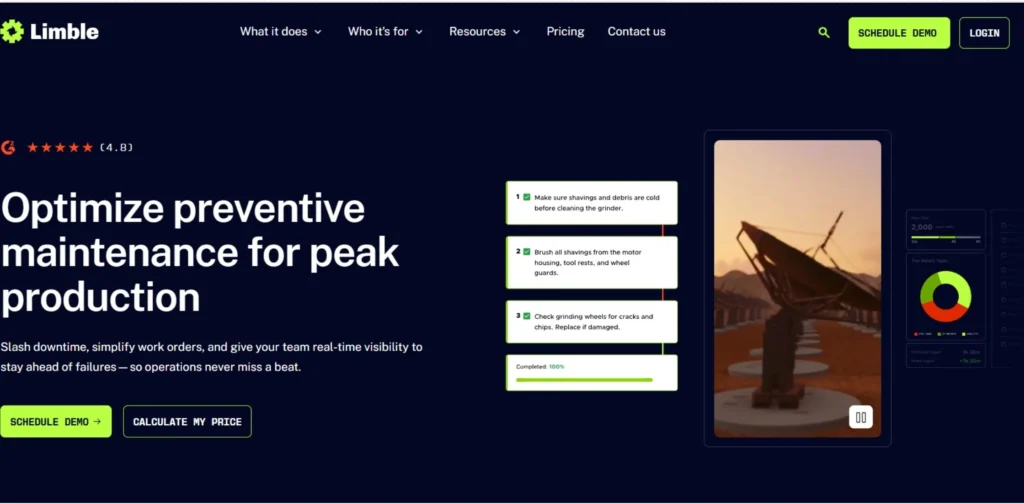
Limble CMMS is known as one of the most intuitive maintenance management software options available — and the new features for 2026 have launched real AI functionality for small and mid-market teams. It said that its upcoming release in the Winter of 2026 will add three key AI capabilities:
Resource Planning (AI-powered scheduling to ensure technicians are balanced), Asset Snap (image recognition to automatically generate asset records from your equipment photos) and Model Context Protocol (integration with enterprise systems and AI agents). Limble is available in 15+ languages, used by DHL, Holiday Inn, L’Oreal and Nike, and has raised $113.5M, the company’s valuation is $450M. It has a generous free plan that makes it available even to the smallest of teams.
| Feature | Detail |
| Key Features | Work order management, PM scheduling, asset tracking, AI resource planning, Asset Snap image recognition |
| Pros | Very easy to use; free plan available; strong mobile app; growing AI capabilities |
| Cons | Advanced AI only in Enterprise tier; less suited for complex multi-site industrial setups |
| Pricing | Free plan; Standard $28/user/mo; Premium+ $69/user/mo |
| Best For | SMBs and mid-market teams modernizing from manual maintenance processes |
| Website | limblecmms.com |
6. Uptake — Best for AI-Driven Predictive Analytics
Uptake is an industrial AI platform designed specifically for asset-intensive industries, such as mining, energy, transportation and heavy manufacturing. Its Uptake Fusion product provides predictive analytics using a comprehensive blend of real-time sensor information, operational context and machine learning algorithms that are trained on the patterns of failure prevalent in a specific domain.
Whereas a control-room data scientist can more easily make predictions, what makes Uptake unique is its ability to output the predictions in a human-readable way, in an actionable, on-the-floor recommendation. It is highly compatible with the existing OT and IT infrastructure, which is making it an excellent choice for businesses already using SCADA, DCS, or ERP solutions. There is strong interest in the verticals of mining, rail and energy.
| Feature | Detail |
| Key Features | Industrial AI analytics, plain-language recommendations, SCADA/ERP integration, failure pattern library |
| Pros | Strong in heavy industry verticals; actionable insights; no data science expertise needed by end users |
| Cons | Enterprise pricing model; less suited for SMBs; implementation requires professional services |
| Pricing | Custom pricing (enterprise) |
| Best For | Mining, energy, transportation, and heavy industrial companies |
| Website | uptake.com |
7. GE Predix — Best for Energy & Utilities

GE Predix APM (Asset Performance Management) is the world’s leading predictive maintenance software platform designed with the world’s most demanding industrial environments in mind: power generation, oil & gas, petrochemicals and aviation. Predix APM provides asset teams with deep visibility into the health of their equipment and remaining useful life through digital twin analytics, advanced failure mode analysis and prescriptive maintenance capabilities.
One such real-world application of its power is that when Intel deployed Predix APM in its chip manufacturing plants, it was able to predict failures ahead of time, pre-stage spare parts and cut the maintenance downtime from 3 to 4 days down to just a few hours. Predix APM has been shown to increase power generation uptime by up to 20% and save up to millions of dollars annually in O&M costs for power generation companies.
| Feature | Detail |
| Key Features | Digital twin analytics, APM, failure mode analysis, prescriptive maintenance, remaining useful life |
| Pros | Industry-leading for energy & utilities; proven ROI track record; strong digital twin capabilities |
| Cons | Complex implementation; enterprise pricing; primarily for large, asset-heavy organizations |
| Pricing | Custom pricing |
| Best For | Power generation, oil & gas, petrochemicals, and aviation companies |
| Website | ge.com/digital/predix |
8. UpKeep — Best for Mobile-First Teams
With the addition of its Nova AI engine, UpKeep has grown steadily to become a powerful predictive maintenance software platform, in a cloud-based, mobile-first CMMS. Built with simplicity in mind, UpKeep enables maintenance professionals to handle work orders, monitor assets, and receive alerts on their mobile devices — one of the most user-friendly solutions for maintenance teams that spend a lot of time in the field.
Nova AI’s AI integration complements the robust capabilities of UpKeep’s CMMS platform, and for those looking to move beyond calendar-based maintenance, the UpKeep Sensors hardware add-on offers real condition monitoring. For organizations seeking to begin their journey with AI in maintenance without the complexity or hefty enterprise costs, UpKeep is the perfect fit.
| Feature | Detail |
| Key Features | Mobile work orders, Nova AI, UpKeep Sensors integration, asset tracking, PM scheduling |
| Pros | Easiest mobile experience; quick setup; affordable entry pricing; growing AI features |
| Cons | Deeper AI only at higher tiers; 2-layer asset hierarchy limits industrial complexity |
| Pricing | From $35/user/month (Essential); advanced AI from $55/user/month |
| Best For | Facilities teams and light manufacturing looking for a mobile-first maintenance solution |
| Website | onupkeep.com |
9. Rockwell FactoryTalk — Best for Discrete Manufacturing
For manufacturers who use Rockwell PLC and Rockwell automation infrastructure, Rockwell Automation’s FactoryTalk suite of maintenance software is their preferred choice. It has developed its FactoryTalk DataMosaix software platform with industry in mind, offering context to the myriad of condition monitoring solutions that already exist on the factory floor at the level of the sensing and control.
Rockwell’s SIMATIC PLC family is fully integrated with FactoryTalk, with production monitoring, compliance management and maintenance workflow tools. For those who have significant investments in Rockwell hardware, the natively integrated value alone is huge despite its AI features being developed in higher tiers.
| Feature | Detail |
| Key Features | FactoryTalk DataMosaix, PLC-native integration, condition monitoring, production analytics, compliance |
| Pros | Best-in-class for Rockwell-heavy plants; strong industrial PM scheduling; native hardware integration |
| Cons | AI features less mature than pure-play PdM platforms; complex implementation; enterprise pricing |
| Pricing | From $45/user/month |
| Best For | Discrete manufacturers with deep Rockwell automation infrastructure |
| Website | rockwellautomation.com/factorytalk |
10. INSIA.ai — Best No-Code Option
As a no-code AI analytics platform, INSIA.ai is a new kid on the block in the field of predictive maintenance software and has carved a niche for itself as the solution for teams who don’t need data scientists or developers to utilize the power of machine learning. INSIA.ai integrates with existing industrial data sources, IoT sensors, ERP systems and provides real-time AI insights through intuitive and easy-to-configure dashboards (no coding required).
It’s especially favored by small-to-mid-sized manufacturers of emerging markets like India and is powering the manufacturing industry with affordable, accessible maintenance analytics powered by AI. It’s no-code, making implementation time and total cost of ownership a fraction of what they would be with code-based solutions.
| Feature | Detail |
| Key Features | No-code AI, real-time insights, IoT connectivity, ERP integration, customizable dashboards |
| Pros | No technical skills needed; fast setup; cost-effective; great for emerging market manufacturers |
| Cons | Less depth than enterprise platforms for complex multi-site setups; newer in market |
| Pricing | Custom pricing |
| Best For | SMBs and mid-market manufacturers needing no-code AI analytics without a data science team |
| Website | insia.ai |
Predictive Maintenance Software Comparison Table
| Tool | AI Maturity | IoT Sensors | Mobile App | Free Trial | Starting Price | Cloud | On-Prem | Primary Industry |
| IBM Maximo | 5/5 | Full | Yes | Yes | $3,150/mo | Yes | Yes | Utilities, Oil & Gas, Manufacturing |
| Siemens MindSphere | 5/5 | Full | Yes | Demo | Custom | Yes | Edge | Manufacturing, Energy |
| Augury | 5/5 | Full (own sensors) | Yes | Demo | $50K+/yr | Yes | No | Manufacturing, Pharma |
| Tractian | 5/5 | Full (own Smart Trac) | Yes | Yes | $60/user/mo | Yes | No | Manufacturing |
| Limble CMMS | 3/5 | Partial | Yes | Yes | Free | Yes | No | SMB, Facilities |
| Uptake | 4/5 | Full | Yes | Demo | Custom | Yes | No | Mining, Energy, Rail |
| GE Predix | 5/5 | Full | Yes | Demo | Custom | Yes | Hybrid | Power, Oil & Gas, Aviation |
| UpKeep | 3/5 | Partial (add-on) | Yes | Yes | $35/user/mo | Yes | No | Facilities, Light Mfg |
| Rockwell FactoryTalk | 3/5 | Full | Yes | Demo | $45/user/mo | Yes | Yes | Discrete Manufacturing |
| INSIA.ai | 4/5 | Yes | Yes | Yes | Custom | Yes | No | Manufacturing, Retail, SMB |
Implementation Guide: How to Deploy PdM Software in 5 Steps
- Step 1 — Define Your Goals & Critical Assets: Determine which machines are most expensive if they fail or downtime or have a very high failure rate. Begin with 3-5 critical assets and work up to monitoring more. Define and establish metrics (KPIs) (e.g., 6 month target of 20% reduction in unplanned downtime).
- Step 2 — Prepare Your Data Infrastructure: Audit and understand existing sensor coverage, historian data and CMMS records. The amount of historical data required for most AI models to establish accurate failure baselines is 6-12 months. Prior to passing your data into any predictive maintenance platform, clean and structure your data.
- Step 3 — Pick the Right Tool: Whether you need to choose a platform that aligns with your budget, technical ability, and industry, you’ll need to select the right tool. Install the IoT sensors on the most critical assets, integrate the sensors with your preferred predictive maintenance tool and set up real-time dashboards. Make use of vendor onboarding support, most of the enterprise platforms have professional implementation services.
- Step 4 – Train Your Team: If your technicians don’t trust and follow the recommendations of predictive maintenance software, it will not provide you with ROI. Deliver practical training, implement response protocols and designate an internal “PdM champion” to promote and hold accountable the use of PdM.
- Step 5 — Measure, Optimize & Scale: Measure, Optimize & Scale. Is there too many false or nuisance alarms being generated by alert thresholds? Adjust parameters of an AI model. After demonstrating with the first equipment, roll-out to additional equipment. Keep track of all interventions for ongoing improvement of the model.
Predictive Maintenance Software for Indian Manufacturing Industry
The manufacturing industry in India, which is large in size, and has a significant number of MSMEs, automotive factories, textile mills, and chemical factories is poised to reap many benefits from the implementation of predictive maintenance tool in 2026.
- INSIA.ai is an India based SaaS platform that provides no code AI Analytics solutions – which is ideal for SMB Manufacturers in India who might not have a big IT team.
- Tractian has been growing in the Indian market, with its all-in-one sensor + software combination, which is perfect for manufacturers in the auto-component and process segment in the Asia-Pacific market.
- An extensive range of public sector organisations, large power utilities and steel plants are using IBM Maximo in India and AWS India and IBM Cloud data centres are available for data residency.
- Offering a free plan and per user price in Indian Rupees, Limble CMMS is a great affordable solution for the Indian MSMEs.
- Siemens MindSphere enables interaction with all the widely used automation solutions of Siemens in India’s major manufacturing centers in Pune, Chennai and Gujarat.
- India’s push towards “Industry 4.0” with the adoption of the National Manufacturing Policy is the right time for manufacturers to invest in the PdM platform and benefit from incentives related to digital transformation under the PLI scheme.
- Most cloud-based predictive maintenance software solutions are available to integrate with IIOT sensor hardware from vendors such as Honeywell, Bosch and local Indian vendors using MQTT/OPC-UA protocols.
- The manufacturers can begin with either free or low-cost tiers of Limble or UpKeep, and gradually escalate to the tier with AI, as the ROI becomes evident.
- The deployment of cloud (preferred for India) does not require huge upfront investments into IT infrastructure, and most of the leading PdM vendors have India-based AWS or Azure regions to support data sovereignty.
Free vs Paid Predictive Maintenance Tools: What’s Right for You?
| Factor | Free / Freemium Tools | Paid / Enterprise Tools |
| Best For | Small teams, trials, budget-constrained SMBs | Mid-market to enterprise operations with critical assets |
| AI Capabilities | Basic or none | Advanced ML, anomaly detection, failure probability |
| IoT Sensor Integration | Limited or manual input | Full real-time sensor integration |
| Work Order Automation | Manual triggering | Automated trigger from AI alerts |
| Mobile Access | Basic | Full-featured mobile apps |
| Multi-Site Support | Usually limited to 1 site | Multiple sites, plants, and geographies |
| Data History & Reporting | Limited | Full historical analytics and compliance reporting |
| Customer Support | Community/email only | Dedicated success manager, SLA-backed support |
| Setup Time | Hours to days | Days to weeks (with professional implementation) |
| Examples | Limble Free, UpKeep Starter | IBM Maximo, Tractian, Augury, GE Predix |
| ROI Potential | Moderate (process improvement) | High (30–50% downtime reduction, 10–30x ROI) |
| Verdict | Start here to build the habit | Scale here once your pilot proves value |
Conclusion
The traditional reactive maintenance strategy is now a thing of the past, with the end of reactive maintenance now firmly in sight. By 2026, predictive maintenance software is no longer just a valuable tool, it’s a must-have for any manufacturer or asset-rich company looking to remain competitive, minimize downtime and secure profits. From large utilities looking to implement IBM Maximo or GE Predix, to large manufacturers considering Tractian or Augury, to an SMB just beginning its quest to implement Limble CMMS or INSIA.ai, there is a platform to fit just your scale, budget and industry. The secret is to get started, track your performance and follow the data to the next place.
As Industry 4.0 is gaining momentum all around the world and especially in India’s fast-growing manufacturing industry, the opportunity to leverage intelligent maintenance is at its best. Companies implementing predictive maintenance tool now will experience reduced downtime, more satisfied techs, reduced expenses and extended asset lifetimes. The tools are here. The ROI is proven. The next question is: “Which platform will you begin with?
FAQs
What is Predictive Maintenance Software and how does it operate?
Predictive maintenance tool leverages IoT sensors, AI and machine learning to continuously track equipment’s health. It takes a look at information from sensors (vibration, temperature, pressure) and a history of past data to anticipate failures before they occur, thus giving maintenance teams time to take action before the failure happens.
In your opinion, what is the difference between predictive and preventive maintenance?
Preventive maintenance is a scheduled service (happens at specific times or intervals, such as every 3 months). Predictive maintenance systems keep track of the condition of equipment in real-time, and only alert for maintenance when data shows signs of equipment failure, preventing unnecessary maintenance and catching an issue that a maintenance schedule might overlook.
What are the costs of predictive maintenance software?
Costs vary widely. SMB friendly tools such as Limble CMMS begin at $28/user/month or free of charge. The mid-market platforms, such as UpKeep and Tractian, cost anywhere between $35 – $60/user/month. The price for enterprise platforms, such as IBM Maximo, begin at $3,150/month, and for purpose-built platforms, such as Augury, at $50,000+/year.
Are there affordable tools for predictive maintenance in the small manufacturer’s hands?
Absolutely. Other solutions, such as platform SMBs Limble CMMS (free plan), UpKeep (from $35/user/month), or platform INSIA.ai (no-code, custom pricing) are designed for SMBs. A free trial makes use of a small amount of key machines to demonstrate value, before scaling up.
Which sensors are used in the IoT solutions of predictive maintenance?
Typical sensors include vibration sensors (accelerometers), temperature sensors (thermocouples and infrared), pressure sensors, current/voltage sensor for electrical equipment, ultrasonic sensor for checking leaks and oil analysis sensors. Some sensors, such as Tractian and Augury, can provide its own custom sensor hardware, or some can connect to third-party sensor hardware using MQTT, OPC-UA or Modbus protocols.