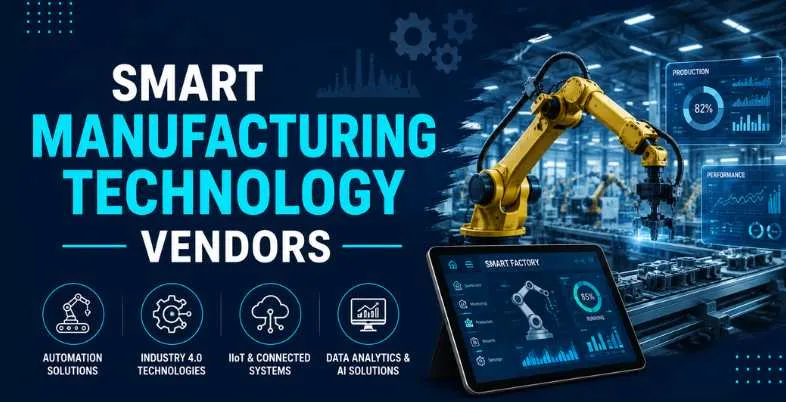
The manufacturing landscape in 2026 is vastly different from what it was even five years ago. Sensors, cloud dashboards, and AI models are buzzing in factories no longer dependent on isolated machines and paper logs, and now forecasting a breakdown before it even happens. It has led to a huge demand for the smart manufacturing technology that are required to connect shop-floor hardware with intelligent software.
As a small component unit in Pune or a big automotive plant, you need to select the right partner among the smart manufacturing technology vendors that determines your growth pace, downtime and global competitiveness. Here are the top 15 global leaders, their India representation and how to choose the right one for your factory floor in 2026.
What Is Smart Manufacturing Technology & Why It Matters in 2026
Smart manufacturing technology brings machines, sensors, and software together with which factories will be able to sense and respond to conditions, analyze data immediately, and even without human involvement. It eliminates guesswork and provides real-time visibility throughout all production lines, warehouses and supply nodes.
- Transforms raw machine data into real-time decision making, not end-of-day reports!
- Reduces unplanned downtime with predictive maintenance and early fault detection
- Receives Inline inspection and corrects the product quality automatically to improve the product quality
- Minimizes energy use and loss by monitoring and improving usage on an ongoing basis
- Promotes compliance, safety, and sustainability goals for factories in a quicker timeframe
Core Tech Stack: PLCs, Industrial IoT, MES, Industrial AI
- PLCs (Programmable Logic Controllers): the hardware brains that control motors, sensors and robotic arms on the floor.
- Industrial IoT: wireless sensors and gateways that transfer machine health data to the cloud or edge.
- MES (Manufacturing Execution Systems): software used to schedule production, monitor work orders and capture real time quality.
- Industrial AI: models that predict failures and optimise throughput, and detect anomalies before they become costly.
Quick Reference Table: Top Smart Manufacturing Technology Vendors
| Vendor | HQ | Core Offering | Best For | Deployment | Notable Clients |
| Siemens | Germany | Digital twins, PLCs, Xcelerator | Discrete & process manufacturing | Cloud, Edge, On-prem | Automotive, electronics OEMs |
| Rockwell Automation | USA | FactoryTalk MES, Allen-Bradley PLCs | Discrete automation | On-prem, Edge, Cloud | Packaging, automotive |
| ABB | Switzerland | Robotics, DCS, drives | Heavy electrification | On-prem, Edge | Metals, chemicals, auto |
| Schneider Electric | France | EcoStruxure, IoT control | Sustainable smart factories | Cloud, Edge | FMCG, energy, pharma |
| Honeywell | USA | Forge software, OT security | Continuous process plants | Cloud, On-prem | Oil & gas, pharma |
Categories of Smart Manufacturing Vendors
Comparing individual names is best done after the smart manufacturing technology vendors can be segmented into three categories by their position in the factory stack.
PLC/Automation Hardware Vendors
These vendors manufacture the actual machines that are equipped with physical controllers, drives, and sensors on the shop floor. They are the first layer on which all smart manufacturing technologies vendors rely to ensure real-time control, motion accuracy and safety.
MES & Industrial Software Platforms
Established above the hardware layer are MES and industrial software vendors, which are tasked with scheduling work orders, monitoring product quality and linking production data to ERP systems. They provide a centralized view of throughput, yield, and inventory at multiple locations for plant managers.
Industrial AI & Predictive-Maintenance Vendors
The vendors use machine learning on sensor streams to enable factories to identify early signs of equipment failure, lower the amount of scrap, and plan maintenance in advance. Their tools are now more likely to connect to the existing MES and IoT platforms as opposed to replacing them.
Top 15 Smart Manufacturing Technology Vendors (Global Leaders)
1. Siemens
| Metric | Details |
| Founded In | 1847 |
| Team Size | ~320,000 employees globally |
| Best-For / Specialization | Industrial digital twins, automation, PLCs, cloud software |
| Key Differentiator | Seamless hardware-to-lifecycle digital twin integration |
| Price / Founded-Year | Enterprise tiers based on deployment scale / 1847 |
| Address (India) | Birla Aurora, Level 21, Plot No. 1080, Dr. Annie Besant Road, Worli, Mumbai, Maharashtra 400030 |
| Website | http://www.siemens.com/in |
Siemens provides a digital portfolio of products and services called Xcelerator which combines high fidelity simulation of a digital twin with real world factory operations across both discrete and process industries to drive industrial transformation. The advantage is that companies can simulate factory lines to optimize machinery layout and to avoid line errors, and save time and money in setting up a line. A trusted, long-term automation partner, its core competency is automated factory design, where it combines intelligent PLCs, edge analytics and cloud-based software solutions to reduce time-to-market and improve asset productivity in automotive, electronics, semiconductor and heavy engineering factories around the world.
Also Read:
2. Rockwell Automation
| Metric | Details |
| Founded In | 1903 |
| Team Size | ~27,000 employees globally |
| Best-For / Specialization | Discrete automation, Allen-Bradley PLCs, MES software |
| Key Differentiator | Pure-play automation focus with floor-to-cloud security |
| Price / Founded-Year | Modular software subscription & license structures / 1903 |
| Address (India) | 11, Global Tech Park, Divyasree Chambers, O’Shaughnessy Rd, Langford Town, Bengaluru, Karnataka 560025 |
| Website | http://www.rockwellautomation.com/en-in.html |
Rockwell Automation creates connected enterprise networks using its FactoryTalk suite, which transforms the past machine data into secure, actionable information that plant managers can make sense of and act on in real time. The benefit of growth is in the reduction of unexpected breakdowns, improvement in first-pass, and real-time plant visibility to lessen the time between problems and solutions. The engineering specialty is dedicated to discrete manufacturing, where floor-to-cloud security, high-speed motion control and Allen-Bradley PLCs ensure consistent, reliable production performance without expensive downtime, for packaging lines, automotive assembly tracks and consumer goods facilities.
3. ABB
| Metric | Details |
| Founded In | 1988 (merger of ASEA and BBC) |
| Team Size | ~105,000 employees globally |
| Best-For / Specialization | Industrial robotics, energy-efficient drives, heavy DCS |
| Key Differentiator | High-tier robotics paired with deep electrification control |
| Price / Founded-Year | Quote-based custom project pricing / 1988 |
| Address (India) | Disha, 3rd Floor, Plot No. 5 & 6, 2nd Stage, Peenya Industrial Area IV, Bengaluru, Karnataka 560058 |
| Website | https://global.abb/group/en |
ABB boosts industrial production with high precision robotics, automated drives and distributed control systems which are able to meet the challenges of production environments. The growth benefit is based on its ability to put to use AI-powered autonomous mobile robots that dynamically adapt to different assembly lines, monitor and reduce electrical energy usage, and subsequently, costs. The specialty focuses on cross-industry heavy electrification and machine automation, enabling high-speed processes and high precision engineering accuracy in plants like automotive, chemical and metal processing plants in facilities around the world, with low waste indices and strong operational safety profiles.
4. Schneider Electric
| Metric | Details |
| Founded In | 1836 |
| Team Size | ~160,000 employees globally |
| Best-For / Specialization | Sustainability software, smart energy distribution, IoT control |
| Key Differentiator | Treats energy efficiency as a core manufacturing metric |
| Price / Founded-Year | Custom hardware/software tiers by site architecture / 1836 |
| Address (India) | 15th Floor, Block 4, DLF Downtown, Phase 3, Sector 25A, Gurugram, Haryana 122002 |
| Website | http://www.se.com/in |
Starting at the factory floor and extending to the highest level of the building, Schneider Electric’s unified EcoStruxure architecture brings energy analytics and rich process automation together to boost factory efficiency. The smart manufacturing technology vendors benefit of growth is that it simultaneously tracks and eliminates carbon emissions and operational waste down to the individual machine, helping to achieve cost savings as well as sustainability reporting objectives. It is particularly specialized in the creation of sustainable smart factories by linking instruments, smart motor control centers, and green software ecosystems, and ensuring high-volume automated production remains productive without compromising on the global regulatory landscape.
5. Honeywell

| Metric | Details |
| Founded In | 1906 |
| Team Size | ~95,000 employees globally |
| Best-For / Specialization | Continuous process automation, OT cybersecurity, plant safety |
| Key Differentiator | Process automation dominance paired with world-class OT protection |
| Price / Founded-Year | Enterprise software licensing and field contract pricing / 1906 |
| Address (India) | 56 & 57, Hadapsar Industrial Estate, Pune, Maharashtra 411013 |
| Website | https://www.honeywell.com/us/en |
Honeywell provides a complete suite of edge controls, smart instruments and industrial software, Forge, to optimize process manufacturing industries under challenging operations. Maximized uptime, monitored equipment integrity, and enhanced safety in high-risk areas are among the growth benefits that can be achieved through factory uptime, monitored equipment integrity, and enhanced safety in high-risk areas—all of which help minimize compliance risk and unplanned costs. It is designed to tackle continuous process automation, and has real-time data visualization, predictive maintenance and operational technology (OT) cybersecurity capabilities specifically for pharmaceutical laboratories, chemical plants and heavy refinery configurations that cannot afford unplanned downtime or safety incidents.
6. General Electric (GE Vernova)
| Metric | Details |
| Founded In | 1892 |
| Team Size | ~125,000 employees globally |
| Best-For / Specialization | Additive manufacturing tracking, heavy asset management |
| Key Differentiator | Deep industrial heritage combined with modern AI-driven twins |
| Price / Founded-Year | Customized enterprise service level agreements / 1892 |
| Address (India) | AIFACS Building, 1 Rafi Marg, New Delhi 110001 |
| Website | https://www.ge.com |
Digital intelligence is General Electric’s next step in the heavy engineering and smart manufacturing technology vendors sector, building on its trusted legacy of infrastructure solutions. The value proposition is to use additive manufacturing applications and asset performance software that maximize the use of raw material, maximize the life of equipment, and minimize unplanned maintenance costs in large fleets of machines. It is a specialized operation with respect to the development of complex digital twins of highly complex, high-stake discrete manufacturing environments, to support safe data-driven production loops for aerospace, heavy power generation and international industrial machinery.
7. Mitsubishi Electric

| Metric | Details |
| Founded In | 1921 |
| Team Size | ~150,000 employees globally |
| Best-For / Specialization | e-F@ctory integration, edge computing, microcontrollers |
| Key Differentiator | Edge controllers that process heavy data locally, no cloud lag |
| Price / Founded-Year | Component-based pricing and volume licenses / 1921 |
| Address (India) | Emerald House, 1B, 1st Floor, Sector 18, Gurugram, Haryana 122015 |
| Website | https://www.mitsubishielectric.com/en/index.html |
Mitsubishi Electric promotes the manufacture floor intelligence through its worldwide-famous e-F@ctory concept, which connects the shop floor equipment directly to the higher IT management systems, thus achieving close control of the manufacturing process. The benefit of the growth lies in the processing of heavy data flows on edge computing units, which filters and processes the data locally before uploading to the cloud, thereby reducing latency and bandwidth expenses. It has a clear specialisation of providing ultra-low latency microcontrollers, high response servo drives and agile industrial robots that speed up the productivity in the factory and make the integration overheads for plant engineering easier.
8. Emerson
| Metric | Details |
| Founded In | 1890 |
| Team Size | ~67,000 employees globally |
| Best-For / Specialization | DeltaV DCS platforms, fluid control, smart process devices |
| Key Differentiator | Precision and depth in smart field instrumentation |
| Price / Founded-Year | Contract-dependent plant integration pricing / 1890 |
| Address (India) | Delphi, B-Wing, 6th Floor, Hiranandani Business Park, Powai, Mumbai, Maharashtra 400076 |
| Website | https://www.emerson.com |
Emerson’s highly flexible DeltaV distributed control system for variable and demanding plant conditions dominates the fluid management and chemical manufacturing markets. This smart manufacturing technology vendors main growth benefit relates to the reduction in material scrap, chemical batch stabilisation, and safe fluid flow through varying factory conditions directly safeguarding margins and safety records. The operational niche is high-end smart process instrumentation, providing intelligent control valves, protected wireless sensor grids and analytical software frameworks that keep quality loops in automated facilities, for food, beverage, or water treatment applications.
9. Yokogawa
| Metric | Details |
| Founded In | 1915 |
| Team Size | ~17,000 employees globally |
| Best-For / Specialization | Plant autonomy, analytical instruments, high-availability DCS |
| Key Differentiator | Pioneer of Industrial Autonomy with near-zero-failure hardware |
| Price / Founded-Year | Custom enterprise deployment contracts / 1915 |
| Address (India) | 96, Electronic City Complex, Hosur Road, Bengaluru, Karnataka 560100 |
| Website | http://www.yokogawa.com/in |
Yokogawa is helping to create an autonomous operational world for industrial sectors by providing high-availability control architectures and process-safe ecosystems for continuous running facilities. Its key differentiator is the ability to quickly convert legacy manual workflow environments into highly adaptable, self-healing automated workflows to ensure zero-shutdown production schedules, while minimizing manual involvement. Specific technical aspects include precision chemical analyzers and distributed control platforms, allowing for advanced manufacturing intelligence, full quality reproduction and comprehensive environmental safety monitoring of continuous manufacturing oil, gas and power plants across the world.
10. Cisco

| Metric | Details |
| Founded In | 1984 |
| Team Size | ~84,000 employees globally |
| Best-For / Specialization | Industrial IoT networking, ruggedized routing, plant cyber security |
| Key Differentiator | Enterprise-grade IT security adapted for harsh factory settings |
| Price / Founded-Year | Hardware sales plus recurring SaaS subscriptions / 1984 |
| Address (India) | SEZ Unit, Cessna Business Park, Kadubeesanahalli, Outer Ring Road, Bengaluru, Karnataka 560103 |
| Website | https://www.cisco.com |
Cisco engineers rugged, secure digital networking backbones that enable millions of automated devices on the factory floor to connect securely to enterprise clouds, while maintaining reliability and uptime. The distinct advantage it brings to manufacturing business is the secure deconstruction of siloed operational technology (OT) data without any associated online vulnerabilities, delivering quicker analytics and cross-site visibility for plant leaders. Cisco’s industrial switch solutions provide a special set of features that offer zero-interruption data streams, as well as comprehensive threat detection, in the harshest, heaviest industrial manufacturing environment in the world.
11. Oracle
| Metric | Details |
| Founded In | 1977 |
| Team Size | ~164,000 employees globally |
| Best-For / Specialization | Cloud ERP, smart supply chain execution, IoT analytics |
| Key Differentiator | Autonomous cloud database built for high-volume factory telemetry |
| Price / Founded-Year | Monthly Cloud SaaS per-user or per-gigabyte pricing / 1977 |
| Address (India) | One Horizon Center, 6th & 7th Floor, Golf Course Road, Sector 43, Gurugram, Haryana 122003 |
| Website | https://www.oracle.com/in/ |
Oracle takes the smart manufacturing technology vendors from the cloud to the ground, using autonomous data platforms to align the supply chain with shop floor activities at multiple locations. Live data feeds of IoT into predictive algorithms benefit growth by helping to optimize material schedules to match the real-time assembly output, minimizing stockouts and excess inventory. The main specialism is its ‘Manufacturing Cloud’ applications combined with its floor analytics, which enable factory operators and executives to monitor the equipment utilisation metrics, warehouse levels and deviations in supplies through a central cockpit.
12. SAP
| Metric | Details |
| Founded In | 1972 |
| Team Size | ~105,000 employees globally |
| Best-For / Specialization | Enterprise ERP integration, asset management, supply chain tracking |
| Key Differentiator | Ties high-level financial planning directly to floor production logs |
| Price / Founded-Year | Enterprise cloud transformation subscription packages / 1972 |
| Address (India) | 6th Floor, Vatika Towers, Sector 54, Golf Course Road, Gurugram, Haryana 122002 |
| Website | http://www.sap.com/india |
SAP is the enterprise resource planning and digital supply chain solution provider that powers the digital center of the complex, global manufacturing networks and is the industry leader. The main benefit of this explicit growth is that it eliminates the need for manual intervention during order-to-delivery process, which directly links customer orders with active floor machinery routines without any lag, thereby reducing the time period of order to delivery in various plants. The SAP core operational expertise provides enterprise-wide synchronization, tracks production costs at hundreds of international production centers in parallel, monitors multi-site material transfers and maintains historic quality logs, all from a single connected platform.
13. PTC

| Metric | Details |
| Founded In | 1985 |
| Team Size | ~7,000 employees globally |
| Best-For / Specialization | Industrial IoT (ThingWorx), PLM solutions, Augmented Reality |
| Key Differentiator | Blends physical factory telemetry with immersive spatial AR |
| Price / Founded-Year | Annual subscriptions based on user count and connectivity / 1985 |
| Address (India) | 15th Floor, Amar Paradigm, Baner Road, Baner, Pune, Maharashtra 411045 |
| Website | https://www.ptc.com |
PTC’s ThingWorx platform for connected engineering teams is helping to shape a new industry paradigm that connects the manufacturing design space with real manufacturing operations. Growth benefits include reducing engineering time and optimizing operator efficiency through live spatial instructions that minimize training time on the shop floor. The company’s flagship expertise is its ability to connect CAD data directly to real machine plans, and to display performance data and step-by-step repair instructions directly on top of physical machines for maintenance teams, using augmented reality technology.
14. Keyence
| Metric | Details |
| Founded In | 1974 |
| Team Size | ~10,000 employees globally |
| Best-For / Specialization | Machine vision, automation sensors, digital microscopes |
| Key Differentiator | Direct-sales model with fast, accurate on-site engineering |
| Price / Founded-Year | Device-specific hardware catalog pricing / 1974 |
| Address (India) | Unit 1201-1205, 12th Floor, Alpha Wing, Raheja Towers, Anna Salai, Chennai, Tamil Nadu 600002 |
| Website | https://www.keyence.com |
Keyence’s ability to deliver ultra-precise sensors, vision systems, and electronic measuring devices optimized for high production speeds ensures absolute quality control on high-speed factory lines. The short-term operational advantage is that it is systematic removal of production line defects, made possible by high frequency optical verification loops that verify in-line before the defect reaches the customer. Keyence’s design expertise encompasses precision hardware, offering smart manufacturing technology vendors with lightning code readers, laser-marking instruments and AI-powered vision cameras to verify the tolerances of microscopic parts, ensuring that each new output is identical to the last.
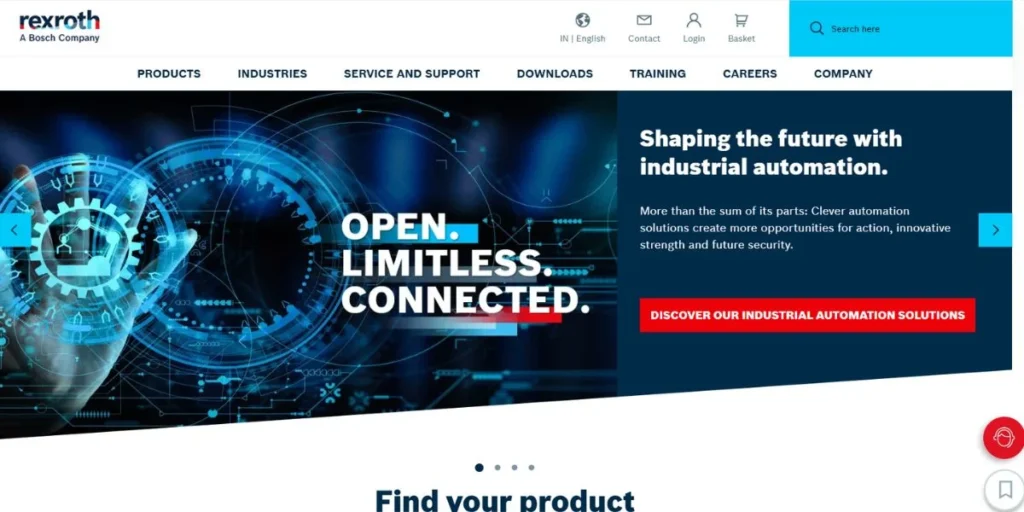
15. Bosch Rexroth
| Metric | Details |
| Founded In | 2001 (multi-firm structural evolution) |
| Team Size | ~34,000 employees globally |
| Best-For / Specialization | Linear motion components, industrial hydraulics, open automation software |
| Key Differentiator | High-force hydraulics paired with open Linux-based control systems |
| Price / Founded-Year | System architecture configuration quotes / 2001 |
| Address (India) | Sanand-Viramgam Highway, Near Village Sanand, Ahmedabad, Gujarat 382110 |
| Website | http://www.boschrexroth.com/en/in |
Bosch Rexroth engineers are able to create completely flexible modular drive and motion assemblies that enable low volume, high mix custom production lines across a wide range of manufacturing industries globally. It provides the growth advantages associated with flexibility, allowing factories to physically change the way that they work dynamically without having to stop the entire operation to retool, significantly reducing changeover times and increasing overall equipment effectiveness. Its engineering specialty is built on rugged linear motion components, high force hydraulics, and open ecosystem software architectures to enable heavy manufacturing machinery to move with greater precision and the ability to share device health telemetry directly with edge dashboards.
Emerging & India-Focused Smart Manufacturing Vendors
India’s smart manufacturing technology vendors are catching up with the giants and are helping factories to digitize without going global.
- Tata Elxsi: has an auto-industrial presence in India, delivering design-led engineering and IoT integration to its clients.
- L&T Technology: Services provides plant digitization, MES implementation and industrial engineering services to the heavy manufacturing industry.
- Godrej Precision Engineering: provides precision automation solutions for manufacturing lines in Aerospace & Defence.
- Bharat Fritz: Werner supplies domestic factories with machine tools with built-in IoT-ready control systems.
- Faclon Labs: specializes in the development of low-cost sensor networks for the application to the mid-size manufacturing units in India.
Indian Systems Integrators and Industry 4.0 Specialists
- Global platforms such as Siemens or Rockwell are tailored for Indian layouts and power conditions by the local integrators.
- They offer comparatively less expensive implementation and quicker support on site than foreign teams
- Many specialize in putting sensors on legacy machines instead of replacing the line.
- They tend to include the training, spares and AMC support on one contract.
Comparison Table: Vendor Specialization & Deployment Models
The table below matches up all fifteen smart manufacturing technology vendors side-by-side, allowing you to readily align specialization with preferred deployment model.
| Vendor | Specialization | Cloud | Edge | On-Prem |
| Siemens | Digital twins & PLCs | Yes | Yes | Yes |
| Rockwell Automation | Discrete MES | Yes | Yes | Yes |
| ABB | Robotics & DCS | Partial | Yes | Yes |
| Schneider Electric | Energy & IoT control | Yes | Yes | Partial |
| Honeywell | Process automation | Yes | Partial | Yes |
| GE | Heavy asset twins | Yes | Partial | Yes |
| Mitsubishi Electric | Edge computing | Partial | Yes | Yes |
| Emerson | Fluid/process DCS | Partial | Yes | Yes |
| Yokogawa | Plant autonomy | Partial | Yes | Yes |
| Cisco | Industrial networking | Yes | Yes | Partial |
| Oracle | Cloud ERP & supply chain | Yes | No | No |
| SAP | Enterprise ERP | Yes | No | Partial |
| PTC | IoT & AR/PLM | Yes | Partial | Partial |
| Keyence | Machine vision | No | Yes | Yes |
| Bosch Rexroth | Motion & hydraulics | Partial | Yes | Yes |
How to Choose a Smart Manufacturing Vendor for Your Plant
Choosing among a variety of smart manufacturing technology vendors is a matter of plant size, budget and whether you want to retain or replace your legacy infrastructure.
SME vs Enterprise Budgets
| Factor | SME Plants | Enterprise Plants |
| Typical Budget | Lower, project-based | Higher, multi-year contracts |
| Preferred Vendors | Local integrators, Keyence, Mitsubishi | Siemens, SAP, Rockwell, Oracle |
| Rollout Speed | Fast, single-line pilots | Phased, multi-site programs |
| Support Need | Local, hands-on | Global account management |
On-Prem vs Cloud vs Edge Deployment
| Deployment | Best For | Trade-off |
| On-Premises | Data-sensitive, regulated plants | Higher upfront hardware cost |
| Cloud | Multi-site visibility, scalability | Needs stable connectivity |
| Edge | Low-latency control, remote sites | Limited storage, needs periodic sync |
Industrial AI & Physical AI Trends Shaping Vendor Selection in 2026
The trends are directly impacting the buyer’s perspective on smart manufacturing technology vendors as they enter the second half of 2026.
- Physical AI, which learns through the feedback from real-world sensors, has become an expected criterion for buyers.
- The vendors are embedding generative AI copilots in MES dashboards for quick root cause analysis.
- Increasingly, predictive maintenance models have made the transition from a cloud-only approach to edge-cloud processing. More and more of the predictive maintenance models have moved from a cloud-only solution to edge-cloud processing for quicker response.
- The need for cybersecurity for OT networks has become a critical part of every RFP.
- Sustainability reporting features are no longer add-ons, but embedded in platforms provided by vendors.
- Single-vendor lock-in is becoming less popular than interoperability between vendors.
Conclusion
Choosing the right partner for today’s smart manufacturing technology vendors is no longer a matter of acquiring individual pieces of hardware or software. It’s all about identifying the right partner with a platform that is suitable for your plant’s size, budget, and long-term digital strategy. International giants such as Siemens, Rockwell, and ABB provide tried and tested experience and expertise, while new Indian firms provide quicker and cheaper assistance for local factories.
Monitoring vendors, the hardware that is reliable coupled with smart software, will keep driving smart manufacturing transformation in all industries as physical AI and predictive maintenance continues to develop and evolve through 2026.
FAQs
Which are the most promising smart manufacturing companies in 2026?
Siemens, Rockwell Automation, ABB, Schneider Electric, Honeywell, GE, Mitsubishi Electric, Emerson, Yokogawa, Cisco, Oracle, SAP, PTC, Keyence, and Bosch Rexroth are the top smart manufacturing technology vendors in the world in 2026.
What is the difference between MES and smart manufacturing platforms?
MES is used for on floor production scheduling and tracking, and a smart manufacturing platform integrates MES, IoT and AI for end to end factory intelligence.
What is the price of a smart manufacturing software?
The price ranges are huge from project-based pricing for small integrators to enterprise pricing of lakhs or crores per annum for large multiple site deployments.
Any smart manufacturing vendors who are focused on India?
Yes, players such as Tata Elxsi, L&T Technology Services and local systems integrators provide specific solutions to Industry 4.0 for Indian plants at a competitive cost.
What is ‘physical AI’ in manufacturing?
Physical AI is a type of AI that involves the learning of robots and machines directly from their physical interactions with the real world, requiring minimal or no reprogramming for accuracy and adaptability.