
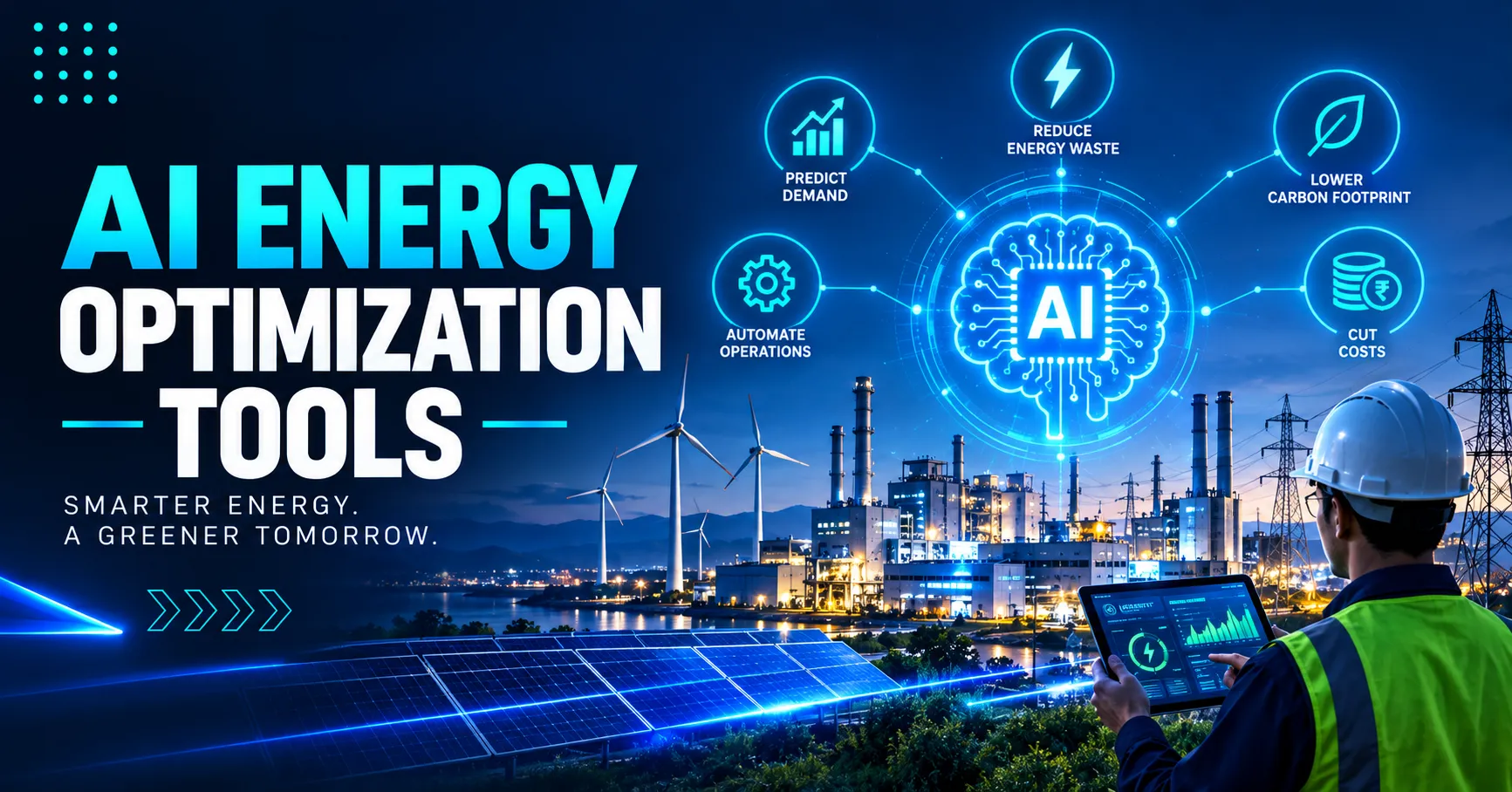
Energy costs are rising everywhere, and no one has the time to constantly monitor thermostats or pore over spreadsheets to track where all the energy is going. This is where AI energy optimization tools come into play. These platforms don’t rely on mere guesswork or annual audits; instead, they monitor your building, plant, or portfolio around the clock, understand its typical operating patterns, and gradually guide equipment toward its most efficient operating mode.
The market for AI energy optimization tools has matured significantly and is poised for rapid growth through 2026. What was once a niche, expensive feature reserved for large corporations has now become an exciting and competitive space accessible to everyone—from small warehouses with a staff of five to major retail chains with 500 locations. While some tools focus on HVAC automation, others handle ESG reporting or predictive maintenance, they all share a common goal: automatically reducing waste and costs.
This guide helps you understand 12 of the best AI energy optimization tools of 2024—covering their features, pricing, pros, cons, and use cases—to assist you in selecting the right tool for your needs.
What Are AI Energy Optimization Tools? (Featured-snippet target)
AI energy optimization tools are computer programs designed to analyze and optimize the consumption of electricity, gas, and water resources within a building or facility by leveraging machine learning, sensor data, and real-time data analysis. The best AI energy optimization tools do more than just display dashboards of numbers; they actively make decisions—such as adjusting HVAC setpoints, modifying equipment schedules, or identifying faulty equipment before it wastes energy for weeks on end.
They typically gather data from smart meters, IoT sensors, Building Management Systems (BMS), and information regarding weather and occupancy (occupancy feeds). Machine-learning models analyze this data to identify patterns that might go unnoticed by humans—such as a chiller running longer than usual at 3 AM, or store inventory being kept excessively cold on cloudy days.
The overall benefits include: reduced electricity bills, fewer equipment-related issues, improved ESG and sustainability reporting, and the elimination of the need for a full-time energy manager to constantly monitor every setting.
How AI Energy Optimization Works
Predictive analytics & consumption forecasting
- It analyzes historical usage patterns based on the time of day, day of the week, and season.
- It automatically adjusts to variables such as weather conditions, occupancy, and utility tariffs.
- It forecasts future energy requirements.
- It alerts you to unusual activity before the bill becomes excessively high.
Automated controls (HVAC, lighting, equipment)
- It enables real-time adjustments to HVAC setpoints without human intervention.
- It adjusts or programs lighting based on occupancy.
- It schedules the operation of heavy equipment during ‘off-peak’ hours to reduce energy consumption.
- It balances comfort with cost-efficiency
Anomaly detection & predictive maintenance
- It prevents motors, pumps, or compressors from drawing excessive energy.
- It issues alerts regarding minor faults before they escalate into major, costly breakdowns.
- It minimizes unplanned shutdowns and repair costs.
- It extends equipment lifespan through early intervention.
Top 12 AI Energy Optimization Tools in 2026
1. Schneider EcoStruxure
Schneider Electric’s EcoStruxure is one of the most trusted and established names in AI energy optimization tools. It is not merely an app but a multi-layered IoT architecture—featuring connected edge devices, on-premise control software, and cloud-based analytics. This architecture allows EcoStruxure to be deployed anywhere, from a single commercial building to a nation-wide electrical grid; consequently, it is highly popular among large manufacturers, utility companies, and multi-site enterprises.
A key feature of EcoStruxure is its open and interoperable nature; it does not require a third-party building management system to function effectively. It offers capabilities such as real-time monitoring, predictive maintenance, and comprehensive energy analytics, enabling facility teams to instantly identify inefficiencies or issues without waiting for energy bills.
Key Features
- Real-time energy monitoring
- Predictive maintenance alerts
- IoT device integration
- Multi-site scalability
Pros
- Highly scalable platform
- Strong industrial reliability
- Broad system compatibility
Cons
- Custom, quote-based pricing
- Steep learning curve
- Best suited for larger sites
Pricing: Starts around $200/month for entry monitoring; enterprise deployments are custom-quoted .
Best For: Manufacturers and enterprise facility teams managing multi-site industrial and commercial energy operations.
2. IBM Envizi
Unlike solutions focused solely on HVAC automation—which often pay less attention to ESG and sustainability reporting—IBM Envizi leverages robust ESG and sustainability reporting capabilities. This makes it one of the most unique AI energy optimization tools on this list. It consolidates hundreds of data points—covering energy, water, waste, and emissions—into a single, audit-ready system. Additionally, its AI-driven emissions calculation engine, based on the GHG Protocol, simplifies Scope 1, 2, and 3 reporting.
Envizi is designed for medium-to-large enterprises that require finance-grade sustainability data to meet regulatory requirements, investor demands, or corporate decarbonization goals. Its pricing is determined based on modules, so that smaller sustainability programs do not have to pay extra for enterprise-level features they do not need.
Key Features
- Scope 1-2-3 GHG accounting
- ESG data consolidation
- Automated disclosure reporting
- Utility bill analytics
Pros
- Excellent ESG reporting depth
- Audit-ready data trails
- Wide framework coverage
Cons
- High cost for SMBs
- Complex initial setup
- Not built for HVAC control
Pricing: Modular packages — Essentials from around $30,000/year, Standard from around $45,000/year, Premium custom-quoted.
Best For: Enterprise sustainability and ESG teams needing audit-ready carbon and energy disclosure across distributed operations.
3. Honeywell Forge
Honeywell Forge Energy Optimization is a closed-loop, cloud-based platform specifically designed to automate HVAC performance across large-scale building portfolios. It integrates seamlessly with virtually any HVAC system or Building Management System (BMS), leveraging data on weather, occupancy, and energy costs. It employs machine learning to automatically make continuous, incremental adjustments without compromising occupant comfort.
The data confirms its effectiveness: customers typically see energy cost savings of 10–20% within just a few months of implementation. Additionally, Forge includes a ‘Sustainability Plus’ layer for tracking emissions and a ‘Digitized Maintenance’ layer for the early detection of equipment faults. For stadiums, hospitals, airports, and commercial real estate, it stands out as a true ‘all-in-one’ solution compared to other enterprise-class AI energy optimization tools.
Key Features
- Autonomous HVAC optimization
- Occupancy-based adjustments
- ENERGY STAR integration
- Predictive equipment fault alerts
Pros
- Proven 10-20% cost savings
- System-agnostic BMS integration
- Strong industrial track record
Cons
- Pricing not publicly listed
- Best for larger portfolios
- Requires BMS compatibility
Pricing: Custom quotes based on connected assets; some modules are priced per square foot .
Best For: Commercial real estate, airports, hospitals, and large building portfolios wanting autonomous HVAC control.
4. BrainBox AI

BrainBox AI is a prominent name in the field of autonomous HVAC control systems and is now part of Trane Technologies. It connects easily to a building’s HVAC system without requiring any equipment replacement. Using deep-learning algorithms, it automatically optimizes temperature, airflow, and equipment cycling every five minutes based on weather, utility tariffs, grid emissions, and occupancy data.
BrainBox AI is well-known for its retail case studies; for instance, Dollar Tree saved over $1 million by implementing these controls across thousands of stores. The platform claims it can reduce emissions by up to 40% and cut energy costs by 25–30%, with results achievable within a year or less. This is one of the fastest-to-implement AI energy optimization tools, as it does not require expensive retrofitting.
Key Features
- Autonomous HVAC adjustments
- 99.6% consumption prediction accuracy
- Zone-level granular control
- Non-intrusive existing-system integration
Pros
- Fast, low-capex deployment
- Strong retail case studies
- Up to 30% energy savings
Cons
- Needs compatible BMS
- Savings vary by climate
- Independent verification limited
Pricing: Roughly $0.10–$0.30 per square foot per year .
Best For: Retail chains, offices, and institutions wanting fast, non-disruptive HVAC-focused energy savings.
5. Verdigris
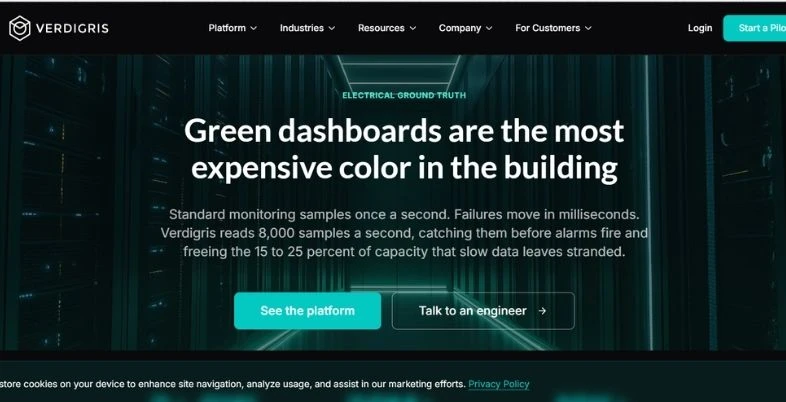
The Verdigris solution combines hardware and software, utilizing circuit-level meters installed within electrical panels alongside AI analytics. It provides facility teams with “virtual meters” for devices, eliminating the need for sub-metering every single piece of equipment—a significant time-saving advantage for data centers, hospitality venues, and manufacturing facilities.
The system employs self-learning capabilities to optimize HVAC and cooling controls and typically pays for itself within six months to two years. Among AI energy optimization tools designed specifically for mission-critical infrastructure, Verdigris has also advanced into predicting equipment failures weeks in advance by utilizing high-frequency waveform analysis.
Key Features
- Circuit-level energy metering
- AI-powered anomaly detection
- Adaptive HVAC automation
- Equipment failure prediction
Pros
- Granular, device-level visibility
- Strong for data centers
- Early fault detection
Cons
- Requires sensor hardware install
- Quote-based pricing only
- Electricity-focused scope
Pricing: Custom quote-based (hardware plus subscription); no published flat rate.
Best For: Data centers, hospitality, and manufacturing sites needing circuit-level reliability and efficiency monitoring.
6. ABB Ability Energy Manager
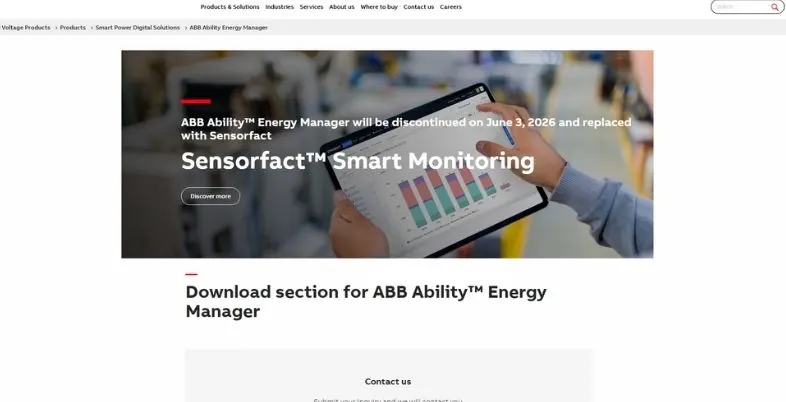
ABB Ability Energy Manager is a high-level platform that displays real-time energy data from systems across a single site or multiple locations involving hundreds of users. It integrates seamlessly with SCADA, PLCs, and industrial sensors, making it an excellent choice for large commercial buildings, heavy industry, and chemical plants; notably, the Burj Khalifa utilizes ABB’s system to remotely control over 400 electrical loads.
ABB recently integrated generative AI into the platform, enabling non-technical users to interpret energy and operational data through conversational interaction. Beyond asset health monitoring, ABB Ability Energy Manager stands out as a leading industrial AI energy optimization tool, claiming potential savings of up to 30% on energy bills and 40% on maintenance costs.
Key Features
- Real-time industrial monitoring
- SCADA and PLC integration
- Asset health prediction
- Generative AI data insights
Pros
- Deep industrial integration
- Scalable single-to-multi-site
- Strong maintenance savings
Cons
- Enterprise-focused pricing
- Complex deployment
- Not ideal for small offices
Pricing: Custom quote-based, priced by modules and site scale.
Best For: Industrial plants, chemical facilities, and large commercial buildings needing integrated energy and asset management.
7. Upkip AI Energy Optimization
While energy optimization for HVAC systems is a primary objective, UpKeep’s AI-powered maintenance platform takes a different approach, focusing heavily on the maintenance aspect. Poorly maintained motors, compressors, and HVAC units are often major sources of hidden energy costs within a facility; UpKeep’s built-in AI assistant, Nova, helps maintenance and reliability teams identify these issues early.
By integrating CMMS, EAM, and APM capabilities into a single mobile-first platform, UpKeep is an ideal choice for SMBs and mid-market manufacturers who may not be ready for enterprise-grade energy platforms but seek AI-driven benefits for asset tracking and preventive maintenance (PM). It is one of the more cost-effective AI energy optimization tools on this list.
Key Features
- AI-powered predictive maintenance
- Mobile-first work order management
- Asset and parts tracking
- IoT sensor integrations
Pros
- Affordable entry pricing
- Fast mobile adoption
- Flexible per-user plans
Cons
- Not HVAC-automation focused
- Costs rise with team size
- Advanced tiers need a quote
Pricing: Essential from $20-24/user/month; Premium around $55/user/month; Professional and Enterprise custom-quoted.
Best For: SMB and mid-market manufacturers wanting AI-assisted preventive maintenance to reduce energy waste from failing equipment.
8. Futurism Technologies
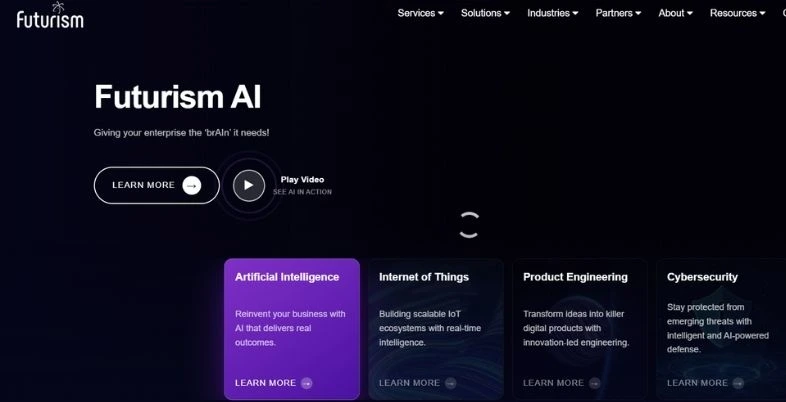
Futurism Technologies (or Futurism AI) is not merely a product; it is an AI consulting and solutions firm that develops custom energy optimization solutions for clients across various industries, including smart cities, manufacturing, and utilities. Futurism creates tailored AI energy optimization tools—such as digital twins, predictive load forecasting, and ERP-integrated energy dashboards—for businesses requiring specialized solutions.
The company can handle reporting requirements specific to any equipment, tariff structure, or enterprise reporting need; it possesses over 20 years of experience in AI delivery and maintains teams across multiple countries worldwide. It is ideally suited for businesses seeking custom-made solutions rather than “one-size-fits-all” subscription models.
Key Features
- Custom AI model development
- Digital twin simulations
- ERP and legacy system integration
- Predictive load forecasting
Pros
- Fully tailored solutions
- Broad industry experience
- Long-term partnership model
Cons
- Longer implementation timelines
- Custom project pricing
- Not a plug-and-play SaaS
Pricing: Project-based custom quotes; no published flat pricing.
Best For: Enterprises needing a bespoke, consultant-built AI energy optimization solution beyond standard software.
9. Sensorfact
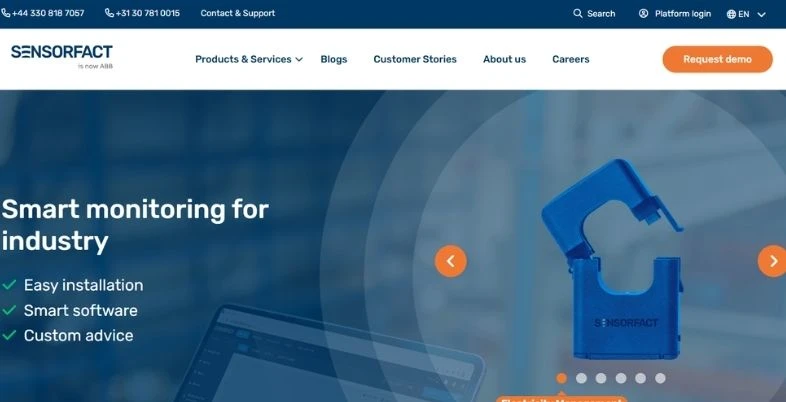
Sensorfact’s concept was specifically designed for industrial SMEs—businesses that may not operate on the scale of giants like Schneider or ABB but are losing money due to the wastage of electricity, gas, compressed air, and water. It utilizes wireless, non-invasive sensors that do not require an electrician for installation on machinery, alongside a cloud dashboard that alerts users to machine-level wastage through simple language and customized savings reports.
Sensorfact also incorporates OEE (Overall Equipment Effectiveness) monitoring and predictive maintenance, offering small manufacturers a dual benefit: energy savings and insights into production capacity. The company claims to have helped customers reduce energy bills by up to 15% and serves over 600 clients across more than 25 European countries.
Key Features
- Machine-level energy monitoring
- OEE and downtime tracking
- Predictive maintenance alerts
- Non-invasive wireless sensors
Pros
- Built for industrial SMEs
- Easy self-install sensors
- Clear savings reporting
Cons
- Quote-based pricing
- Mainly Europe-focused rollout
- No public free trial
Pricing: From roughly €50/month for add-on services; core platform is quote-based.
Best For: Industrial small and medium-sized manufacturers wanting affordable, machine-level energy and OEE monitoring.
10. WatchWire
WatchWire (formerly EnergyWatch) is designed to manage utility bills across a portfolio, rather than controlling equipment in real-time. It automatically processes utility bills and interval meter data, identifies anomalies, and converts this information into Scope 1–3 carbon accounting metrics aligned with major ESG disclosure frameworks.
Serving as a back-office-friendly AI energy optimization tool for real estate, retail, and multi-site companies, WatchWire eliminates the need for spreadsheets and provides a reliable source of data for tracking energy expenditure, budgeting, and benchmarking across dozens or even hundreds of properties.
Key Features
- Automated utility bill ingestion
- Multi-commodity anomaly detection
- Scope 1-3 emissions reporting
- Excel-integrated dashboards
Pros
- Strong portfolio-wide visibility
- Simplifies ESG reporting
- High user satisfaction ratings
Cons
- Not a building-control tool
- Pricing not fully public
- Best suited to larger portfolios
Pricing: Starts around $100/user/month, quote-based for full deployments.
Best For: Real estate portfolios and multi-site enterprises needing centralized utility bill and emissions reporting.
11. GridPoint
GridPoint aims to integrate building equipment to automate HVAC and lighting system capabilities in commercial buildings—particularly multi-site retail stores, restaurants, and convenience stores. It also offers energy management solutions for grid-interactive load flexibility, enabling businesses to save additional money and generate new revenue streams by participating in demand response programs.
Through a partnership with Hannon Armstrong, GridPoint has launched a financing arrangement that allows small and medium-sized buildings to utilize enterprise-level AI energy optimization tools without incurring heavy upfront costs.
Key Features
- Remote HVAC and lighting control
- Demand response participation
- EV charging management
- Anomaly and fault detection
Pros
- Zero-capital monthly pricing
- Multi-site retail expertise
- Demand-response revenue potential
Cons
- Limited public review data
- Deployment effort upfront
- Best for chains, not single sites
Pricing: Subscription-based, custom-quoted with no upfront hardware cost.
Best For: Multi-site retail and restaurant chains wanting affordable, subscription-based HVAC and lighting automation.
12. Enel X
Enel X rounds out this list with a service-oriented approach to commercial and industrial energy management, providing both software and practical support services. Its offerings include demand optimization, the consolidation of utility bills (across various commodities), and—given Enel X’s status as a global leader—large-scale demand response capabilities (encompassing gigawatts of grid-interactive load).
Among providers of enterprise-grade AI energy optimization tools, Enel X is an excellent choice for businesses seeking far more than just software; it acts as a true energy partner that simplifies billing, optimizes consumption, and maximizes demand-response revenue potential—especially for companies with a global or multi-regional presence.
Key Features
- Multi-commodity bill consolidation
- Large-scale demand response
- AI-powered benchmarking analysis
- Global energy program management
Pros
- Global demand-response scale
- Strong billing automation
- Established enterprise credibility
Cons
- Service-heavy, less self-serve
- Pricing not transparent
- Better fit for large enterprises
Pricing: Custom, program-based enterprise pricing.
Best For: Large, multi-region enterprises wanting demand-response participation alongside energy monitoring and billing consolidation.
Comparison Table — Features, Pricing & Best-Fit
| Tool | Best For | Key Features | Pricing | Free Trial |
| Schneider EcoStruxure | Enterprise manufacturing | Real-time monitoring, predictive maintenance | From ~$200/mo, custom enterprise | Limited/demo |
| IBM Envizi | ESG & sustainability teams | GHG accounting, ESG data hub | From ~$30,000/yr | Demo only |
| Honeywell Forge | Commercial real estate | Autonomous HVAC, ENERGY STAR sync | Custom quote | Demo only |
| BrainBox AI | Retail & offices | Autonomous HVAC, 99.6% forecasting | ~$0.10–$0.30/sq ft/yr | Pilot programs |
| Verdigris | Data centers, hospitality | Circuit-level metering, anomaly detection | Custom quote | Demo only |
| ABB Ability Energy Manager | Industrial plants | SCADA integration, asset health AI | Custom quote | Demo only |
| Upkip (UpKeep) | SMB/mid-market manufacturing | AI predictive maintenance, mobile CMMS | From $20-24/user/mo | Free trial |
| Futurism Technologies | Custom enterprise builds | Digital twins, bespoke AI models | Project-based | Consultation |
| Sensorfact | Industrial SMEs | Machine-level monitoring, OEE tracking | From ~€50/mo add-ons | Demo only |
| WatchWire | Real estate portfolios | Utility bill automation, ESG reporting | From ~$100/user/mo | Demo only |
| GridPoint | Multi-site retail chains | Remote HVAC control, demand response | Custom, zero-capex | Demo/consult |
| Enel X | Global enterprises | Demand response, bill consolidation | Custom program pricing | Consultation |
Enterprise vs SMB: Which Tool Fits Your Business?
| Factor | Enterprise-Fit Tools | SMB-Fit Tools |
| Best Tools | Schneider EcoStruxure, IBM Envizi, Honeywell Forge, ABB Ability Energy Manager, Enel X | Sensorfact, UpKeep, BrainBox AI, GridPoint |
| Deployment Time | Months (multi-site rollout, system integration) | Weeks (plug-and-play sensors, minimal setup) |
| Upfront Cost | High (custom licensing, hardware, integration fees) | Low to zero (subscription or zero-capex models) |
| Pricing Model | Custom enterprise quotes, per-site or per-account | Per-user/month or per-sq-ft, more transparent |
| Integration Needs | Deep BMS, SCADA, and ERP integration | Works with existing HVAC/machines, minimal IT lift |
| Reporting Depth | Advanced ESG, Scope 1-3 GHG, audit-ready disclosures | Basic usage dashboards, savings reports |
| Team Requirement | Dedicated facility/sustainability team | Can run with a single ops or maintenance manager |
| Ideal Use Case | Multi-site portfolios, compliance-heavy industries | Single-site or few-site SMBs wanting fast ROI |
| Typical Payback | 1-3 years depending on scale | 3-12 months |
Overall, the ‘Enterprise-fit’ category is best suited for large companies with geographically dispersed portfolios, complex compliance requirements, and robust facilities teams. These AI energy optimization tools offer the highest levels of customization and scalability, along with detailed ESG reporting; however, they come with higher costs and longer implementation times, delivering true value primarily at scale.
The lightweight, rapidly deployable options in the SMB category are better suited for small and medium-sized businesses. Instead of months-long rollouts and massive upfront investments, these tools leverage features like machine-level monitoring, automated HVAC fine-tuning, and predictive maintenance to deliver benefits within months rather than years.
Real-World Savings — What Results Look Like
- Honeywell Forge enables customers to achieve 10–20% savings within 3–6 months.
- Using BrainBox AI can reduce HVAC costs by up to 25–30%.
- Sensorfact customers have seen energy bill savings of up to 15%.
- ABB Ability Energy Manager offers up to 30% energy savings and 40% maintenance savings.
- Verdigris users typically see a return on investment (payback) within 6 months to 2 years.
How to Choose the Right AI Energy Tool
- Check compatibility with your existing BMS, meters, and IoT sensors.
- Verify if the solution can scale from a single site to multiple sites without requiring a complete system overhaul.
- Inquire about cloud hosting and data security certifications.
- Check for compatibility with the ESG reporting frameworks relevant to you, such as the GHG Protocol, CSRD, etc. Look at the pricing structure (per user, per square foot, or enterprise flat rate).
- Try to find a free trial, pilot program, or demo before signing up for a long-term contract.
Conclusion
When it comes to selecting the right AI energy optimization tool for your needs, it all depends on your specific situation and your biggest challenge. However, to curb HVAC-related waste, autonomous-control products like Honeywell Forge or BrainBox AI will almost certainly yield the quickest savings. If ESG reporting and billing complexities are common issues, tools like IBM Envizi or WatchWire are designed to handle these tasks with ease.
Don’t assume this technology is reserved for large corporations; companies like Sensorfact, UpKeep, and GridPoint have made it more accessible by offering affordable, non-invasive technology and subscription models that require no significant upfront capital expenditure (CAPEX). Meanwhile, large industrial operators and multinational companies have access to robust solutions like Schneider EcoStruxure, ABB Ability Energy Manager, and Enel X, which can be seamlessly scaled across hundreds of sites.
The core message behind all these AI energy optimization tools is the same: minimize reliance on manual guesswork, reduce energy bills, and create a clear path toward achieving sustainability goals. Start with a pilot program, measure actual savings against your baseline, and then scale up.
FAQs
AI energy optimization tools are tools that leverage artificial intelligence to help optimize energy use.
They are computer programs that listen, predict, and make automated decisions for a building or facility to reduce electricity, gas and water consumption—even if the user is not there to manage.
What are the savings in energy that can be achieved with these tools?
With automation systems deployed to different extents, depending on the type of building, climate and the level of automation, most reputable AI Energy Optimization Tools produce energy cost savings between 10% and 30% with energy maintenance savings up to 40%.
Do these tools work for large enterprises or not?
No. Platforms such as IBM Envizi and Schneider EcoStruxure are built for platforms that are lean enterprise, whereas others such as Sensorfact, UpKeep and GridPoint are tailored to the needs of SMBs that have less of a budget and quicker deployment.
Are these tools IoT sensors enabled?
There are many who use IoT sensors or smart meters to create granular, real-time data but some have been developed using existing utility bill and interval meter data, such as WatchWire.
So, what is the most suitable tool for ESG/sustainability reporting?
For comprehensive, audit-proof ESG and GHG reporting, IBM Envizi is the best option, and for consolidating utility data from a portfolio for sustainability reporting, WatchWire is a good solution.