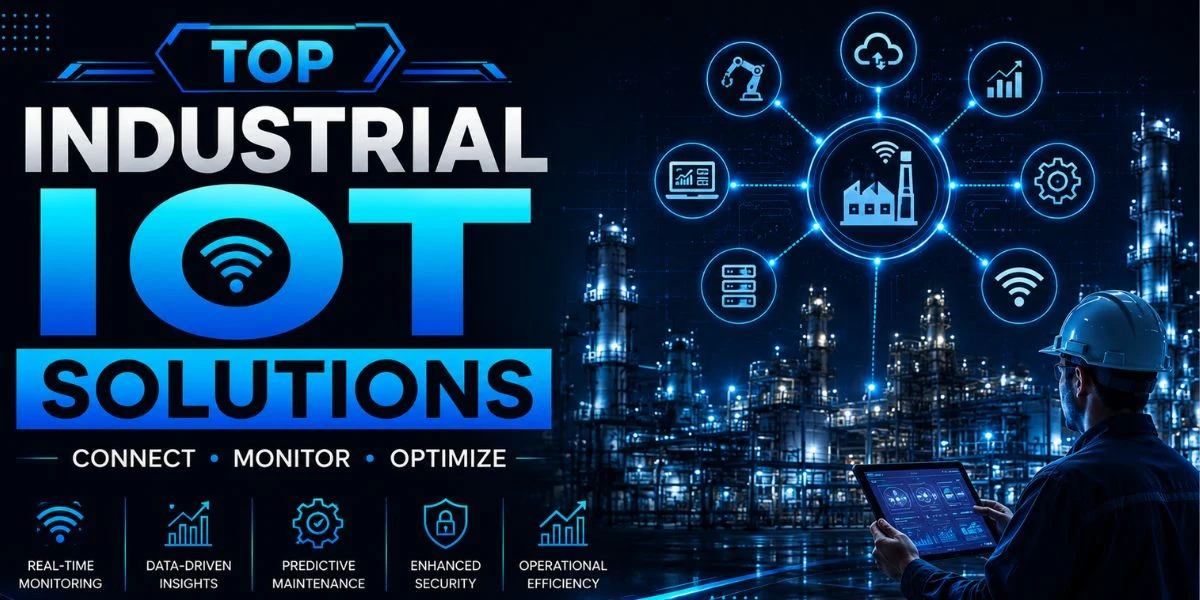
Factories, power systems and supply chains no longer operate from a guess – they operate on a data basis. By 2026, Industrial IoT Solution have transformed into the foundation of modern manufacturing, bringing together machines, sensors, and cloud systems to form a single intelligent network. These systems are revolutionizing various industries from predicting equipment malfunction before it occurs to tracking shipments in real-time across continents. The increasing demand for uptime, margins, and rising energy costs have driven businesses of all sizes to embrace connected technology.
Understand how Industrial IoT Solutions work, how to select the right one for your business, and the architecture, protocols, and top providers.
What is Industrial IoT (IIoT)?
Industrial IoT is the network of sensors, machines, controllers and software that gather and share data in industrial settings like factories, power plants, warehouses, and oil fields. Unlike conventional automation, IIoT integrates physical assets with cloud or edge analytics, allowing for the monitoring, prediction and control of assets in real time.
It integrates operational technology (OT) and information technology (IT) so that engineers and managers can obtain real-time machine health, production and energy data data from consolidated dashboards. In real life, a well-designed Industrial IoT Solutions translates signals from machines into meaningful, actionable business information, on every shift, at every location.
IIoT vs Consumer IoT – Key Differences
| Aspect | Industrial IoT (IIoT) | Consumer IoT |
| Purpose | Operational efficiency, safety, uptime | Convenience, lifestyle |
| Environment | Harsh – heat, dust, vibration | Controlled home/office settings |
| Reliability Needs | Mission-critical, near-zero downtime | Tolerant of occasional failure |
| Data Volume | Massive, continuous telemetry streams | Lower, intermittent data |
| Security Standards | Strict, regulatory-driven (OT security) | Basic consumer-grade security |
| Examples | Predictive maintenance sensors, PLCs | Smart bulbs, fitness trackers |
Core Components of an Industrial IoT Solution
Sensors & Edge Devices
Sensors are one of the most important parts of an Industrial IoT system. They are placed on machines, pipelines, vehicles, and other equipment to collect information such as temperature, pressure, vibration, current, and images. An edge device checks this data near the machine and removes unnecessary information before sending it to the main system.
This helps save internet bandwidth and allows quick action when something goes wrong. For example, if a machine starts vibrating more than normal, the system can alert the team or stop the machine. Some new devices can also use basic machine learning to find unusual activity on their own.
Connectivity Protocols: MQTT, OPC-UA & 5G
Industrial machines need a reliable way to send data to other machines, computers, or cloud systems. MQTT is a simple and lightweight option that works well when the internet connection is slow or limited. It is often used with remote sensors and battery-powered devices. OPC-UA helps different machines and equipment communicate with each other safely, even when they are made by different companies.
Private 5G networks are also becoming popular in factories because they can provide fast connections and very low delay. This is useful for robots, automated vehicles, and other machines that need to respond quickly.
Cloud & Edge Analytics Platforms
Factories collect a lot of data every day, but that data is useful only when businesses can understand it and take action. Edge systems can check data immediately and help with quick decisions on the factory floor. Cloud systems can store data for a longer period and help companies look at past performance, find trends, and compare different factories.
Many platforms now also offer simple dashboard tools, so managers can create their own reports without knowing how to code. This is making Industrial IoT easier for both large and small businesses.
Digital Twins & AI Integration
A digital twin is a digital copy of a real machine, production line, or factory. It helps engineers see how equipment is working and test possible changes without changing the real machine first. This can help companies avoid mistakes and reduce downtime. The data from the real machine can also help find signs of a possible problem before the machine actually breaks down.
Teams can check the condition of machines from another location instead of always visiting the factory. AI can make this even more useful by helping teams plan maintenance and find better ways to run their machines.
Top Industrial IoT Use Cases
Industrial IoT Solutions are being deployed in almost every heavy industry today and the following are a few of the use cases in which businesses are experiencing the highest and most quantifiable returns.
Predictive Maintenance
- Vibration, heat and sound patterns are monitored constantly at sensors on equipment
- Detects mechanical wear before physical symptoms are evident
- Teams are notified ahead of failure and not on a scheduled basis.
- Unplanned downtime is a major cost wither on production lines.
- Plans and conducts equipment servicing on time and in a condition-based manner to extend the life of the equipment.
- Minimizes urgent repair expenses and late delivery of parts
- By far, the most popular application of connected industrial technology globally.
Smart Factory & Process Automation
- Automatic and adjustment of the production lines to the speed, temperature and material flow.
- Machines communicate to each other to allow real time workload balancing.
- Quality problems are immediately identified via real-time feedback from the sensors
- Minimizes human error in repetitive and precise activities
- Enhances uniformity in production batches and shifts
- Enables manufacturers to operate more leanly with increased throughput
- Implements improved product quality assurance throughout the plant
Asset Tracking & Fleet Monitoring
- Vehicles, containers and valuable equipment tracked with GPS and RFID technology are mapped.
- Fuel consumption is monitored in real-time and driver behaviour is monitored by the managers.
- With live delivery route tracking, you can avoid missed deliveries and ensure accurate scheduling.
- Prevents the theft of equipment and assets and unauthorized use
- Increases deliveries precision and customer satisfaction percentage.
- Supports businesses to maximize fleet efficiency over wide areas
- Reduces costs and increases efficiency throughout geographically distributed supply chains
Energy & Utilities Monitoring
- Smart meters measure the real-time use of electricity, water and gas.
- Grid sensors can detect an outage, leak or unusual use of the grid instantly
- Automated alerts enable teams to act before minor issues become failures.
- Tracking usage data helps support sustainability objectives and corporate emissions reporting
- Waste identification and cost saving prospects using granular tracking.
- The analysis of historical trends enables planning for future capacity/capacities and infrastructure upgrades.
- The reduction of manual meter reading and site visits are the benefits of remote monitoring
Leading Industrial IoT Solutions Providers (2026)
1. Siemens AG
| Field | Details |
| Founded in | 1847 |
| Ratings | 4.5 / 5 |
| Website | https://siemens.com |
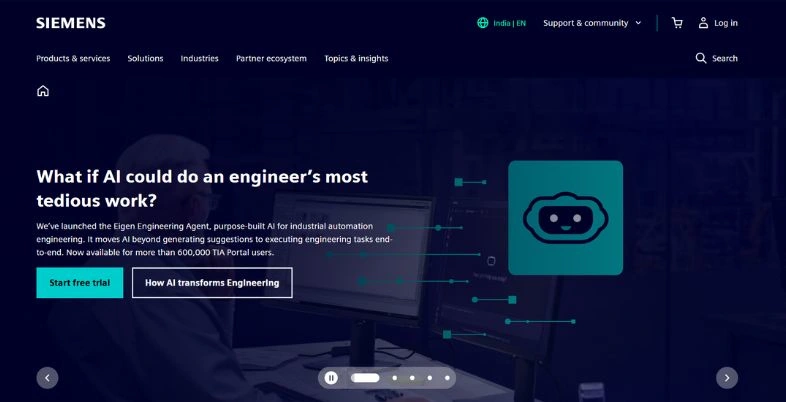
Siemens AG is an unrivaled worldwide leader in manufacturing automation and digital industry solutions. The Siemens Industrial Operations X portfolio is a comprehensive system of advanced Industrial Operations that is built on its flagship Industrial IoT system Siemens Insights Hub (formerly MindSphere) as the data layer. Its niche is to develop full digital twins of physical machines and combine them with cloud analytics. With the introduction of physical AI, Siemens helps heavy industries accelerate their long-term revenue growth and scalability. This significant hardware-to-software integration offers enormous efficiency gains and Siemens is one of the most reliable vendors of Industrial IoT in the world.
Key Services:
- Industrial Edge Processing
- Digital Twin Simulation
- Machine Predictive Maintenance
- Smart Asset Management
- Automated PLC Integration
- Energy Consumption Analytics
2. PTC Inc.
| Field | Details |
| Founded in | 1985 |
| Ratings | 4.4 / 5 |
| Website | https://ptc.com |
PTC Inc. is known for its one of the most successful and established purpose-built Industrial IoT application development platforms called ThingWorx. PTC has a strong solution that eliminates some of the developer friction by enabling complex manufacturing hardware to be connected easily by offering a powerful low-code framework. It differentiates itself from other growth products by offering a combination of augmented reality (Vuforia) with its core data architecture, allowing field engineers to engage with real-time machine analytics visually. The specialization contributes to boosting workforce productivity, giving product services an edge over the competition and quickly building digital twins, making PTC a good contender for the modern Industrial IoT category for product engineering teams.
Key Services:
- Low-Code App Development
- Augmented Reality Guidance
- Real-Time Telemetry Analytics
- Multi-Protocol Asset Connectivity
- Digital Performance Management
- Remote Device Management
3. Amazon Web Services (AWS)
| Field | Details |
| Founded in | 2006 |
| Ratings | 4.7 / 5 |
| Website | https://amazon.com |
AWS dominates the cloud-native infrastructure market, with the ability to deliver unmatched global scale with AWS IoT Core and AWS IoT SiteWise. AWS makes the management of huge amounts of telemetry data from millions of geographically dispersed physical assets its specialty while also offering an attractive “pay-as-you-go” financial model. The platform’s biggest strength is Greengrass V2, which allows providers to add and integrate sophisticated machine learning services and automated edge computing. It enables asset-heavy companies to securely handle, access, and analyse huge volumes of data from their operations, gain valuable insights of their facilities, and streamline workflows without any manual effort. AWS is one of the most trusted names in providing large-scale Industrial IoT Solutions today.
Key Services:
- Secure Device Gateway
- Cloud Data Aggregation
- Edge Compute Processing
- Real-Time Analytics Streaming
- Automated Shadow Provisioning
- Industrial Protocol Transformation
4. Microsoft Corporation

| Field | Details |
| Founded in | 1975 |
| Ratings | 4.6 / 5 |
| Website | https://microsoft.com |
Microsoft Corporation provides enterprise-level operational visibility with its Azure IoT Hub and cloud-native solutions that are custom-built for factories. Microsoft’s focus is on creating a full-featured and highly secure hybrid-cloud solution that fits existing enterprise IT structures. It’s fundamental growth advantages come from its state-of-the-art digital twin functionality, converting raw signals from industrial machinery into structured and actionable business intelligence. By doing so, Microsoft enables manufacturers to manage the life cycles of their products, keep machines running and maintain Zero Trust security regulations throughout their global operations, putting them at the forefront of enterprise choice for solutions that are scalable.
Key Services:
- Secure Device Authentication
- Hybrid Cloud Architecture
- Virtual Facility Modeling
- Predictive Health Insights
- Edge Security Compliance
- Automated Firmware Updates
5. Samsara Inc.
| Field | Details |
| Founded in | 2015 |
| Ratings | 4.5 / 5 |
| Website | https://samsara.com |
Samsara Inc. is shaking up the industry with its high-growth model focused on connected, physical operations and real-time fleet telemetry. By pairing wireless field sensors with AI-powered camera technology, Samsara brings tracking together in one dashboard, from vehicles to heavy-duty warehouse equipment to distribution center operations. The biggest advantage of using Samsara for businesses is the speed at which they will see an ROI from the features it provides, such as automated workflows, decreased accident numbers and fuel costs. What makes it truly special is its capacity to translate complex operational information into easily digestible software, positioning Samsara as one of the fastest-growing Industrial IoT Solution in logistics today.
Key Services:
- Fleet Asset Tracking
- AI Safety Cameras
- Real-Time Logistics Insights
- Wireless Sensor Monitoring
- Predictive Maintenance Diagnostics
- Automated Workflow Digitization
6. IBM Corporation
| Field | Details |
| Founded in | 1911 |
| Ratings | 4.3 / 5 |
| Website | https://ibm.com |
The IBM Corporation continues to be a leader in enterprise asset management, primarily through its AI-powered IBM Maximo and Watson IoT platform. IBM’s strength lies in processing vast amounts of historical data and creating a cognitive asset management system for assessing machine health and structural integrity. One important differentiator in its service is the ability to provide advanced predictive maintenance, thus minimizing the number of unplanned industrial failures and extending often-costly equipment lifecycles. With data pipelines connected directly to hybrid clouds, IBM guarantees critical infrastructure operators’ data security and operational efficiency, solidifying its position as one of the most trusted Industrial IoT Solutions for enterprises with extensive heavy assets.
Key Services:
- Cognitive Asset Optimization
- Predictive Maintenance Analytics
- Advanced Hybrid Cloud
- Digital Twin Mapping
- Secure Edge Computing
- Enterprise System Integration
7. Cisco Systems, Inc.

| Field | Details |
| Founded in | 1984 |
| Ratings | 4.5 / 5 |
| Website | https://cisco.com |
Cisco Systems, Inc. brings the same robust enterprise networking legacy to the Industrial Internet of Things (IIoT) where it provides highly secure, ruggedized infrastructure solutions. Cisco’s specialty is safely connecting hardware at huge volume in tough environments such as oil fields, utility networks and intricate factories. It is essential for its benefit to growth because it offers zero trust network perimeter protection and real time data visibility at the edge of the network, which is unbreakable. This helps to eliminate costly security breaches and decrease the latency of communication, which makes Cisco a key network layer for secure, large-scale Industrial IoT across the globe.
Key Services:
- Secure Scale Connectivity
- Industrial Network Automation
- Real-Time Edge Processing
- Threat Visibility Infrastructure
- Ruggedized Access Routing
- Centralized Device Management
Benefits & ROI of Industrial IoT Adoption
The benefits of an Industrial IoT Solution are so broad that businesses get a return on investment much quicker than anticipated, mostly because the benefits impact virtually every aspect of the operation from the shop floor to financial. These are the advantages behind the move for 2026:
- Minimizes unexpected downtime by proactively detecting and alerting on faults.
- Improves maintenance schedules; switching from scheduled to condition-based maintenance improves maintenance costs.
- Enhances worker safety by monitoring hazards in real time and shutting down automatically
- Optimizes machine scheduling and workflows to boost production capacity
- Reduces energy use through granular tracking of energy use and waste prevention
- Improves visibility in the supply chain by tracking assets and shipments in real time
- Improves the process for making decisions using real-time dashboards rather than manual reports
- Implements maintenance interventions on schedule, based on data to extend equipment life
- Allows for regulatory compliance by featuring automated audit trails and reporting
- Provides ROI in 12 to 24 months after deployment, on average
Challenges – Security, Integration & Cost
| Challenge | Description | Common Mitigation |
| Cybersecurity Risks | Connected devices expand the attack surface for hackers | Zero-trust architecture, network segmentation |
| Legacy System Integration | Old machinery often lacks native connectivity | Retrofit sensors, protocol gateways |
| High Initial Investment | Sensors, gateways, and platforms require upfront capital | Phased rollouts, pilot projects |
| Data Overload | Massive telemetry volumes can overwhelm teams | Edge filtering, AI-driven prioritization |
| Skills Shortage | Few workers combine OT and IT expertise | Vendor training, managed services |
| Interoperability Gaps | Multi-vendor equipment may use incompatible protocols | Standards like OPC-UA, middleware layers |
How to Choose the Right IIoT Solution for Your Business
There are dozens of vendors available and finding the right Industrial IoT Solutions for your operation can be daunting. Refer to this checklist to make a decision:
- Establish clear business objectives first – such as reducing downtimes, saving money or enhancing safety.
- Ensure your current legacy equipment and IT are compatible?
- Focus on platforms that have robust cybersecurity credentials and OT-specific security measures.
- Explore pricing options – subscription, usage and/or per device licensing.
- Check scalability to allow platform to expand as more facilities or sensors are added on.
- Check for good customer support as well as experience in the industry from vendors
- Ask for a pilot rollout before investing in a rollout.
- To prevent vendor lock-in, make sure the platform is open protocols.
Comparison Table – Top IIoT Platforms
The following table outlines the strengths and weaknesses of the top Industrial IoT Solutions to help narrow down your short list of platforms to consider for your industry, capabilities and cost.
| Platform/Vendor | Best For (Industry) | Key Features | Protocols Supported | Pricing Model | Notable Clients |
| Siemens Insights Hub | Manufacturing, Heavy Industry | Digital twins, edge analytics | OPC-UA, MQTT | Subscription-based | Automotive, energy firms |
| PTC ThingWorx | Product & Field Engineering | Low-code apps, AR integration | MQTT, REST, OPC-UA | Per-app licensing | Industrial equipment makers |
| AWS IoT | Cloud-Scale Enterprises | Massive scalability, ML integration | MQTT, HTTP, LoRaWAN | Pay-as-you-go | Global logistics, energy |
| Microsoft Azure IoT | Hybrid Enterprise Deployments | Hybrid cloud, digital twins | MQTT, AMQP, OPC-UA | Consumption-based | Manufacturing conglomerates |
| Samsara | Fleet & Field Operations | Telematics, AI cameras | Cellular, GPS, MQTT | Subscription-based | Transportation, construction |
| IBM Maximo | Asset-Heavy Enterprises | Predictive maintenance, EAM | MQTT, REST | Tiered licensing | Utilities, oil and gas |
| Cisco IoT | Network & OT Security | Secure connectivity, edge networking | MQTT, OPC-UA, 5G | Hardware plus subscription | Utilities, critical infrastructure |
Conclusion
By 2026, Industrial IoT Solutions are a fundamental part of the infrastructure of competitive manufacturing, logistics, and energy operations and are no longer just a point of experimentation. Whether it’s taking data at the sensor level or leveraging AI-powered digital twins, each level of the technology stack is built to minimize downtime, lower costs and enhance safety. The platform you select will be based on your industry, current systems, and future scalability requirements.
From Siemens’ deep manufacturing know-how to AWS’ cloud-scale capabilities, the providers listed here are the best of the many choices available today. The businesses that will be most efficient and resilient in their growth in the future will be those that use connected technology wisely.
FAQs
What’s the difference between IoT and Industrial IoT (IIoT)?
IoT is typically used to describe everyday consumer devices such as smart speakers or wearables, whereas IIoT applies to industrial machinery in factories, plants and fleets, and demands greater reliability, more rugged hardware and more severe security standards to avoid expensive downtime.
What are the most widely-used Industrial IoT protocols?
Bandwidth, latency and level of security required drive selection between MQTT, OPC-UA and now more commonly, private 5G, as a means to connect industrial sensors, machines and cloud platforms.
What is the price of implementing an Industrial IoT Solutions?
The number of sensors, facilities and the complexity of integration will determine the cost and range from a few thousand dollars for small pilot projects to millions for enterprise-wide implementations.
Who are the industries that are best suited to Industrial IoT?
The rate of measurable ROI is highest for manufacturing, energy and utilities, logistics, oil and gas, and heavy equipment industries, which tend to have high equipment capital expenses and unplanned downtime costs.
What are the greatest threats to security in Industrial IoT deployments?
The most common risks are expanded attack surface, insecure legacy equipment, and poor network segmentation, which are often mitigated by using a zero-trust architecture, regularly updating firmware and monitoring networks for unusual activity.