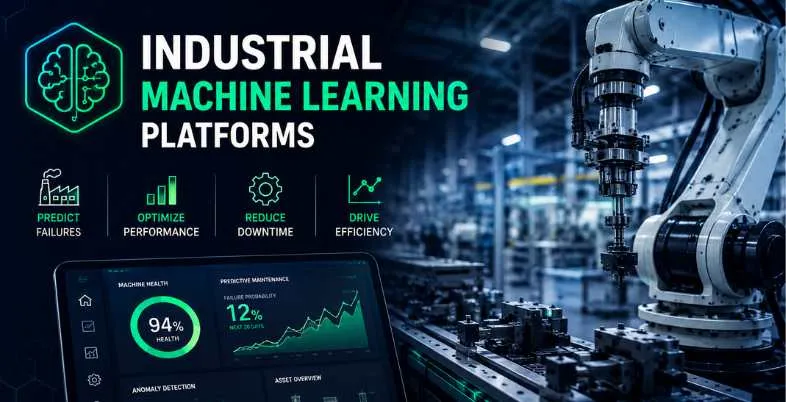
By 2026, the era of the Industrial machine learning platforms is not a pipe dream but it would be the lifeline of our manufacturing and energy and heavy industries. The mass adoption of automation in factories has never been greater and platforms needing to understand, analyse, and predict faults, and optimise and automate production lines are more important than ever. In 2026, the value of the machine learning market is expected to reach $126.91 billion with a CAGR of more than 33% until 2035, when it is expected to hit $1.7 trillion.
Reducing costs and downtime, while maintaining output quality, is a challenge for industries. That is where industrial machine learning platforms come in: They enable connecting machines, data and decisions in real time. More than two-thirds of the manufacturing companies intend to adopt AI-based predictive systems by 2026, according to industry data. The market for predictive maintenance will grow to $23.79 billion by 2031, which represents a 77% increase from 2026.
Any organization in any industry — from automotive to oil & gas, pharmaceuticals, or discrete manufacturing — will be able to achieve ROI from the selection of an appropriate industrial ML platform — most likely within 9-18 months for process industries. This guide includes details on the top 15 platforms in 2026, an analysis of the differences between them, an explanation of when you should use them, and a framework for deciding on which platform to purchase.
What Are Industrial Machine Learning Platforms?
Industrial machine learning platforms are software solutions designed for deployment, management and scaling of AI and machine learning models in industrial settings. They are also designed to interact with OT (Operational Technology) data that includes sensor streams, PLCs, SCADA systems and IIoT devices, as opposed to the general kinds of machine learning platforms previously mentioned above.
They link shop floor data to the analytical engines for use cases such as predictive maintenance, quality management, anomaly detection and process optimization. By 2026, more than 80% of top companies say their investments in platforms for ML and AI boost their revenue. Their platforms run on edge, cloud, and hybrid, and so are flexible for large enterprises and growing, medium-sized manufacturers. In 2026, the MLaaS market is projected to hit $61.58 billion, making the use of industrial ML more cost-effective and scalable than ever.
Core Capabilities to Evaluate
In 2026, there will be many industrial machine learning platforms to choose from, and the main criterion will be functionality. The MLaaS market is expanding at a rate of 34.58%, with new features gaining the ground in a quicker rate – it is essential to analyse the platforms based on their essentials which will have lasting worth.
- IIoT & Protocol Support: Natively support OPC-UA, MQTT, Modbus and Profinet as the most widely used industrial communication protocols, with no need to install custom middleware.
- Edge-to-Cloud Flexibility: Ensure platforms support running ML inference at the edge with low latency for near-shore decision-making and transferring models to the cloud for training or governance.
- AutoML & No-Code Tools: Platforms that provide these tools empower process engineers to build, test, and deploy models on those platforms, without requiring the expertise of data science professionals.
- Model Monitoring & Drift Detection: Equipment wears over time in industrial settings and it is critical to notify a team of model drift or a change in the process that may cause a loss in model accuracy.
- Develop Domain-Specific AI Templates: Academic Organizations have pre-built templates for predictive maintenance, OEE tracking and quality inspection to reduce risks of implementation and deployment by weeks.
Comparison Table – Top 15 Industrial ML Platforms in 2026
| Tool Name | Best For | Key AI Features | Deployment | IoT Support | Rating (G2/Gartner) |
| Siemens Insights Hub | Manufacturing & Energy | Digital Twin, Predictive Maintenance, Anomaly Detection | Edge + Cloud | Yes (OPC-UA, MQTT) | 4.3/5 |
| PTC ThingWorx | Custom IIoT Apps | AR Integration, ML Analytics, Process Monitoring | Cloud + On-Prem | Yes | 4.2/5 |
| Microsoft Azure ML | Enterprise & Multi-Industry | AutoML, MLOps, Responsible AI | Cloud + Hybrid | Yes | 4.4/5 |
| Amazon SageMaker | Data Science Teams | AutoML, Managed Training, Pipelines | Cloud | Yes (via IoT Core) | 4.3/5 |
| DataRobot | AutoML & Governance | AutoML, Gen AI, Lifecycle Management | Cloud + On-Prem | Partial | 4.2/5 |
| C3 AI | Enterprise Asset Optimization | Agentic AI, Predictive Maintenance, Supply Chain | Cloud + Hybrid | Yes | 4.1/5 |
| SymphonyAI Industrial | Process Industries | Anomaly Detection, Root Cause Analysis | Edge + Cloud | Yes | 4.2/5 |
| Intelecy | SME Manufacturing | No-Code ML, Time-Series AI | Cloud | Yes | 4.4/5 |
| SparkCognition | Energy & Industrial Safety | NLP, Predictive Analytics, Asset AI | Cloud + On-Prem | Yes | 4.1/5 |
| Edge Impulse | Embedded & Edge ML | TinyML, Sensor Fusion, Real-Time Inference | Edge | Yes | 4.5/5 |
| GE Predix (Vernova) | Energy & Power | Asset Performance Management, Digital Twin | Cloud + Hybrid | Yes | 4.0/5 |
| IBM watsonx | Governed Enterprise AI | Foundation Models, MLOps, Explainability | Cloud + On-Prem | Yes | 4.3/5 |
| SAS Viya | Analytics & Compliance | Advanced Analytics, Visual ML, Governance | Cloud + On-Prem | Yes | 4.3/5 |
| Altair RapidMiner | Data Science & R&D | AutoML, Visual Workflow, AI Studio | Cloud + On-Prem | Partial | 4.6/5 |
| Hitachi Lumada | IIoT & Asset Intelligence | DataOps, Digital Twins, Edge AI (Lumada 3.0) | Edge + Cloud | Yes | 4.2/5 |
Top 15 Industrial ML Platforms in 2026
1. Siemens Insights Hub
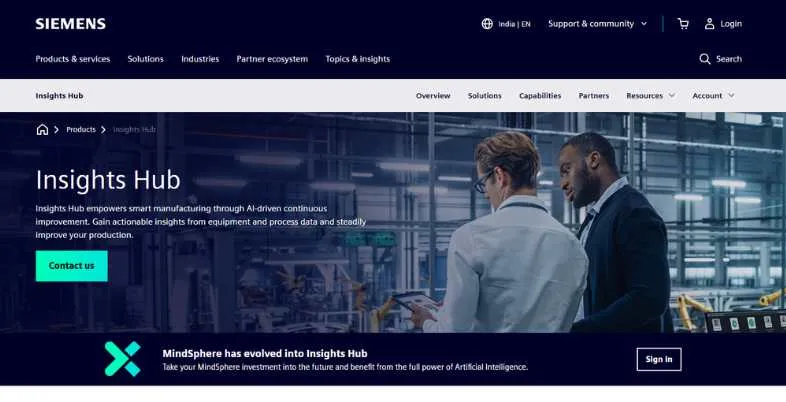
One of the oldest Industrial machine learning platforms available in the market is Siemens Insights Hub (previously, MindSphere). It has been developed based on a low-code Mendix platform and is designed to link machines, plants, and systems from edge to cloud. It is suitable for large-scale industrial applications and natively configured to Siemens automation solutions such as Picks, CNCs and drives.
Advanced analytics, AI Condition Monitoring and Digital Twin capabilities are provided by Insights Hub. It is able to support both OPC-UA and MQTT protocols and is widely used in manufacturing, energy and transportation industries around the world.
Key Features
- Digital Twin Integration
- Predictive Maintenance AI
- OEE Analytics Dashboard
- Edge-to-Cloud Data Pipeline
- Open API & App Marketplace
Industry Use Case: Manufacturing, Energy, Transportation
Deployment: Edge + Cloud
Website: https://www.siemens.com/en-us/products/insights-hub/
Also Read:
2. PTC ThingWorx
PTC ThingWorx is one of the Industrial machine learning platforms designed for the industry, rooted in Product Lifecycle Management (PLM) and smart manufacturing. It gives a flexible development platform to create custom applications using IIoT with the analytical feature of ML algorithms. One of ThingWorx’s standout features is its seamless compatibility with PTC’s Vufori augmented reality suite, facilitating AR-supported maintenance processes in the factory.
It has a versatile range of industrial protocols and interfaces with ERP and MES systems. For engineers who demand high levels of customization and industrial-grade reliability in their tools, ThingWorx is still one of the best choices in 2026.
Key Features
- AR-Guided Maintenance Tools
- ML-Powered Anomaly Detection
- Industrial Protocol Connectors
- Digital Performance Insights
- Low-Code App Builder
Industry Use Case: Smart Manufacturing, Aerospace
Deployment: Cloud + On-Premise
Website: https://www.ptc.com/en/products/thingworx
3. Microsoft Azure Machine Learning

Microsoft Azure Machine Learning is a cloud based platform to create, train, and deploy ML models at enterprise scale. If you are using an industrial Azure component like Azure IoT Hub, Azure Digital Twins, or Power BI, it integrates with it to form end-to-end intelligent manufacturing solutions. It provides responsible AI tools, Automated Machine Learning and also a drag-and-drop designer for non-data scientists.
With its MLOps features, industrial teams can version models, monitor them and retrain them in production. Azure ML is a good choice for companies that are already embarked on the Microsoft journey, such as those using Dynamics 365 and Microsoft Fabric for aggregate analytics.
Key Features
- AutoML with Industrial Templates
- Responsible AI Dashboard
- Azure IoT & Digital Twin Integration
- Collaborative MLOps Pipelines
- Model Monitoring & Drift Alerts
Industry Use Case: Manufacturing, Pharmaceuticals, Energy
Deployment: Cloud + Hybrid
Website: https://azure.microsoft.com/en-us/products/machine-learning
4. Amazon SageMaker (AWS)
Organizations use Amazon SageMaker to easily create, train, and deploy machine learning models at scale, offering a completely managed platform for the AWS machine learning team. It provides an integrated development environment (IDE) featuring a model registry, a debugger, and model pipelines & Jupyter notebooks.
In addition to Amazon SageMaker’s existing connectivity and ability to deploy models at our edge, we added enhanced support for AWS IoT SiteWise and AWS IoT Greengrass.
Key Features
- Managed Model Training & Deployment
- SageMaker Pipelines for MLOps
- Built-In Algorithms & AutoML
- Edge Inference via Greengrass
- Model Monitor for Drift Detection
Industry Use Case: Manufacturing, Finance, Healthcare
Deployment: Cloud (Edge via Greengrass)
Website: https://aws.amazon.com/sagemaker/
5. DataRobot
DataRobot is a leader in the AI lifecycle market, the inventor of AutoML and Automated Time Series forecasting. Now it provides a full enterprise AI suite ranging from model development to MLOps, governance and Generative AI. To date, over 1,000 organizations all over the world depend on DataRobot for AI governance and policy enforcement.
The 2026 releases introduce templates for specific industrial AI use cases, such as predictive maintenance, demand forecasting, and quality inspection, to ease model deployment. For companies looking to spread AI across departments but without a data science team, DataRobot is a great option.
Key Features
- AutoML & Automated Time Series
- Gen AI with Embedding Drift Detection
- AI Governance & Compliance Engine
- Domain-Specific Industrial Templates
- Shadow AI Management
Industry Use Case: Manufacturing, Supply Chain, Finance
Deployment: Cloud + On-Premise
Website: https://www.datarobot.com/
6. C3 AI
C3 AI is a prominent enterprise AI software vendor, creating and scaling AI-based solutions across asset-intensive sectors. The new April 2026-launch C3 Code adds code-free production-grade AI application development for business analysts to its C3 Agentic AI Platform.
C3 AI has numerous applications, such as supply chain optimization, energy management, and predictive maintenance, across various industry verticals including oil and gas, utilities, defense, and heavy industrial manufacturing. Cooperation with Baker Hughes and Shell puts it in a good position within the energy industry. C3 AI pre-builts more than 40 industry specific AI applications.
Key Features
- Agentic AI Application Builder
- Predictive Asset Maintenance
- Supply Chain Optimization AI
- Energy Management Applications
- Natural Language App Development (C3 Code)
Industry Use Case: Oil & Gas, Utilities, Defense
Deployment: Cloud + Hybrid
Website: https://c3.ai/
7. SymphonyAI Industrial
SymphonyAI Industrial is an AI platform designed specifically for process & discrete manufacturers. It places emphasis on applying AI to detect anomalies, understand and review root causes, perform soft sensing, and optimize process performance in the industry sector. SymphonyAI provides out-of-the-box AI capabilities for industries such as chemical, food, metals and semiconductor manufacturing.
It has an industrial AI engine that can directly link to hierarchies, including historian data, DCS, and SCADA, to minimize integration time. SymphonyAI is continuing its AI suite path to Tier 1 and Tier 2 manufacturers facing a challenge with time to value and small data science teams.
Key Features
- Anomaly Detection & Root Cause AI
- Soft Sensor Modeling
- Historian & SCADA Integration
- Process Optimization Engine
- Ready-to-Deploy Industry Apps
Industry Use Case: Chemicals, Food & Beverage, Metals
Deployment: Edge + Cloud
Website: https://www.symphonyai.com/industrial/
8. Intelecy
Intelecy is an industrial machine learning platform for small and medium scale manufacturers looking to infuse AI without needing to recruit data scientists. It links to existing industrial data sources like OPC-DA, OPC-UA, and cloud historians, and has a simple drag-and-drop interface for process engineers to create time-series ML models. Intelecy’s emphasis is on the quick deployment, implementation, and minimum IT involvement.
This is especially the case in the Nordic manufacturing industry and is receiving some momentum in the world as no-code AI grows to become an industry standard for SME operations in 2026.
Key Features
- No-Code ML Model Builder
- Time-Series Anomaly Detection
- OPC-UA & Historian Connectors
- Cloud-Based Model Deployment
- Engineer-Friendly Dashboard
Industry Use Case: SME Manufacturing, Process Industries
Deployment: Cloud
Website: https://www.intelecy.com/
9. SparkCognition | Avathon
SparkCognition is an AI company that specializes in Industrial Safety, Energy, and Asset Performance Management. It’s powered by Darwin AI, which integrates machine learning, NLP and explainable AI to assist industrial operators to make quicker, safer decisions. SparkCognition’s customers encompass a variety of industries including aviation, oil and gas, power generation and manufacturing.
It is recognized for its contributions to industrial control systems (ICS) cybersecurity AI and prediction capability. SparkCognition remains a preferred option for companies seeking AI solutions that integrate safety compliance, regulatory transparency, and critical industrial landscapes in 2026.
Key Features
- Darwin AutoML Platform
- Industrial NLP & Text Analytics
- Predictive Asset Management
- Cybersecurity AI for ICS/OT
- Explainable AI for Safety Compliance
Industry Use Case: Energy, Aviation, Oil & Gas
Deployment: Cloud + On-Premise
Website: https://cloud.google.com/find-a-partner/partner/sparkcognitioncom
10. Edge Impulse
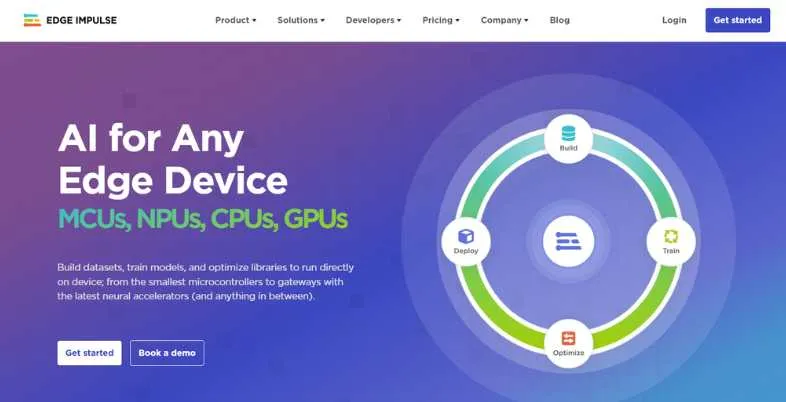
Edge Impulse is the most popular platform for machine learning on devices, microcontrollers and embedded systems. It is designed to deploy ML Models in hardware with minimal power consumption, directly to sensors, PLCs, wearables and IoT Gateways; at minimal power.
Edge Impulse is capable of building TinyML workflows and fusing multiple sensors, ideal for condition monitoring at the device level. 33% growth has been seen in 2026 in the adoption of TinyML for IOT in Industry because of the requirement for real-time inference with a low latency on the shop floor. Examples of where Edge Impulse is commonly applied at the edge of the machine are vibration analysis, sound anomaly detection, and predictive quality inspection.
Key Features
- TinyML Model Development
- Sensor Fusion & Signal Processing
- Embedded Deployment (MCUs & DSPs)
- Real-Time Edge Inference
- Visual Impulse Designer
Industry Use Case: Condition Monitoring, Wearables, Quality
Deployment: Edge
Website: https://www.edgeimpulse.com/
11. GE Predix (GE Vernova)
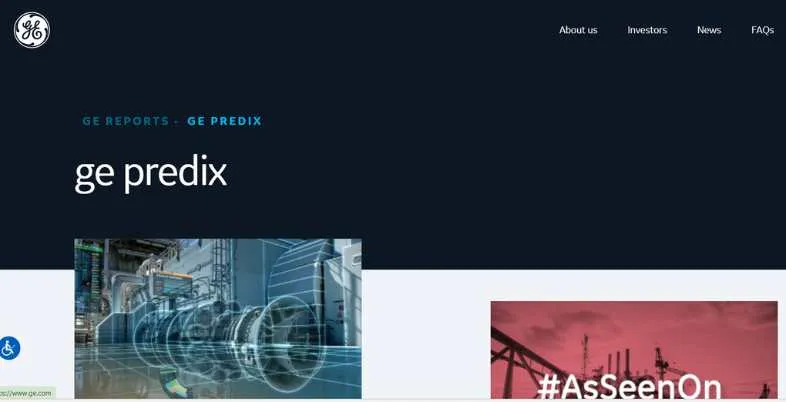
GE Predix is an industrial related and analytics platform for the power generation, aviation and heavy equipment sector, now part of GE Vernova’s industrial software portfolio. Predix provides APE, digital twin asset model and anomaly detection based on machine learning for industrial assets. It integrates OT data with operation insights, and helps teams lower unplanned downtime, to increase the lifecycles of assets.
GE Vernova is continuing to invest in Predix as a major element of its energy transition efforts, and plans to add more AI modules such as for wind, grid and gas power operations for 2026. It still is one of the most mature solutions for energy companies with heavy investments in their asset base.
Key Features
- Asset Performance Management (APM)
- Digital Twin Modeling
- Predictive Anomaly Detection
- Time-Series Data Historian
- Power & Grid Analytics
Industry Use Case: Power Generation, Aviation, Energy
Deployment: Cloud + Hybrid
12. IBM watsonx
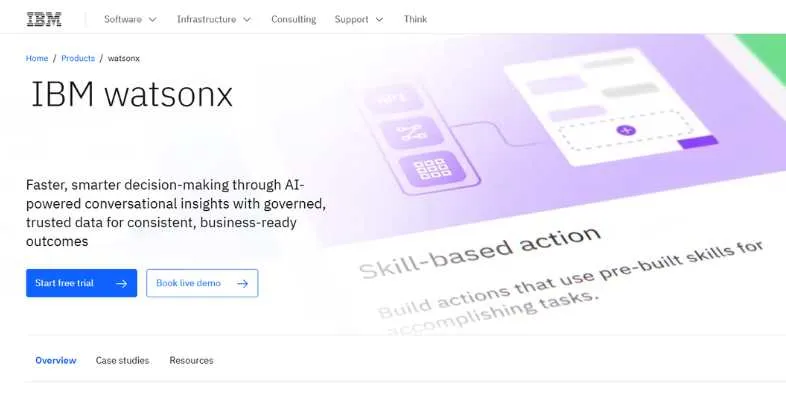
IBM watsonx is IBM’s next-generation AI and data platform comprised of three integrated components: watsonx.ai to develop and deploy models, watsonx.data to manage data governably, and watsonx.governance to ensure AI transparency and compliance. In terms of use cases, WatsonX is designed to be platform-agnostic and seamlessly integrates with IBM Maximo for asset management, while providing ML models for predictive maintenance, quality assurance, and supply chain intelligence for industrial application needs.
It offers users thousands of foundation models, including generative foundation models, and allows for both generative AI and traditional machine learning applications. For enterprises that require enterprise-wide responsible AI, regulatory compliance, and AI governance, IBM watsonx has become a trusted partner.
Key Features
- Foundation Model Access & Fine-Tuning
- watsonx.governance for AI Compliance
- IBM Maximo Integration for Asset AI
- AutoML & Prompt Tuning Studio
- RAG Pipeline Builder
Industry Use Case: Manufacturing, Utilities, Government
Deployment: Cloud + On-Premise
Website: https://www.ibm.com/products/watsonx
13. SAS Viya
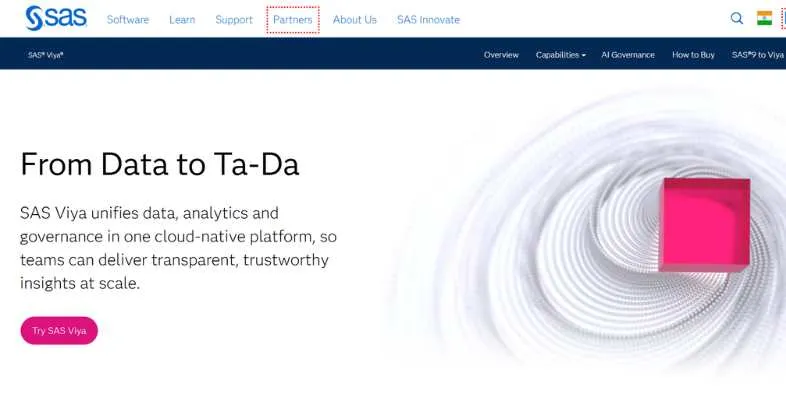
SAS Viya is a decades-old enterprise analytics and governance platform that is built on the cloud and has been augmented with AI capabilities. It’s meant for enterprise use by regulated businesses requiring a sophisticated machine learning solution, visual analytics, and robust model governance. The supervised and unsupervised learning, natural language processing, computer vision, and forecasting capabilities of SAS Viya are just examples of the machine learning powers it brings.
It has strong controls on G2 in 2026, which means that it is listed among the top platforms for analytics. SAS Viya is implemented in the geographic information services (GIS) and utility sectors, as well as in the pharmaceutical manufacturing industry, among others, where data integrity and model accountability are paramount.
Key Features
- Visual ML Pipeline Builder
- Advanced Forecasting & NLP
- AI Governance & Audit Trails
- High-Performance In-Memory Analytics
- Cloud-Native Scalability
Industry Use Case: Pharma Manufacturing, Finance, Utilities
Deployment: Cloud + On-Premise
Website: https://www.sas.com/en_in/software/viya.html
14. Altair RapidMiner (Altair AI Studio)
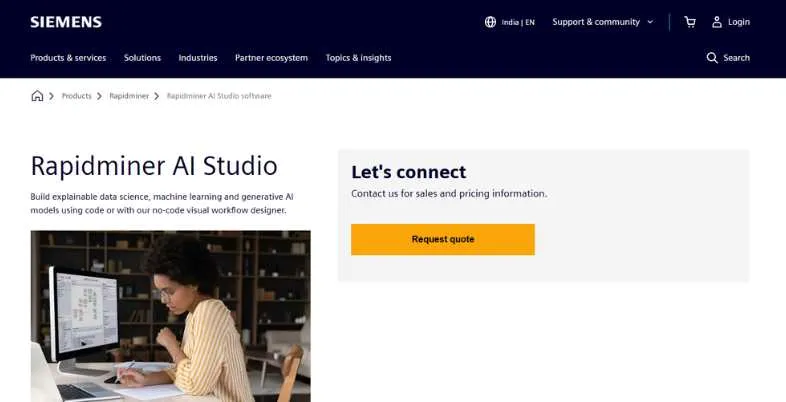
Altair RapidMiner (as it’s now called, Altair AI Studio) is an established data science machine learning platform with an AutoML component, and with a strong visual workflow approach. It’s widely used by R&D teams, Quality Engineers and Data Analysts looking to develop and test ML models with minimal coding effort.
Altair AI Studio includes support to prepare and model across all the stages of deployment, including integration with the rest of Altair’s engineering suite of simulation products. All users are consistently satisfied, so it measures 4.6 stars and becomes a G2 item in 2026. This makes it an excellent choice for industrial teams seeking easy-to-use AI to drive engineering innovation.
Key Features
- Visual Drag-and-Drop ML Workflow
- AutoML with Explainability
- Integration with Altair Simulation Tools
- Data Blending & Preparation Engine
- Model Deployment & REST API Export
Industry Use Case: R&D, Quality Engineering, Process Optimization
Deployment: Cloud + On-Premise
Website: https://academy.rapidminer.com/
15. Hitachi Lumada
Hitachi Lumada is a fully integrated Industrial IoT and AI system with data management, machine learning, digital twins, and edge AI all in one. Hitachi is launching the Lumada 3.0 in 2026 which features new edge AI semiconductor technologies that utilize AI models and algorithms that consume up to 90% less power than current AI chips, allowing real-time inference across space and power constraints in factory settings.
Lumada is applied in smart cities, energy, and rail, as well as in the manufacturing industry. In total, it aims at lowering operations costs by some 30% by applying predictive and prescriptive analytics, and reducing time spent on assembling data by up to 40% by its packaged analytic modules. The application of IT-OT convergence approach differentiates it from other cloud-only competitors.
Key Features
- Lumada 3.0 Edge AI with 1/10 Power Consumption
- Industrial DataOps Framework
- Digital Twin & ML Service
- Anomaly Detection for Equipment
- IT-OT Data Integration Layer
Industry Use Case: Manufacturing, Rail, Smart Infrastructure
Deployment: Edge + Cloud
Website: https://www.hitachi.com/products/it/lumada/global/en/
Use Case Deep-Dives
Predictive Maintenance Platforms that are designed with predictive maintenance in mind, include Siemens’ Insights Hub, C3 AI and Hitachi’s Lumada. They consume the vibration, temperature and pressure data sent by the sensors and use the ML models to predict the failure windows. During production-grade deployments in 2026, more than 3–8 OEE availability point improvements are being realized and 20–40% maintenance cost savings are being achieved by various major industrial groups.
Quality Control & Defect Detection Edge Impulse and SymphonyAI Industrial manage the machine level quality inspection in real time. Utilizing TinyML models on embedded sensors, it is possible to detect defects within sub-millisecond latency, which is beneficial in electronics, semiconductor and automotive production lines.
Process optimization is supported by SAS Viya, Process, DataRobot, and C3 AI by providing a continuous feedback loop with the models. They are adopted by chemical plants, refineries, and food processing facilities to ensure optimum yields, lower energy usage, and consistent product quality without constant human intervention.
EnergySpark (Vernova) and GE Predix are both targeted to power generation, grid management and the oil and gas industry. They use ML to predict demand, optimize asset dispatch and identify anomalies from turbines, pipelines, and substations – all of which are helpful in minimizing expensive unwanted outages.
Demand Forecasting, Inventory optimization, and Supplier risk analysis are utilized with Supply Chain Intelligence (Amazon SageMaker) and Microsoft Azure ML. These platforms can be connected to ERP systems and streams of IoT information and provide supply chain teams with real-time, ML-driven decision support.
On-Premise vs Cloud vs Edge Deployment
| Deployment Type | Best For | Key Advantages | Limitations | Typical Platforms |
| On-Premise | Regulated industries, sensitive OT data | Full data control, low latency for local tasks, no cloud dependency | High upfront cost, maintenance burden, limited scalability | IBM watsonx, SAS Viya, DataRobot |
| Cloud | Enterprise-scale analytics, remote teams | Elastic scaling, fast deployment, lower infrastructure costs | Latency for real-time control, requires reliable internet | Azure ML, SageMaker, C3 AI |
| Edge | Real-time inference, bandwidth-constrained environments | Ultra-low latency, works offline, reduces data transfer costs | Limited compute, harder to update and manage models remotely | Edge Impulse, Hitachi Lumada, Siemens Insights Hub |
| Hybrid (Cloud + On-Prem) | Large enterprises with mixed environments | Balance of control and scalability, phased migration path | Complex architecture, integration overhead | Siemens, PTC, SparkCognition |
| Edge + Cloud (Federated) | Multi-site manufacturers, IIoT-intensive operations | Train in cloud, infer at edge, centralized governance | Requires MLOps maturity, data sync complexity | SymphonyAI, Hitachi Lumada 3.0, Azure IoT |
Industrial ML Platform Pricing Guide
The Industrial machine learning platforms in 2026 can go all the way from $0.01/month to $100,000/month and depends on the model, size, and services provided. The MLaaS market is projected at $61.58 billion in 2026, with the available options available ranging from free-tier entry points for startups, to multi-million dollar contracts en masse for enterprise clients across the globe.
- Usage-Based / Pay-As-You-Go: For predictable workloads, sagemaker’s ML savings plan can cut costs by up to 64% using pay-as-you-go and usage-based pricing models like Amazon SageMaker and Azure ML.
- Subscription / SaaS: Licensed platforms-such as Intelecy and DataRobot-usually cost a few hundred to thousands of dollars per month, per number of users, per monthly volume of data.
- Enterprise / Custom Contracts: Three enterprise options, C3 AI, SymphonyAI, and IBM watsonx, require an enterprise contract-usually beginning at $100,000+ annually that includes full access to the platform, professional services and dedicated support.
- Freemium / Developer Tiers: Edge Impulse and some Azure ML tiers are available for free to develop and prototype, while business or production deployment and team collaboration is available on the paid tiers, and higher level of models available on the paid tiers.
- Pilot-First Pricing: Pilots of 10-30 assets start at €50,000-€200,000, and enterprise programs roll out for programs for €2M and more.
How to Choose the Right Platform – Decision Framework
There’s more to it than comparing lists of features when choosing the right Industrial machine learning platforms. As of 2026, 34% of companies in the United States have already invested in ML, while 42% are actively looking into ML. To make a decision, you need to consider your business’s stage of maturity, team’s skills and abilities, and the current infrastructure state.
Evaluate Your Data Readiness: Determine if your sensor data is reasonably clean and structured, or if it needs scrubbing and cleanup prior to picking a platform. Data environments of imperfect quality, represented by platforms such as SymphonyAI and Intelecy, afford AI solutions that truly harness imperfect data.
Adapt Deployment to Infrastructure: Azure ML or SageMaker will seamlessly fit operations that are cloud first. Edge Impulse or Hitachi Lumada 3.0 might be more appropriate options if you are in an environment where you need to keep an eye out for edges and do not require network connection for inference.
No Code Team Skill Level Evaluation: Platforms such as Intelecy and DataRobot are no code and cater to Engineering teams with no data science skills. Observably better platforms are developer-friendly ones such as Azure ML and SageMaker, which are well suited for organizations with an ML engineer.
Focus on Industry Fit: Select platforms which have pre-built templates and connectors for your vertical. They offer time to value improvements of up to months compared to general platforms with C3 AI for oil and gas, SymphonyAI for process industries and GE Predix for power generation.
Plan for Governance and Scale: If Compliance, Explainability, and Multi-site Governance are key requirements – particularly in Pharma or Defense, IBM watsonx along with SAS Viya and DataRobot have leveraged their AI governance for a while now but lack the same at scale on the cloud.
Conclusion
In 2026, industrial machine learning platforms have emerged as a vital element of infrastructure for any manufacturer or industrial operator looking to be competitive. For small factories, solutions such as Intelecy’s, which are no-code or no-touch based, suit the scale, while enterprise options like IBM’s watsonx or C3 AI work best for businesses with a global footprint.
The ideal industrial machine learning platforms bring together everything needed to get the machine learning application to market: the ability to connect with IoT, the ability to manage the ML models, and domain expertise all in one place. Utilize the comparison table, deployment guide and decision frame featured in this article to help you identify the platform that corresponds to your specific needs, and begin to create a smarter, more resilient industrial operation.
FAQs
What is an industrial machine learning platform?
An industrial machine learning platform is a software that analyses and learns data generated by operational machines, sensors, and industrial control systems to create, deploy and manage AI and machine learning (ML) models. These platforms enable predictive maintenance, quality checking, process optimization and other use cases in manufacturing and energy niche.
What is industrial ML used for?
Applications of industrial ML include predictive maintenance, real-time anomaly detection, quality control automation, energy optimization, process yield optimization, supply chain forecasting and safety monitoring. It turns raw sensor and equipment data into intelligence for front-line operators and managers.
How is industrial ML different from general ML?
Industrial ML is designed to maximize data from OT devices such as PLCs, SCADA, and historian systems and requires low latency and high uptime as well as dealing with noisy or sparse sensor measurements. General ML platforms are created for enterprise or customer data and do not easily integrate with industrial communications standards such as OPC-UA, Modbus or Profinet.
What is the best industrial machine learning platform for manufacturing?
Siemens Insights Hub, C3 AI, and IBM watsonx are robust options for large companies for enterprise-class AI governance and assurances as well as enterprise-class IIoT integration. SymphonyAI Industrial and Intelecy are no-code solutions that can be deployed quickly for mid-sized manufacturers and prepackaged for common manufacturing cases of need.
Can small manufacturers use industrial ML platforms?
Yes. Tools like Intelecy, Edge Impulse, and DataRobot provide low-cost subscription services, intuitive no-code platforms, and cloud-based deployment to make industrial ML attainable even without big IT teams or budgets. For smaller businesses, it may be best to begin with 3-5 critical assets, and work up from there to attain measurable ROI.