
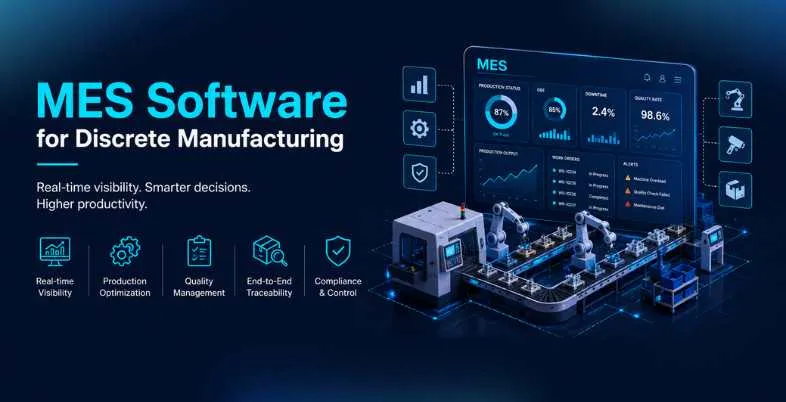
Whether it’s for car manufacturing, aircraft production, circuit board assembly or any other product that is built up from components, you should ensure that you have the right software to handle your shop floor. That’s where MES tool can help. By 2026, factories are more intelligent, quicker and connected than ever before. However, when there are dozens of MES tools available, selecting the suitable tool seems like a daunting task. The top 12 MES Software For Discrete Manufacturing options are analyzed without any jargon, no fluff.
From 10 units a day, to 10,000, this guide is perfect for finding the right fit for your team, your budget, and your industry.
What Is MES Software for Discrete Manufacturing?
A Manufacturing Execution System (MES) is a software that sits between your factory floor and your business systems. It monitors what is happening in the production, such as if a machine is running, how many parts are being produced, who is working on what machine, etc., and whether quality targets are being met. Consider it your shop floor “brain”.
Gathers real-time data, communicates to workers and machines, and aids managers in quick decisions. MES Software for Discrete Manufacturing is designed to serve factories that produce individual, countable products, such as a car door, a jet engine turbine, a smartphone PCB.
MES vs ERP vs SCADA: Key Differences for Discrete Manufacturers
| System | What It Does | Where It Lives |
| ERP (e.g., SAP, Oracle) | Manages business processes — finance, HR, procurement | Business/Office Level |
| MES | Manages shop floor execution — work orders, quality, OEE | Factory Level |
| SCADA | Monitors and controls machines and equipment in real time | Machine/Equipment Level |
Simply put: ERP is used to plan the work, MES is used to perform the work, and SCADA is used to monitor the machines that perform the work.
ISA-95 Standard: Why It Matters When Evaluating MES
ISA-95 is a worldwide standard for organising manufacturing software. It divides the business of the factory into five levels (Level 0 to Level 4):
- Level 0-2: Physical equipment and control systems (SCADA territory)
- Level 3: Manufacturing operations management (MES territory)
- Level 4: Business planning and logistics (ERP territory).
In assessing MES Software for Discrete Manufacturing, make sure that it is applicable to ISA-95 levels. A good MES should be able to work at Level 3 and seamlessly integrate with Level 2 (machines) and Level 4 (ERP).
Why Discrete Manufacturing Needs Specialized MES (Not Process MES)
Process manufacturing processes (chemicals, food, etc. work in continuous flow. Discrete manufacturing is for individual units and assemblies. Having a specific MES makes all the difference, here’s why:
- Bill of Materials (BOM) Complexity — Discrete products generally have hundreds or thousands of parts that should be put together in the correct sequence.
- Routing & Work Order Management — All products have different routing and need to be tracked step-by-step.
- Serialization & Traceability — All individual units must have a serialization number for recalling and compliance.
- Mixed-Model Production — Discrete factories may produce a variety of different products from the same line, requiring flexibility in scheduling.
- Rework & Scrap Tracking — MES tools have trouble when a part fails, it is reworked or marked as a scrap.
Discrete vs Process vs Hybrid Manufacturing: MES Differences
| Feature | Discrete MES | Process MES | Hybrid MES |
| Product Type | Countable units (cars, phones) | Bulk/continuous (chemicals, food) | Mix of both |
| BOM Structure | Multi-level, complex | Formula/recipe-based | Both |
| Tracking Unit | Serial/lot number per unit | Batch/lot number | Both |
| Work Orders | Job-based, routable | Campaign/batch-based | Flexible |
| Quality Checks | Per-unit inspection | Batch sampling | Both |
| Scheduling | Sequence-dependent | Time-continuous | Adaptive |
| Best For | Automotive, aerospace, electronics | Pharma, chemicals, food & beverage | Semiconductor, medical devices |
Key Challenges MES Solves in Discrete Manufacturing
- Poor Visibility on the Shop Floor — MES provides real-time dashboards with the knowledge of what’s going on at all workstations at all times.
- High Defect and Rework Rates — Automated quality checks and SPC (Statistical Process Control) prevent problems from becoming costly.
- Paper-Based Work Instructions — MES eliminates paper travelers by having digital work orders, helping to eliminate errors and delays.
- Low OEE (Overall Equipment Effectiveness) — MES records reasons for downtime and enables maintenance team to react quicker to breakdowns.
- Compliance & Audit Failures — Any audit question that you can ask, you can have the answer in minutes, not days, thanks to full electronic traceability.
How We Evaluated These MES Tools
- Industry Fit — We reviewed the tools that are designed for the Automotive, Aerospace and Electronics industries, and not just general manufacturing.
- ISA-95 Compliance — Each tool was checked to be compliant for the required functional levels for discrete operations.
- AI & Analytics Capabilities — We searched for something more than dashboards, but rather for true predictive maintenance, yield forecasting and anomaly detection.
- Total Cost of Ownership — Mid-market and enterprise buyers considered licensing, implementing and support costs.
MES Tool Comparison Overview Table
| MES Tool | Vendor | Best For | Deployment | ERP Integration | OEE Module | AI/ML Features | Industry Focus | Pricing Model | ABI/Gartner Rating |
| Opcenter Execution | Siemens | Enterprise Discrete | Cloud/On-Prem | SAP, Oracle | Yes | Advanced | Auto, Aero, Electronics | Subscription/License | 88.3/100 ABI |
| Manufacturing Cloud | SAP | SAP-native shops | Cloud | SAP Native | Yes | Embedded AI | All discrete | Subscription | 4.1/5 Gartner |
| Plex Smart Mfg | Rockwell | Mid-market cloud | Cloud-native | SAP, Oracle, MS | Yes | ML Analytics | Auto, Industrial | SaaS/User | 4.2/5 G2 |
| Epicor Advanced MES | Epicor | Mixed-mode mfg | Cloud/On-Prem | Epicor ERP native | Yes | Basic AI | Electronics, Ind. | Subscription | 4.0/5 G2 |
| DELMIA Apriso | Dassault | Automotive, Aero | Cloud/On-Prem | SAP, Oracle | Yes | Advanced | Auto, Aerospace | Enterprise License | 4.3/5 Gartner |
| Critical Manufacturing | Critical Mfg | Electronics, Semi | Cloud/On-Prem | SAP, Oracle, MS | Yes | AI Quality | Electronics, Semi | Module-based | 4.4/5 G2 |
| PINpoint MES | PINpoint | No-code shops | Cloud/On-Prem | Most ERPs | Yes | Basic ML | Auto, General | Per-station | 4.5/5 G2 |
| Proficy Smart Factory | GE Digital | Large facilities | On-Prem/Hybrid | SAP, Oracle | Yes | Industrial AI | Energy, Auto | Enterprise | 4.1/5 Gartner |
| AVEVA MES | AVEVA | Process-Discrete hybrid | Cloud/On-Prem | SAP, Oracle | Yes | AI/ML | O&G, Auto | Subscription | 4.0/5 Gartner |
| Aegis | Aegis | Electronics PCB | Cloud/On-Prem | SAP, Oracle | Yes | IIoT AI | Electronics | Module-based | 4.3/5 G2 |
| Infor MES | Infor | Mid-large discrete | Cloud | Infor CloudSuite | Yes | Coleman AI | Auto, Industrial | Subscription | 4.0/5 Gartner |
| Oracle MES | Oracle | Oracle ERP users | Cloud | Oracle Native | Yes | Oracle AI | All discrete | OCI Subscription | 4.1/5 Gartner |
Top 12 MES Software for Discrete Manufacturing (2026)
1. Siemens Opcenter Execution Discrete — Market Leader (88.3/100 ABI Research)
| Field | Details |
| Vendor | Siemens |
| HQ | Munich |
| Founded | 1847 |
| Deployment | Cloud, On-Premise, or Hybrid — flexible for any enterprise setup |
| Best Industry | Automotive |
| ISA-95 Level | Level 3 |
| ERP Integration | SAP, Oracle |
| G2/Gartner Score | 4.3/5 |
| Website | https://www.siemens.com/en-us/products/opcenter/execution/discrete/ |
Siemens Opcenter Execution Discrete is the world’s leading MES Software solution for Discrete Manufacturing. It was provided by ABI Research’s best automotive and aerospace OEMs and with a rating from 88.3/100. It supports complex multi-level BOMs, real-time WIP tracking and complete electronic device history records (eDHR). It integrates seamlessly with Siemens PLM tools, such as Teamcenter and NX, making it an ideal fit for product-centric manufacturers. It is highly scalable and can be scaled up for single-site plants and rollout across multiple sites around the world.
AI Features:
- Predictive quality defect detection
- AI-driven production scheduling optimization
- Real-time anomaly alerting on lines
Pricing Tier:
- Model: Enterprise license + annual maintenance (no public list price)
- Mid-Size Start: From $150,000+ for a single-site implementation
- Large/Multi-Site: $500,000–$2M+ for global rollouts
- Annual Support: Typically 18–22% of license fee per year
- Quote: Contact Siemens or an authorized implementation partner
2. SAP Manufacturing Cloud — Best ERP-Native MES
| Field | Details |
| Vendor | SAP |
| HQ | Walldorf |
| Founded | 1972 |
| Deployment | Cloud-native on SAP BTP (Business Technology Platform) |
| Best Industry | Automotive |
| ISA-95 Level | Level 3–4 |
| ERP Integration | SAP Native |
| G2/Gartner Score | 4.1/5 |
| Website | https://www.sap.com/products/erp/s4hana/features/manufacturing.html |
For companies using SAP S/4HANA, SAP Manufacturing Cloud is ideal. It’s natively developed on the SAP ecosystem, so there is no need for any middleware between the MES and ERP layers. This translates to quicker data movement, cost savings in integration, and one source of truth for production and financials. It supports all of the Level 3–4 of the ISA-95 standard, such as plant maintenance integration, quality notifications and production order management. This is the least-risky MES option for large discrete manufacturers who are already on SAP.
AI Features:
- SAP AI Core predictive OEE monitoring
- Machine learning yield prediction models
- Intelligent work order prioritization engine
Pricing Tier:
- Model: Subscription on SAP BTP (Business Technology Platform)
- Pricing Basis: Production volume + number of modules selected
- Mid-Size Range: $80,000–$500,000+/year depending on scope
- Add-Ons: Quality Management, Plant Maintenance, and Analytics modules priced separately
- Quote: Contact your SAP account executive or SAP partner
3. Rockwell Plex Smart Manufacturing — Best Mid-Market Cloud MES
| Field | Details |
| Vendor | Rockwell |
| HQ | Cleveland |
| Founded | 2001 |
| Deployment | 100% cloud-native SaaS — no on-premise option |
| Best Industry | Automotive |
| ISA-95 Level | Level 3 |
| ERP Integration | SAP, Oracle, MS |
| G2/Gartner Score | 4.2/5 |
| Website | https://plex.rockwellautomation.com/en-us.html |
Plex Smart Manufacturing, Rockwell Automation’s, cloud-native MES Software for Discrete Manufacturing, leads the middle-of-the-road market. A lot of automotive Tier 1 and Tier 2 suppliers make use of it. It is a 100% SaaS solution, eliminating the need for servers to manage and updates to install. Plex is a rare one-stop solution that includes production tracking, quality management, supply chain and ERP. It provides templates for the automotive industry which are pre-built (PPAP, APQP, IATF 16949) to accelerate deployment.
AI Features:
- ML-based scrap and defect prediction
- Automated downtime root-cause classification
- Predictive supplier quality risk scoring
Pricing Tier:
- Model: SaaS subscription — priced per user and per module
- Mid-Size Range: $50,000–$250,000+/year for typical manufacturers
- Included: Core MES, quality, and production tracking in base subscription
- Add-Ons: Advanced analytics, supply chain, and ERP integration modules extra
- Quote: Contact Rockwell Automation sales or an authorized Plex distributor
4. Epicor Advanced MES — Best for Mixed-Mode Manufacturers
| Field | Details |
| Vendor | Epicor |
| HQ | Austin |
| Founded | 1972 |
| Deployment | Cloud, On-Premise, or Private Cloud hybrid options |
| Best Industry | Electronics |
| ISA-95 Level | Level 3 |
| ERP Integration | Epicor Native |
| G2/Gartner Score | 4.0/5 |
| Website | https://www.epicor.com/en/products/manufacturing-execution-software-mes/advanced-mes/ |
Epicor Advanced MES is developed for manufacturers that have a mixture of discrete, repetitive and project-based production — known as “mixed-mode” manufacturing. It connects seamlessly with Epicor Kinetic ERP, making it easier to implement a standalone MES. It is very strong in electronics, industrial equipment and specialty vehicle manufacturing, and it has the ability to process complex routing, multi-level BOMs and serialized stock. The shop floor data collection (SFDC) module allows workers to clock in from rugged terminals or tablets to report production and mark quality issues.
AI Features:
- AI-assisted production scheduling suggestions
- Automated non-conformance root-cause analysis
- Predictive inventory replenishment alerts
Pricing Tier:
- Model: Subscription or perpetual license — available as Epicor Kinetic add-on or standalone
- Starting Price: From $40,000 for basic MES modules
- Full Suite Range: $40,000–$150,000+ for initial license/subscription
- Add-Ons: SFDC terminals, advanced quality, and scheduling modules priced separately
- Quote: Contact Epicor directly or an Epicor Value Added Reseller (VAR)
5. DELMIA Apriso (Dassault Systèmes) — Automotive & Aerospace Leader

| Field | Details |
| Vendor | Dassault |
| HQ | Vélizy-Villacoublay |
| Founded | 1981 |
| Deployment | On-Premise, Private Cloud, or 3DEXPERIENCE Cloud |
| Best Industry | Aerospace |
| ISA-95 Level | Level 3 |
| ERP Integration | SAP, Oracle |
| G2/Gartner Score | 4.3/5 |
| Website | https://www.3ds.com/products/delmia/apriso |
One of the most complete systems for Discrete Manufacturing available for complex, high-regulation industries is available through the DELMIA Apriso suite of MES Software. It is implemented on the 3DEXPERIENCE platform and integrates easily with CATIA (design), ENOVIA (PLM) and DELMIE (simulation), providing manufacturers with an actual digital thread from engineering to production. It is a preferred MES of aerospace OEMs such as Airbus and major automotive groups. It’s also built to support multi-site manufacturing with global templates that enable manufacturers to have standardized processes in dozens of plants, but without losing local customization when it comes to production.
AI Features:
- Digital thread AI traceability linking design to production
- Predictive quality AI integrated with CATIA models
- AI-driven global production leveling and sequencing
Pricing Tier:
- Model: Enterprise license — priced by plant count, user roles, and modules
- Starting Price: From $200,000+ for single-site deployments
- Global Rollouts: Can reach $1M–$5M+ for multi-site enterprise programs
- 3DEXPERIENCE Cloud Option: Subscription available via Dassault’s cloud platform
- Quote: Contact Dassault Systèmes or a certified DELMIA implementation partner
6. Critical Manufacturing — Best for Electronics & Semiconductors
| Field | Details |
| Vendor | Critical |
| HQ | Porto |
| Founded | 2009 |
| Deployment | Cloud, On-Premise, or Hybrid — containerized architecture |
| Best Industry | Semiconductors |
| ISA-95 Level | Level 3 |
| ERP Integration | SAP, Oracle, MS |
| G2/Gartner Score | 4.4/5 |
| Website | https://www.criticalmanufacturing.com |
Critical Manufacturing’s development is based on the premise of a high complexity electronics and semiconductor production environment. It’s one of the very few MES Software for Discrete Manufacturing tools that supports SEMI Standards (E10, E30, E40, E87 and E116) for semiconductor equipment communication natively. It’s designed using a modern microservices architecture, enabling it to grow from one fab line to a multi-site, global operation without any degradation in performance. The product is particularly powerful in the areas of PCB assembly, SMT line management, wafer fab tracking and automated optical inspection (AOI) integration.
AI Features:
- AI-powered SPC (Statistical Process Control) with real-time alerts
- Machine learning yield loss prediction by recipe/product
- Automated equipment performance benchmarking with AI insights
Pricing Tier:
- Model: Modular subscription — pay only for the modules you need
- Small Electronics Shops: From $30,000–$80,000/year for entry-level deployments
- Mid-Size Facilities: $100,000–$300,000/year for full quality + OEE + traceability
- Enterprise Semiconductor: Can exceed $500,000/year for high-complexity fabs
- Quote: Contact Critical Manufacturing for a tailored module-by-module quote
7. PINpoint MES — Best No-Code Discrete MES
| Field | Details |
| Vendor | PINpoint |
| HQ | Burlington |
| Founded | 1997 |
| Deployment | Cloud or On-Premise with quick-deploy option |
| Best Industry | Automotive |
| ISA-95 Level | Level 3 |
| ERP Integration | Most ERPs |
| G2/Gartner Score | 4.5/5 |
| Website | https://pinpointinfo.com/ |
PINpoint MES is one of the easiest-to-use, no-code MES Software for discrete manufacturing available on this list. It is built in a way that enables manufacturing engineers to build and maintain the system without the IT departments. It has a drag-and-drop workflow builder for teams to build digital work instructions, quality check gates and production routings without coding. The PINpoint is especially suited for automotive assembly plants where frequent and repetitive assembly line control is needed. It also provides poka-yoke (mistake proof) integration with torque tools, vision and bar code scanners.
AI Features:
- AI-guided operator instruction sequencing
- Predictive torque and fastener failure detection
- ML-based takt time optimization recommendations
Pricing Tier:
- Model: Per-station / per-line pricing — transparent and easy to budget
- Starting Price: From $500/station/year for basic work instruction modules
- Full Features: $1,000–$1,500/station/year with quality gates and poka-yoke integration
- Volume Discounts: Available for plants with 20+ stations
- Quote: Contact PINpoint directly for volume pricing and enterprise agreements
8. GE Proficy Smart Factory — Best for Large Discrete Facilities
| Field | Details |
| Vendor | GE |
| HQ | Boston |
| Founded | 1892 |
| Deployment | On-Premise or Hybrid Cloud (AWS/Azure supported) |
| Best Industry | Automotive |
| ISA-95 Level | Level 3 |
| ERP Integration | SAP, Oracle |
| G2/Gartner Score | 4.1/5 |
| Website | https://www.gevernova.com/software/tour-product-demos/proficy-mes |
GE Proficy Smart Factory (formerly Proficy MES) is a proven, mature MES Software for Discrete Manufacturing solution that is ideal for large, complex manufacturing facilities. It is capable of managing high-speed, high-volume production lines where reliability and uptime are critical. It’s Proficy Plant Applications module is especially good for OEE tracking, downtime management and production efficiency reporting. It seamlessly integrates with GE’s Historian and iFIX SCADA solutions, providing a straight-through data layer from machine to boardroom. Widely used in auto stamping facilities, assembly lines and big electronics factories.
AI Features:
- GE’s Industrial AI engine for predictive maintenance
- Automated root-cause analysis on downtime events
- AI-powered shift performance benchmarking
Pricing Tier:
- Model: Enterprise platform with module-based licensing (perpetual or subscription)
- Starting Price: From $100,000+ for single-facility basic deployment
- Full Suite: $250,000–$1M+ including Plant Applications, Historian, and OEE modules
- Annual Maintenance: Typically 18–20% of license cost per year
- Quote: Contact GE Digital or an authorized GE Digital partner for pricing
9. AVEVA MES — Best for Process-Discrete Hybrid Manufacturers
| Field | Details |
| Vendor | AVEVA |
| HQ | Cambridge |
| Founded | 1967 |
| Deployment | Cloud, On-Premise, or Hybrid on Microsoft Azure |
| Best Industry | Oil & Gas |
| ISA-95 Level | Level 3 |
| ERP Integration | SAP, Oracle |
| G2/Gartner Score | 4.0/5 |
| Website | https://www.aveva.com/en/products/manufacturing-execution-system/ |
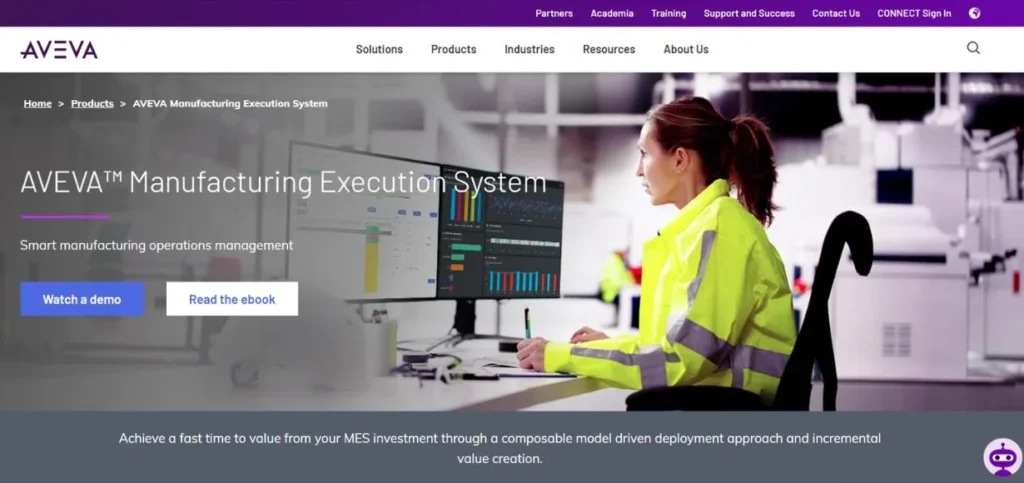
AVEVA MES for Discrete Manufacturing is one of only a few MES Software for Discrete Manufacturing platforms capable of managing both process and discrete, making it ideal for businesses that operate both processes in the same location (such as chemical mixing + discrete assembly). It is based on AVEVA’s industrial software stack and is fully integrated with AVEVA System Platform (SCADA) and AVEVA PI (historian). It is an excellent option for automotive paint shops, chemical blending + filling lines, and food + packaging hybrid facilities.
AI Features:
- AVEVA AI predictive quality and batch analytics
- ML-based process parameter optimization
- Intelligent alarm management with pattern recognition
Pricing Tier:
- Model: Enterprise project-based pricing, transitioning to SaaS subscription on Azure
- Mid-Size Range: $80,000–$400,000+ depending on site complexity and modules
- AVEVA on Azure: Subscription tiers available; pricing negotiated per project
- Add-Ons: PI Historian integration, SCADA connectivity, and analytics modules extra
- Quote: Contact AVEVA directly or an AVEVA certified system integrator
10. Aegis — Best for Electronics & PCB Assembly
| Field | Details |
| Vendor | Aegis |
| HQ | Horsham |
| Founded | 1997 |
| Deployment | Cloud or On-Premise with strong IIoT connectivity |
| Best Industry | Electronics |
| ISA-95 Level | Level 3 |
| ERP Integration | SAP, Oracle |
| G2/Gartner Score | 4.3/5 |
| Website | https://www.aiscorp.com/ |
Aegis by Aegis Software is the leading MES Software for Discrete Manufacturing in the Electronics / PCB Assembly Industry. It has been developed for SMT (Surface Mount Technology) lines and complies with CFX (Connected Factory Exchange) – the IPC standard for electronics machine connectivity. This allows Aegis to communicate directly with pick and place machines, reflow ovens, AOI and X-ray machines, without requiring specific middleware software. It has a module called NPI (New Product Introduction) which can cut the time to bring a new PCB design from engineering to production dramatically.
AI Features:
- AI-powered solder paste and AOI defect prediction
- ML-based component placement optimization
- Intelligent NPI readiness scoring and analysis
Pricing Tier:
- Model: Modular pricing — buy only the modules your lines need
- Base Platform: From $30,000–$100,000 depending on line count and core modules
- CFX Connectivity Module: Priced separately per machine type / line
- Advanced Analytics Add-On: Additional subscription cost on top of base platform
- Quote: Contact Aegis Software for a line-by-line module breakdown and quote
11. Infor MES — Best Cloud MES for Mid-to-Large Discrete Manufacturers
| Field | Details |
| Vendor | Infor |
| HQ | New York |
| Founded | 2002 |
| Deployment | Cloud-native on AWS (Infor CloudSuite) |
| Best Industry | Automotive |
| ISA-95 Level | Level 3 |
| ERP Integration | Infor CloudSuite |
| G2/Gartner Score | 4.0/5 |
| Website | https://www.infor.com/ |
Manufacturers who are already using Infor CloudSuite Industrial (SyteLine) or Infor LN ERP will find Infor MES a great option. Infor MES uses a common data model for Infor customers, just as SAP Manufacturing Cloud for SAP shops does for SAP shops, to eliminate integration headaches. It integrates production scheduling, WIP tracking, quality management and OEE in one cloud platform. Colleen AI is integrated in all areas of the platform to provide predictive insights and smart tips. It is readily applied in industrial equipment, automotive components and specialty manufacturing businesses.
AI Features:
- Coleman AI production performance recommendations
- Predictive material shortage and delay alerts
- Automated workforce scheduling optimization
Pricing Tier:
- Model: Subscription — included with certain Infor CloudSuite tiers or as an add-on
- Pricing Basis: Per user + per module on Infor CloudSuite (AWS-hosted)
- Mid-Size Range: $60,000–$300,000/year for typical discrete manufacturers
- Infor CloudSuite Bundle: MES often bundled with CloudSuite Industrial at a lower cost
- Quote: Contact Infor directly or an Infor channel partner for bundled pricing
12. Oracle MES — Best for Oracle ERP Customers
| Field | Details |
| Vendor | Oracle |
| HQ | Austin |
| Founded | 1977 |
| Deployment | Cloud-native on Oracle Cloud Infrastructure (OCI) |
| Best Industry | Electronics |
| ISA-95 Level | Level 3–4 |
| ERP Integration | Oracle Native |
| G2/Gartner Score | 4.1/5 |
| Website | https://docs.oracle.com/cd/E18727_01/doc.121/e13057/T469821T469824.htm |
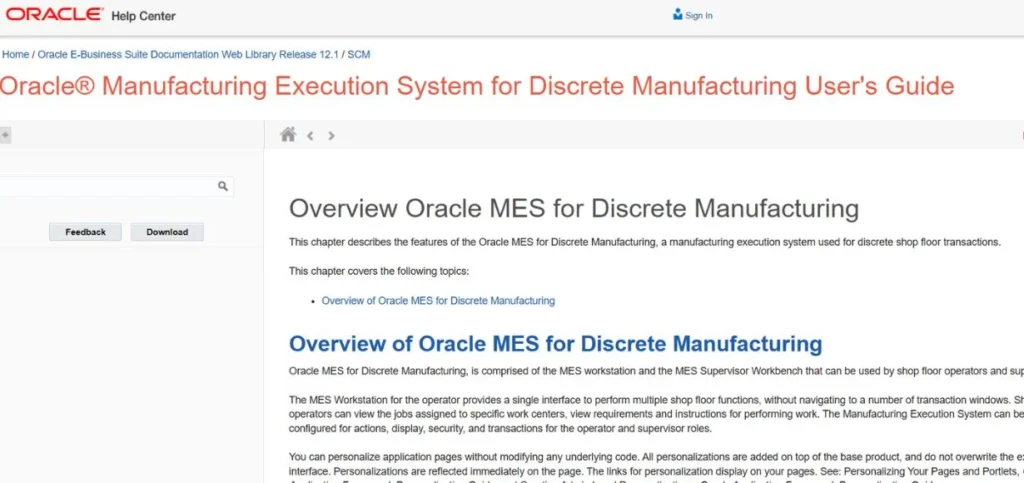
Companies that are implementing Oracle ERP Cloud or Oracle E-Business Suite are a perfect fit for Oracle MES, as part of Oracle Fusion Cloud Manufacturing suite. It is a fully cloud-native MES Software for Discrete Manufacturing that seamlessly integrates production execution directly into demand planning, inventory and financials, with a single Oracle environment. The IoT Intelligent Applications module seamlessly integrates sensors on the factory floor with Oracle AI to provide real-time insights without data silos. It is best suited for high-tech electronics, industrial equipment and consumer goods manufacturers that are part of the Oracle family.
AI Features:
- Oracle AI supply chain disruption prediction
- IoT-connected real-time OEE dashboards
- Intelligent work order exception management
Pricing Tier:
- Model: OCI subscription — sold as part of Oracle Fusion Cloud Manufacturing
- Pricing Basis: Number of employees + modules selected
- Basic Modules: From ~$75/user/month
- Advanced Analytics: $250+/user/month
- Quote: Contact Oracle directly or your Oracle account executive for formal pricing
MES Software Feature Comparison Matrix
- Work Order & Routing Management — All good tools support digital work orders, only a few (Apriso, Opcenter) are good at multi-level and ultra-complex work order routings in the aerospace industry.
- Quality & SPC Integration — Aegis and Critical Manufacturing are better known for electronics SPC; Plex and PINpoint have a stronger focus on automotive assembly quality gates.
- OEE Tracking & Reporting — All tools include OEE, but GE Proficy and Siemens Opcenter have the most detailed breakdown of downtimes.
- IIoT & Machine Connectivity — Aegis (CFX), Critical Manufacturing (SEMI standards), and AVEVA (PI historian) lead in native machine connectivity standards.
- Multi-Site & Global Rollout — DELMIA Apriso and Siemens Opcenter are the only tools purpose-built for rolling out standardized MES templates across 10+ global plants.
MES Software Pricing: What Discrete Manufacturers Should Expect
- Entry-Level (Small Shops, <50 Employees) — A cloud-based application, such as PINpoint or Epicor MES, with basic modules can cost $20,000–$60,000/year.
- Mid-Market (50-500 Employees) — Invest $80,000-$300,000/year in platforms such as Plex, Infor or Oracle MES, complete with full quality integration, OEE and ERP integration.
- Enterprise (500+ Employees, Multi-Site) — Large deployments with Siemens, DELMIA or GE Proficy are generally $500,000 – $3M+ for 3 years with implementation.
- Implementation Costs Can Be Greater Than Software — The industry standard is that implementation services are 1x-3x of the software license cost. Budget accordingly.
- Hidden Costs to Watch — Training, change management, data migration from legacy systems, and annual support fees (typically 18–22% of license) add significantly to total cost.
MES + ERP Integration: SAP S/4HANA, Oracle, Microsoft Dynamics
The most significant difference between MES Software for Discrete Manufacturing solutions for 2026 is the level of integration with ERP. Here’s the info you need to know:
SAP S/4HANA: SAP Manufacturing Cloud is the obvious native choice. Siemens Opcenter also has a certified SAP integration. They both handle standard BAPIs and IDocs, and modern REST APIs for real-time data exchange.
Oracle ERP Cloud / E-Business Suite: Oracle MES is the best option for Oracle shops. There are also certified Oracle connectors that are available from DELMIA Apriso and Critical Manufacturing.
There are three pre-built Dynamics 365 connectors: Microsoft Dynamics 365: Plex (Rockwell), Epicor and PINpoint. This is particularly beneficial to mid-market manufacturers leveraging Microsoft’s ecosystem.
The most important questions to ask any MES vendor are two: “Can you provide a certified connector for my ERP version?” and “Who owns the integration – you or a third-party integrator?
Cloud MES vs On-Premise MES for Discrete Manufacturers
| Factor | Cloud MES | On-Premise MES |
| Upfront Cost | Low (subscription) | High (license + hardware) |
| Total 5-Year Cost | Often higher | Often lower for large sites |
| Deployment Speed | Weeks to months | Months to years |
| IT Maintenance | Vendor-managed | Internal IT required |
| Customization | Limited to configuration | Deep customization spossible |
| Data Security | Shared cloud infrastructure | Full control on-site |
| Offline Capability | Needs internet | Works without internet |
| Updates | Automatic, frequent | Controlled, scheduled |
| Best For | Growing mid-market | Large, regulated enterprises |
| Examples | Plex, Oracle MES, Infor | Opcenter, DELMIA, Proficy |
How to Select MES Software: 10-Step Evaluation Checklist
- Get the Must Have Features First – Make a list of top 5 problems that you have and need MES to solve before you speak with any vendor, this ensures that demos are focused on what you really require.
- Record Your Current Tech Stack — Before assessing MES, document your ERP, SCADA, PLM and quality toolset to evaluate the cost of integration which is #1 hidden cost.
- Pilot MES – Test the MES on one production line for 30 – 60 days to verify performance in the field before embarking on full roll out.
- Assess Vendor Support in Your Region — A good product, with poor regional support is a liability; look for regional implementation partners and local language support.
- Request a Total Cost of Ownership (TCO) Quote — Request a TCO quote from each vendor of 3 years and 5 years, not only for the software, but also for software implementation, training and support.
Conclusion
The right MES Software for Discrete Manufacturing can have a huge positive impact on production efficiency, product quality, compliance and real-time shop floor visibility. There are solutions for various business requirements, ranging from large automotive and aerospace manufacturers to electronics, semiconductor and mid-size companies. Businesses need to assess their business problems, current ERP landscape, scalability needs, and user-friendliness before selecting. Involving both IT and operations teams early in the selection process and conducting a pilot implementation can reduce risks.
Finally, the ideal MES Software is one that meets the current requirements of the factory and allows for the business to grow and meet the objectives of digital transformation as well.
FAQs
What does MES Software (Discrete Manufacturing) mean?
It is software used to control and monitor production on a factory floor, where manufacturers are producing individual countable items such as cars, electronics or airplane parts.
What is the difference between MES and ERP for Manufacturing?
ERP controls business processes (finance, HR, procurement) and MES controls shop floor execution (work orders, quality, OEE) in real-time.
What is the most suitable MES software solution for the automotive industry?
The three leading solutions for tier 1 OEMs to tier 2 suppliers in the automotive market are Siemens Opcenter, DELMIA Apriso and Rockwell Plex.
How much does it cost to put an MES system in place?
Small cloud solutions cost $20,000/year, large enterprise multi-site implementations cost $3M+ and implementation services cost 1x-3x the software cost.
Does MES software support SAP S/4HANA?
Yes — natively integrated with SAP Manufacturing Cloud and certified with SAP S/4HANA by Siemens Opcenter, DELMIA Apriso and Critical Manufacturing.