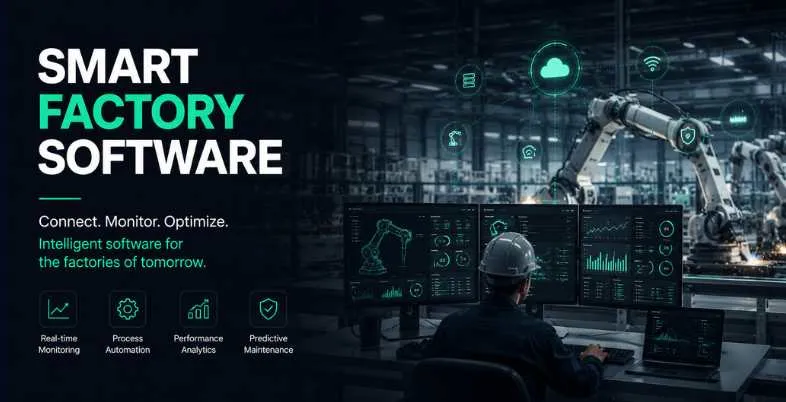
Far and away, the biggest change in manufacturing in the past 100 years. With the increasing complexity of global supply chains and the ever-changing nature of customer needs, factories using spreadsheets and legacy systems are becoming increasingly vulnerable.Global supply chains are becoming more complex and customer needs more unpredictable, leaving factories at risk using spreadsheets and legacy systems. The key to this revolution is Smart Factory tools:
The connecting force between machines, people and data in one intelligent and responsive ecosystem. The usage of Industry 4.0 technologies has entered the new phase from “nice to have” to “survive or fall behind” in 2025–26. This buyer’s guide features the 10 leading Smart Factory Software platforms that are available today, and gives operations managers, plant directors and digital transformation leaders the real-world context, with honest comparisons to make confident, informed investment decisions.
What Is Smart Factory Software?
Smart Factory Software is a digital, integrated solution joining the shop floor machinery, production processes, quality systems and people data together with a real-time layer of intelligence. It is not just a traditional MES or ERP system, it is an IIoT sensor, AI/ML algorithm and digital twin system that can not only document the past, but predict the future and prescribe the actions to take, as well.
It makes a conventional factory into a self optimizing and adaptive operation. The best Smart Factory solutions enable you to track OEE, implement predictive maintenance, move to autonomous scheduling and much more—even with augmented reality assistance!
Key Modules: MES, OEE, Predictive Maintenance, Digital Twin, SCADA
- The real-time monitoring: of production orders, Work-in-Progress, labor and material flow from raw material to finished products is handled by MES (Manufacturing Execution System).
- OEE (Overall Equipment Effectiveness): Failure to use OEE will leave the shop floor with the six big losses and OEE measures these to identify and reduce the losses.
- Predictive Maintenance: AI-based and data from vibration/temperature sensors to predict machine failures before they happen and reduce unplanned machine downtimes up to 50%.
- Digital Twin: An active virtual model of physical assets or a whole production line, which can be simulated and/or modelled in scenarios, and which can be used for remote diagnostics.
- Supervisory Control and Data Acquisition (SCADA): On-line monitoring and control of industrial systems and automation of response to deviations in equipment and processes.
- Quality Management: SPC ( Statistical Process Control), non-conformance tracking, Root Cause Analysis and Compliance Reporting.
- Reduce energy: waste and achieve ESG targets with real-time monitoring energy consumption data per machine, line and/or shift.
Difference: Smart Factory Software vs Traditional MES vs ERP
| Feature | Smart Factory Software | Traditional MES | ERP |
| Real-Time Data | Yes — live IIoT streaming | Partial — often batch | No — transactional only |
| AI/ML Capability | Built-in, predictive | Rare / add-on | Minimal |
| Digital Twin | Core feature in leading platforms | Not standard | Not available |
| Shop Floor Integration | Native PLC/SCADA/OPC-UA | Partial | Not native |
| Predictive Maintenance | Yes | No | No |
| Scalability | Cloud, Edge, Hybrid | On-prem mostly | Cloud ERP available |
| User Focus | Operators + managers + IT | Production managers | Finance + supply chain |
| Implementation Time | Weeks to months | Months | 6–18 months typically |
| Cost Range | $500/mo – enterprise | $50K–$500K+ | $100K–$5M+ |
Why Smart Factory Software Matters in 2025–26
- There is a shortage of labour in factories, so they have to put their own machines to do repetitive monitoring and decision-making tasks, which will otherwise need to be completed by a dedicated engineer.
- Worldwide, energy expenses have skyrocketed and real-time energy intelligence now impacts the bottom-line decision-making of Smart Factory Software.
- Volatility in customer demand calls for reconfigurable production systems that are able to flexibly respond and legacy MES cannot support.
- End-to-end visibility across the entire supply chain is the only way to achieve this — and only a connected platform can deliver it — and that’s when supply chain disruption becomes an issue.
- Manufacturers need to report scope 1 and 2 emissions – and do so with machine level accuracy – as required by sustainability regulations (EU CSRD, SEC climate disclosures).
- The days of using partially mechanized factories are quickly coming to an end in North America and Europe, thanks to the competition from manufacturers in Asia who have switched to fully mechanized factories.
- The lack of clean and structured IIoT data pipelines in factories will not allow them to reap the benefits of generative AI at all within 2–3 years.Within 2–3 years, factories without clean and structured IIoT data pipelines will be cut off from the benefits of generative AI.
How to Choose Smart Factory Software — 7-Point Buyer Checklist
- IIoT Connectivity: Do you need to use expensive middleware to connect natively to your existing PLCs, SCADA systems and legacy machines through OPC-UA, MQTT or Modbus?
- Deployment Flexibility: What is its flexibility, across cloud, on-premises, edge and hybrid deployments – particularly important for regulated or air-gapped environments?
- Scalability Path: Is it possible to scale a pilot across a line and/or plant without re-architecting a solution?
- ERP Integration: Is there an out-of-the-box connector to SAP, Oracle, Microsoft Dynamics or existing ERP solution or do you need to have it developed to your ERP system?
- AI/ML Maturity: Can predictive analytics and anomaly detection be integrated as an inbuilt feature or does it have to be an added-on and require a separate team of data scientists?
- Time to Value: What is your ROI time? In search for platforms, look for those with deployment tracks for three months or industry templates are pre-built.
- Vendor Profitability, Parent Vendor Supportability, and (24/7) Vendor Support with SLA Guarantee: Is the Vendor profitable, has a reputable parent company, and will provide 24/7 support with SLA guarantees?
Top 10 Smart Factory Software Platforms Reviewed 2026
1. Siemens Xcelerator — Best for Digital Twin & Large Enterprises
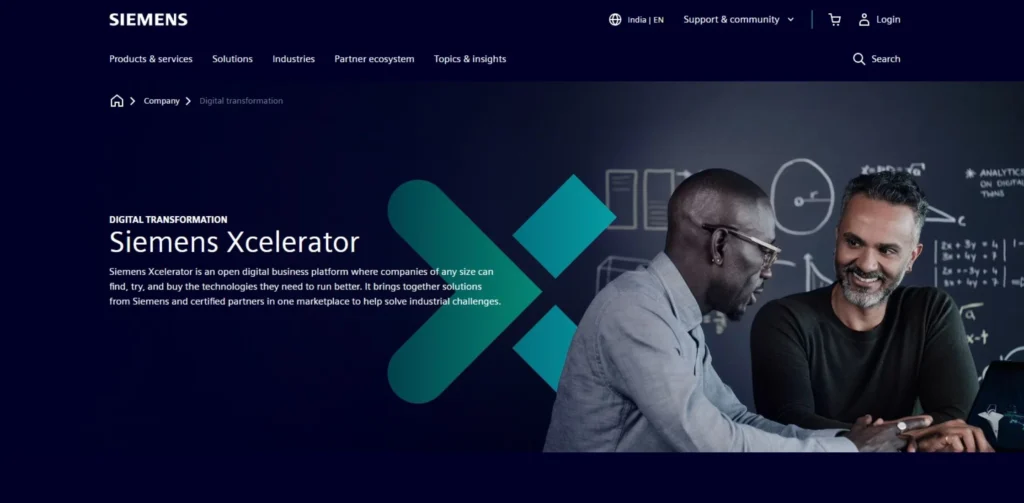
Siemens Xcelerator is the market leader in medium-size and large manufacturers that require a comprehensive and end-to-end digital enterprise solution. It brings decades of proven industrial automation experience, into one digital ecosystem, with a digital twin simulation, MES, PLM and energy management platform. It has an open marketplace which enables third party app developers to add specialist, tailor-made apps that makes it extremely future-proof.
Siemens Xcelerator provides an unprecedented depth in enterprises with complex, multi-plant business and strict regulations such as automotive, aerospace, pharmaceuticals. The ability to integrate with Siemens hardware, such as Siemens PLCs, Siemens drives and Siemens HMIs, ensures an integrated environment that helps minimize the risk of integration.
| Field | Details |
| Founded / Parent Company | 1847 / Siemens AG |
| Best For | Large enterprises needing full digital twin + PLM + MES integration |
| Key Modules | Digital Twin (NX, Teamcenter), MES (SIMATIC IT), OEE, Energy Mgmt, SCADA (WinCC) |
| IIoT & Integration | OPC-UA, REST APIs, SAP/Oracle connectors, Siemens TIA Portal |
| Deployment Options | Cloud, On-Prem, Hybrid |
| AI/ML Features | Predictive quality, anomaly detection, AI-assisted engineering simulation |
| Pricing Model | Enterprise licensing — contact for quote (typically $200K–$1M+/year) |
| Ease of Implementation | 2/5 (complex but heavily supported) |
| Customer Review | “Xcelerator transformed how we simulate product changes — we cut physical prototyping costs by 40%.” — Manufacturing Director, Automotive OEM (G2, 2024) |
| Ideal Company Size | Large enterprise (1,000+ employees) |
| Industry Fit | Automotive, Aerospace, Pharma, Electronics |
| Website | siemens.com/xcelerator |
2. Fabrico — Best Unified OEE + Maintenance + Quality Platform
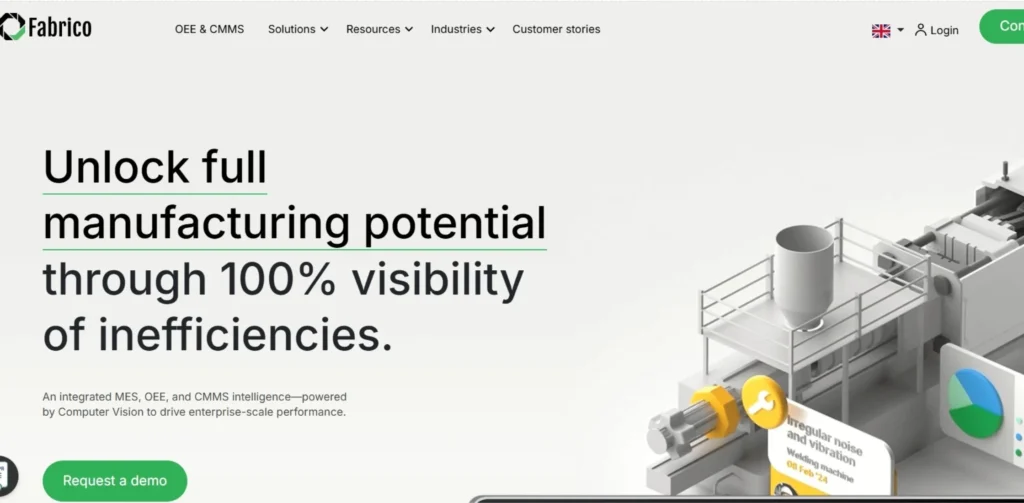
Fabrico is a fast-growing Smart Factory Software solution specifically designed for manufacturing companies that seek to have a unified, clean interface to handle OEE (Overall Equipment Effectiveness), Predictive Maintenance, Quality Control and Production Analytics—without the need to integrate various tools. The design approach of this product is simple: operators can log issues with no training and can see real time dashboards without any hassle, and track the causes of downtime.
Fabrico’s unique value in 2025–26 is its fully-integrated data model. Unlike platforms that add maintenance as an add-on to MES, Fabrico views OEE, maintenance history and quality events as inter-dependent datasets that can be analysed together to find the root cause of the events happening in the machine, the operator’s reaction, and any impacts to the process.
| Field | Details |
| Founded / Parent Company | 2019 / Fabrico Ltd. |
| Best For | Mid-size manufacturers wanting unified OEE + maintenance + quality in one platform |
| Key Modules | OEE Monitoring, Predictive & Preventive Maintenance, Quality Management, Production Analytics, Digital Checklists |
| IIoT & Integration | PLC/SCADA connectors, REST API, ERP integration (SAP, Oracle, custom), MQTT support |
| Deployment Options | Cloud, On-Prem, Hybrid |
| AI/ML Features | Predictive maintenance alerts, anomaly detection, downtime pattern recognition |
| Pricing Model | Subscription-based; starts ~$500/month per plant |
| Ease of Implementation | 5/5 (designed for rapid deployment, often live within weeks) |
| Customer Review | “We went live in 3 weeks and saw a 22% OEE improvement in the first quarter.” — Plant Manager, Food & Beverage (Fabrico case study, 2024) |
| Ideal Company Size | SMB to Mid-Enterprise (50–2,000 employees) |
| Industry Fit | Food & Beverage, Plastics, Metal Fabrication, Consumer Goods |
| Website | fabrico.io |
Also Read: Manufacturing Business Ideas
3. PTC ThingWorx — Best for IIoT App Development & AR
The developer-focused IIoT giant company that helps manufacturers to create custom industrial applications without having to start from scratch is PTC ThingWorx. Together with PTC’s Vuforia AR platform, it helps to enhance the maintenance and training workflows with augmented reality, significantly decreasing the required repair time. For manufacturers that have successful internal IT/OT teams, ThingWorx is a must-have.
The key selling point of the platform is its broad connectivity: There are 150+ prebuilt adapters to connect to virtually any industrial asset with ThingWorx. It has a drag-and-drop app builder, enabling OT engineers to create custom dashboards and workflows without needing to have a strong coding background knowledge, speeding up time to value for custom use cases.
| Field | Details |
| Founded / Parent Company | 2009 / PTC Inc. |
| Best For | Manufacturers building custom IIoT apps and AR-enabled maintenance workflows |
| Key Modules | IIoT Connectivity, Digital Twin, AR (Vuforia), Analytics, Remote Monitoring |
| IIoT & Integration | 150+ industrial adapters, OPC-UA, REST, SAP/Oracle/Salesforce |
| Deployment Options | Cloud (AWS/Azure), On-Prem, Hybrid |
| AI/ML Features | ThingWorx Analytics — predictive scoring, anomaly detection |
| Pricing Model | Modular licensing — starts ~$30K/year for base platform |
| Ease of Implementation | 3/5 (flexible but requires skilled developers) |
| Customer Review | “ThingWorx gave us a connected factory backbone in 6 months — the AR maintenance module alone saved us $800K in Year 1.” — VP of Operations, Discrete Manufacturer (PTC case study) |
| Ideal Company Size | Mid to Large Enterprise |
| Industry Fit | Industrial Equipment, Defense, Electronics, Automotive |
| Website | ptc.com/thingworx |
4. Rockwell Automation FactoryTalk — Best for NA Manufacturers
Rockwell Automation’s flagship Smart Factory Software suite, FactoryTalk is fully integrated in North American manufacturing infrastructure. It is tightly integrated with Allen-Bradley PLCs and Logix controllers and is the easiest upgrade of any plant currently running Rockwell hardware. The SCADA to enterprise MES spectrum is all covered by FactoryTalk Analytics, Optix and Production Centre.
FactoryTalk provides the local support, certified system integrators, and North American industrial standards compliance which are unmatched for manufacturers in the U.S., Canada and Mexico. The 2024–25 update added much to its cloud analytics and AI capabilities and has become much more competitive with newer, born-in-cloud products.
| Field | Details |
| Founded / Parent Company | 2004 / Rockwell Automation |
| Best For | NA manufacturers on Allen-Bradley/Rockwell hardware infrastructure |
| Key Modules | MES (Production Centre), SCADA (FactoryTalk View), OEE, Analytics, Remote Access |
| IIoT & Integration | Allen-Bradley native, OPC-UA, EtherNet/IP, SAP/Oracle ERP |
| Deployment Options | On-Prem, Cloud (Azure), Hybrid |
| AI/ML Features | FactoryTalk Analytics — prescriptive maintenance, process optimization |
| Pricing Model | Module-based licensing — mid to enterprise pricing |
| Ease of Implementation | 3/5 (smooth for Rockwell shops, complex for mixed environments) |
| Customer Review | “FactoryTalk Optix replaced five separate tools and gave our operators one screen to run the whole line.” — Controls Engineer, Packaging Manufacturer (Rockwell case study, 2025) |
| Ideal Company Size | Mid to Large Enterprise |
| Industry Fit | Automotive, CPG, Packaging, Food & Beverage, Life Sciences |
| Website | rockwellautomation.com/factorytalk |
5. ABB Ability Genix — Best for Autonomous Operations
ABB Ability Genix has been designed for manufacturers seeking truly autonomous operations and where AI makes adjustments to control in real time without human involvement. Developed from ABB’s century-long experience in the industry, Genix delivers an integrated Industrial DataOps platform that integrates process analytics, asset performance management and energy optimization. It is very good in continuous process industries.
The key to Genix’s differentiator is its closed-loop artificial intelligence functionality, which not only notifies operators about anomalies, but also proposes and in some configurations, takes corrective measures. This level of autonomy brings revolutionary efficiency gains to industries that demand millisecond precision and where human actions are not feasible, such as oil & gas, mining, and paper/pulp.
| Field | Details |
| Founded / Parent Company | 2019 (Genix platform) / ABB Ltd. |
| Best For | Process manufacturers targeting autonomous, AI-driven operations |
| Key Modules | Asset Performance Management, Process Analytics, Energy Optimization, Digital Twin |
| IIoT & Integration | ABB hardware native, OPC-UA, PI System, SAP PM integration |
| Deployment Options | Cloud (Azure), On-Prem, Edge |
| AI/ML Features | Closed-loop AI recommendations, anomaly detection, autonomous process control |
| Pricing Model | Enterprise licensing — contact ABB for quote |
| Ease of Implementation | 2/5 (deep but requires ABB professional services) |
| Customer Review | “Genix reduced our unplanned downtime by 35% in the first year through proactive AI-driven maintenance.” — Asset Manager, Mining Company (ABB case study, 2024) |
| Ideal Company Size | Large Enterprise |
| Industry Fit | Mining, Oil & Gas, Power Generation, Pulp & Paper, Chemicals |
| Website | new.abb.com/ability/genix |
6. MachineCDN — Best for Fast Deployment & Cellular Connectivity
MachineCDN is a modern Smart Factory Software Player that is particularly suited for manufacturers that require production visibility quickly – with no extensive wiring projects or IT infrastructure changes. It is also a cellular-first connectivity solution, which allows sensors and gateways to communicate through the 4G/5G network, allowing the deployment of this solution in days instead of months, even in buildings with limited WiFi coverage.
This is a great solution for multi-site manufactures looking to roll it out across multiple sites very quickly without local IT personnel. Operators with no software background can easily adopt the pre-built dashboards provided by MachineCDN for OEE, downtime and maintenance scheduling, with higher adoption rates, compared to traditional platforms.
| Field | Details |
| Founded / Parent Company | 2020 / MachineCDN Inc. |
| Best For | Manufacturers needing fast, cellular-connected IIoT deployment across multiple sites |
| Key Modules | OEE, Downtime Tracking, Maintenance Scheduling, Production Reporting, Alerts |
| IIoT & Integration | Cellular (4G/5G), WiFi, Ethernet gateways; REST API; ERP webhooks |
| Deployment Options | Cloud-native, Edge gateways |
| AI/ML Features | Anomaly alerts, downtime pattern analysis |
| Pricing Model | Hardware + SaaS subscription — starts ~$299/machine/month |
| Ease of Implementation | 5/5 (plug-and-play hardware, live in days) |
| Customer Review | “We deployed across 4 plants in 2 weeks. No IT project, no consultants — just plug in and go.” — Operations Director, Metal Fabricator |
| Ideal Company Size | SMB to Mid-Market (10–500 employees) |
| Industry Fit | General Manufacturing, Metal Fabrication, Plastics, Contract Manufacturing |
| Website | machinecdn.com |
7. Plex Systems — Best Cloud MES for SMB Manufacturers
Plex Systems (now Rockwell Automation) is the pioneer in the cloud native MES space and is the benchmark for small and mid-size manufacturers looking to get enterprise grade production control without enterprise grade IT infrastructure. It has a Smart Manufacturing Platform, with MES, quality, supply chain and HR all in one, browser-based suite.
Plex’s power lies in its extensive knowledge of the manufacturing domain, directly integrated into the software — hundreds of pre-configured workflows are included in the automotive, food & beverage and industrial manufacturing domains. This results in a quicker solution that would require less customizations than the generic ERP-bolt-on solutions do.
| Field | Details |
| Founded / Parent Company | 1995 / Rockwell Automation (acquired 2021) |
| Best For | SMB manufacturers wanting true cloud MES without heavy IT overhead |
| Key Modules | MES, Quality (SPC, FMEA), Supply Chain Visibility, HR/Labor, OEE |
| IIoT & Integration | PLC connectors, EDI, REST APIs, ERP integrations (SAP, QAD) |
| Deployment Options | Cloud (multi-tenant SaaS) |
| AI/ML Features | Quality prediction, supply chain risk analytics |
| Pricing Model | Subscription — mid-market pricing, contact for quote |
| Ease of Implementation | 4/5 (industry templates accelerate go-live) |
| Customer Review | “Plex gave us the visibility we only dreamed about as a 200-person shop. Quality defects dropped 30% in 6 months.” — Quality Manager, Tier 2 Automotive (G2, 2025) |
| Ideal Company Size | SMB to Mid-Enterprise (50–1,000 employees) |
| Industry Fit | Automotive Tier 2/3, Food & Beverage, Industrial Equipment |
| Website | plex.com |
8. Tulip — Best No-Code Platform for Frontline Engineers
With no-code app builder, Tulip portends to a new era in Smart Factory Software delivery allowing frontline engineers — not IT departments — to create and deploy production apps. Tulip apps are visually designed and deployed from the line within hours including digital work instructions, quality checklists and process tracking. Essentially, it’s a democratisation of factory digitalisation.
The platform is particularly useful for complicated assembly tasks that involve using paper work instructions that lead to quality mistakes. The combined Tulip machine monitoring, IoT integration and analytics give an impressively powerful operational platform, all in the hands of people who know how it works.
| Field | Details |
| Founded / Parent Company | 2014 / Tulip Interfaces |
| Best For | Operations and industrial engineers building no-code digital work instruction and quality apps |
| Key Modules | No-Code App Builder, Digital Work Instructions, OEE, Quality Tracking, Machine Monitoring |
| IIoT & Integration | Native machine connectors, OPC-UA, REST API, ERP/MES integrations |
| Deployment Options | Cloud, On-Prem (Edge IO devices) |
| AI/ML Features | Process analytics, defect pattern detection |
| Pricing Model | Per-operator subscription — starts ~$1,200/operator/year |
| Ease of Implementation | 5/5 (no-code drag-and-drop; production apps in days) |
| Customer Review | “Our engineers built 40 apps in 3 months without writing a single line of code. It changed everything on the floor.” — Manufacturing Engineer, Medical Device Company (Tulip case study, 2024) |
| Ideal Company Size | SMB to Large Enterprise |
| Industry Fit | Medical Devices, Electronics Assembly, Aerospace, Consumer Goods |
| Website | tulip.co |
9. SYSPRO — Best ERP + Smart Factory Hybrid
SYSPRO brings together a combination of traditional ERP and today’s Smart Factory Software—it’s the perfect solution for manufacturers that require both financial and supply chain and production intelligence without having to manage two distinct systems. SYSPRO’s Industry 4.0 features enable IIoT connectivity and AI analytics to be added directly to the SYSPRO ERP backbone, purpose-built for manufacturing and distribution.
For manufacturers that have yet to digitize their business due to the “ERP can’t do it” restriction, SYSPRO gets them there in one fell swoop. Because it is designed with manufacturing in mind, it has fewer customizations and faster implementations than other ERP systems such as generic systems like SAP or Oracle – and total cost of ownership is much lower for companies that have 50 to 500 employees.
| Field | Details |
| Founded / Parent Company | 1978 / SYSPRO Group |
| Best For | Mid-size manufacturers wanting ERP + smart manufacturing in a single system |
| Key Modules | MES, Inventory & Supply Chain, Financial Management, OEE, Quality, IIoT Add-ons |
| IIoT & Integration | REST APIs, third-party IIoT connectors, EDI, B2B integrations |
| Deployment Options | Cloud, On-Prem, Hybrid |
| AI/ML Features | Demand forecasting, inventory optimization, production scheduling AI |
| Pricing Model | Per-user licensing — mid-market; starts ~$199/user/month |
| Ease of Implementation | 4/5 (manufacturing templates reduce configuration time) |
| Customer Review | “SYSPRO gave us one version of the truth — finance and the factory floor finally speak the same language.” — CFO, Specialty Manufacturer (Gartner Peer Insights, 2024) |
| Ideal Company Size | SMB to Mid-Enterprise (50–500 employees) |
| Industry Fit | Electronics, Food & Beverage, Automotive Components, Industrial Equipment |
| Website | syspro.com |
10. iFACTORY — Best Industry 4.0 Platform Ranking Tool
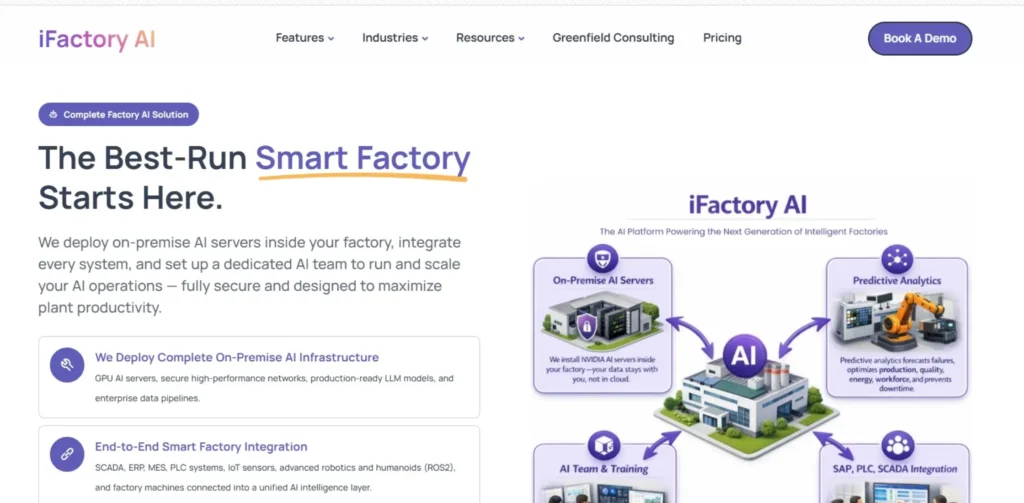
iFACTORY is an emerging Smart Factory Software platform and Industry 4.0 assessment tool to enable manufacturers to benchmark their digital maturity and create a structured transformation roadmap. It integrates production data, process digitization and a unique maturity scoring system to enable plant leaders to know exactly where they are, and where to invest next.
iFACTORY offers an organized and data-driven approach for manufacturers just starting their Industry 4.0 journey and struggling to keep up with vendors’ offerings and the latest technology trends. It is an invaluable starting point with its guided implementation methodology and pre-built transformation templates, before making bigger investments in the platform.
| Field | Details |
| Founded / Parent Company | 2018 / iFACTORY GmbH |
| Best For | Manufacturers benchmarking Industry 4.0 maturity and planning digital roadmaps |
| Key Modules | Maturity Assessment Engine, Production Analytics, Process Digitization, KPI Dashboards |
| IIoT & Integration | Sensor integration, REST APIs, ERP connectors |
| Deployment Options | Cloud, SaaS |
| AI/ML Features | Maturity scoring AI, process optimization recommendations |
| Pricing Model | SaaS subscription — starts ~$299/month |
| Ease of Implementation | 5/5 (guided setup wizard, live in under a week) |
| Customer Review | “iFACTORY showed us exactly where our losses were hiding. We prioritized maintenance first and recovered 18% productivity.” — Operations Manager, Plastics Manufacturer |
| Ideal Company Size | SMB to Mid-Market |
| Industry Fit | General Manufacturing, Plastics, Metal, Consumer Goods |
| Website | ifactory.ai |
Smart Factory Software Comparison Table
| Platform | Best For | Deployment | IIoT Native | AI Capability | Pricing Tier | Ease of Use |
| Siemens Xcelerator | Digital Twin + Enterprise | Cloud/On-Prem/Hybrid | Yes | Advanced | Enterprise ($$$$$) | 2/5 |
| Fabrico | OEE + Maintenance + Quality | Cloud/On-Prem/Hybrid | Yes | Strong | Mid ($$) | 5/5 |
| PTC ThingWorx | IIoT App Dev + AR | Cloud/On-Prem/Hybrid | Yes | Strong | Mid-Enterprise ($$$) | 3/5 |
| Rockwell FactoryTalk | NA Manufacturers | On-Prem/Cloud | Yes | Strong | Enterprise ($$$$) | 3/5 |
| ABB Genix | Autonomous Operations | Cloud/Edge | Yes | Advanced | Enterprise ($$$$$) | 2/5 |
| MachineCDN | Fast Cellular Deployment | Cloud/Edge | Yes | Basic | SMB ($) | 5/5 |
| Plex Systems | Cloud MES for SMB | Cloud SaaS | Yes | Moderate | Mid ($$$) | 4/5 |
| Tulip | No-Code Factory Apps | Cloud/Edge | Yes | Moderate | Mid ($$) | 5/5 |
| SYSPRO | ERP + Smart Factory | Cloud/On-Prem/Hybrid | Partial | Moderate | Mid ($$$) | 4/5 |
| iFACTORY | Industry 4.0 Roadmapping | Cloud SaaS | Partial | Basic | SMB ($) | 5/5 |
Implementation Roadmap: From Level 0 to Level 4
- Level 0 – Paper and Spreadsheets: Basic assessment of existing KPIs, data sources and process flows. Once you’ve figured the most costly losses in production, mark the top three losses first to get a clear idea of what software to choose.
- Level 1 — Connected Machines: Deploy IIoT sensors, gateways, on critical assets. Create OPC-UA or MQTT data pipelines. Start taking real-time OEE data for the first time
- Level 2 — Visibility and Dashboards: adopt MES core modules, operator dashboards and digital shift logs. Eliminate paper work orders and manual data entry by replacing it with digital workflows.
- Level 3 — Analytics and Alerts: Enable predictive maintenance models, SPC quality monitoring and automated reason coding for downtimes. Start AI-based root cause analysis and reporting in due course
- Level 4 — Autonomous Optimization: Faster closed-loop AI-based recommendations for scheduling, maintenance and quality. Implement enterprise-wide simulation-based decision-making and scenario-planning with the help of digital twins.
TCO Analysis & Hidden Implementation Costs
- The cost of software licensing is generally 40-60% of the total cost of the initial year, and many buyers neglect to account for the remaining aspects of the cost when they purchase software.
- For older facilities lacking existing sensor installation, hardware costs, or the cost of the IIoT sensors, gateways, edge devices or tablets, can amount to 20–40% of the software licensing fees.
- System integration, or integration with existing ERP, SCADA, PLCs and databases, can be $50K-$200K+ for mid-size deployments in professional services.
- Underestimate change management and training, add 10-15% of project costs for operator training, process redesign and support for adoption;
- Data cleaning and normalization — the majority of factories have years of inconsistent and incomplete production data that needs to be cleaned in order to run AI/ML models properly.
- Price increases each year of the subscription – SaaS platforms usually have 5-15% price increases per year when the subscription follows multi-year contracts; model this in your 3-year TCO analysis
- The introduction of OT networks to cloud platforms creates new attack surfaces, necessitating firewall upgrades, OT security monitoring, and compliance audits.The integration of OT networks with cloud platforms adds new attack surfaces that need to be hardened, monitored for security, and audited for compliance.
Conclusion
The Smart Factory Software market is available for every manufacturer – from plug-and-play cellular platforms for small shops to enterprise digital twin environments for worldwide manufacturers. The best option will depend on the features offered, but also on your digital maturity, the capacity of your IT/OT teams, the level of integration, and strategic goal.
You can begin with a targeted OEE solution such as Fabrico, expand to a cloud-based MES system such as Plex or embrace a complete digital enterprise transformation with Siemens Xcelerator—whatever the approach, the key is to get started. But manufacturers who wait to implement Smart Factory Software are not sitting still, they’re playing catch-up. Follow this as a guide, conduct a pilot and follow the data to forward motion.
FAQs: Smart Factory Software
What is smart factory software?
Smart factory software is a digital platform that enables the integration of IIoT, Artificial Intelligence and the Cloud to form a real-time self-optimizing factory.
The best smart factory software for 2026 depends on the specific requirements and goals of the factory.
Siemens Xcelerator excels in large enterprises, Fabrico offers uniform OEE and maintenance for mid-size manufacturers and Tulip has the best no-code frontline digitization. The right platform will vary based on the size of your business, industry and specific objectives.
The difference between MES and smart factory software is mainly in the way they are used.
The difference between MES and smart factory software is more in the usage. Normal MES documentation and monitoring of production activity. Smart factory software is connected to IIoT through Smart factory software, intelligent analytics with AI/ML, digital twins and predictive capabilities mean it is proactive and prescriptive, not descriptive.
Smart factory software costs vary depending on the specific requirements.
The starting price for SaaS platforms is around ~$299/month and it might be $1 million or more for enterprise solutions. The cost of a mid-market platform is generally $500-$5,000/month and its price range depends on the number of machines and users, as well as the modules.
Industry 4.0 is the term used for the fourth Industrial Revolution, which is being driven by the use of software.
The fourth industrial revolution is Industry 4.0, which features cyber-physical systems, Internet of Things for industry (IIoT), artificial intelligence (AI) and data exchanges. Smart factory software is the layer that gathers shop floor information, adds intelligence to it and provides real time actionable information to operators and managers.
Absolutely, it was a technology that they could use.
Absolutely. Platforms such as Fabrico, MachineCDN, Tulip and iFACTORY are built to meet the requirements of SMBs, in addition to being quick to set up, user-friendly and cost-effective enough to provide ROI for 10-machine shops.
A digital twin in manufacturing is a virtual representation of the manufacturing process itself.
A digital twin is a representation of a real asset, production line or factory in real time. It mimics the real world with sensor data and allows the engineers to change it, predict it could fail, and optimize it without having to go to the equipment.