
Pricing used to be relatively simple. Competitors’ prices would be checked and prices would be adjusted accordingly. That seems to be increasingly difficult to handle as prices, demand and competition may vary from day to day. This way of doing it is ineffective today. Markets change all the time, competitors change prices using bots and customers compare 5 tabs before making any purchases. This is where AI pricing optimization tools can come in handy. They review market, sales and stock information to make pricing recommendations, without having to keep an eye on all the details on their own.
By researching the product information, price, features and publicly available customer feedback, we created this list. This guide compiles all the facts and figures: from enterprise products such as Competera, Pricefx and others, to budget-friendly products like Prisync.
There are tools available for different kinds of catalog sizes and pricing requirements, whether you have a small online business or are responsible for pricing in a large retail enterprise. Let’s dive into what they are, who they’re for, and which ten tools we found the best during testing and comparison for 2026.
Also Read – AI Energy Optimization Tools
What Is AI Pricing Optimization and How Does It Work?
AI pricing optimization involves using machine learning algorithms to suggest or automatically determine prices based on the actual market conditions of competitors, demand trends, inventory availability, and other factors such as seasonality and consumer purchasing trends. AI pricing software uses the following data to analyze competitor pricing, demand, inventory, seasonality and customer behavior. It then takes that information and suggests a price that can be the right one to make sales and profit equal.
Most platforms do the same, they gather pricing and sales information, determine the price sensitivity, and suggest/reapply a new price. They gather data – all the information they pull in from competitor sites, your sales history and even stock or demand signals. Secondly, the AI model analyzes this information and creates a model of the price elasticity, or the change in demand that occurs as a result of a price change. Thirdly, the system suggests a new price to your team or will push it live automatically to your store or marketplace listings.
Some platforms also simulate the effects like cannibalisation and halo effect. These features are not just limited to competitor-price tracking. It’s what makes basic price trackers stand out as not being true AI price optimization tools.
Who Needs AI Pricing Software? (Enterprise Retail vs. Mid-Market vs. SMB Ecommerce)
| Business Type | Typical Catalog Size | What They Need | Good Fit |
| Enterprise Retail | 50,000+ SKUs, multiple stores | Demand forecasting, omnichannel sync, custom AI models | Competera, Intelligence Node, PROS |
| Mid-Market Retail/D2C | 1,000–50,000 SKUs | Rule + AI hybrid pricing, competitor tracking, fast rollout | Omnia Retail, Wiser |
| SMB Ecommerce | Under 1,000 SKUs | Simple, transparent pricing and quick setup | Prisync, Repricer.com |
| B2B / Manufacturing | Quote-based, complex contracts | CPQ integration, deal-level pricing guidance | Pricefx, PROS, Zilliant |
Quick Comparison Table — Best Tool by Use Case
| Tool | Best For | Starting Price (or ‘Custom/Demo’) | Standout Feature | Free Trial Available? |
| Competera | Mid-market & enterprise retail | Custom (demo required) | 20+ demand factors, 930 deep-learning market models | No, demo only |
| Pricefx | Complex B2B / CPQ pricing | Custom (often $100k+/yr for enterprise) | Full price-to-quote suite | No, demo only |
| Prisync | Small/mid ecommerce | $99/month | Transparent per-plan pricing | Yes, 14 days |
| Wiser | Omnichannel + in-store retail | Custom (demo, often $30,000+/yr) | Billions of SKUs tracked daily | No, demo only |
| Intelligence Node | Enterprise price intelligence | Custom (demo required) | 99% AI product-matching accuracy | No, demo only |
| Omnia Retail | Rule + AI hybrid pricing | From €399/month | Omnia Agent conversational AI | Demo based |
| PROS | B2B / airline dynamic pricing | Custom (enterprise only) | Sub-second, quote-level AI pricing | No, demo only |
| Buynomics | Revenue growth management simulation | Custom (demo required) | Virtual Shopper AI simulation | No, demo only |
| Zilliant | B2B price guidance | Custom (demo required) | Deal scoring and guardrails | No, demo only |
| Repricer.com | Amazon & marketplace sellers | From around $58/month | Marketplace-specific repricing rules | Yes |
The 10 Best AI Pricing Optimization Tools 2026
Competera — Best for Mid-Market & Enterprise Retail
For retailers who require pricing decisions that are not just based on competitor price, Competera is designed. The company details that the platform takes in account factors like seasonality, stock levels, cross-product effects, among others, and demand elasticity. While Competera can match the price of the lowest competitor, it takes into account over 20 pricing and non-pricing factors – such as demand elasticity, stock levels, seasonality, even cross-product cannibalization – by studying them through its contextual AI. It is powered by almost 930 industry-specific deep learning models, a key factor in retailers’ confidence in it for day-to-day pricing decisions, like for Sephora and Flaconi.
Competera is a repricing tool that is different from other simple repricing tools because it takes into account the reasons for changing a price, as opposed to just the lowest competitor price. Competera does more than just give you a list of things to decrease the price of – it gives you the reason behind the customer behavior you are recommended to decrease. It also has a 99% SLA on accuracy of the data when it comes to competitor matching, which is a big deal in a large catalog as a single competitor match error could upset a pricing strategy.
Key Features:
- Demand-based AI pricing
- Real-time competitor tracking
- SKU-level campaign control
- Omnichannel price sync
Pros:
- Competitor matching capabilities
- Deep customization options
- Excellent customer support
Cons:
- No public pricing
- Steep initial learning curve
- Enterprise-only focus
Pricing: Custom quote, demo required
Best For: Mid-market and enterprise retail chains
Pricefx — Best for Complex B2B/CPQ Pricing

Pricefx is more oriented towards B2B pricing than the typical pricing application for ecommerce. It’s intended for industries where the prices are frequently negotiated by means of quotes, contracts, discounts and rebates. It is designed for companies in the B2B manufacturing, distribution and chemicals and where pricing does not consist of a single number on a website, but is a negotiated quote with contracts, discounts and rebates. Pricefx is one of the proven AI pricing optimization solutions in this field, and integrates pricing logic straight into your CPQ (configure-price-quote) workflow.
When sales reps use AI to get price recommendations, they receive them right in the quoting tool – Sales reps can get pricing suggestions directly as they are working on a quote and pass them on to the customer when submitting a proposal. Pricefx is cloud-based, and requires less time to roll out than older pricing engines on-premise, but reviewers indicate that it can still take a significant amount of time and internal resources to set up a large enterprise catalog.
Key Features:
- CPQ integration
- Deal-level price guidance
- Margin optimization engine
- Rebate management tools
Pros:
- Built for complex B2B
- Cloud-native architecture
- Strong customization depth
Cons:
- No published pricing
- Longer implementation time
- Needs dedicated pricing team
Pricing: Custom, $100,000+ per year
Best For: B2B manufacturers and distributors
Prisync — Best for Small/Mid Ecommerce (Transparent Pricing)
If your feeling of frustration towards the “contact sales” buttons on all pricing pages is here, then there’s hope for you with Prisync. It’s one of the few AI pricing optimization software that actually has its pricing structures listed on their internet site – without calling.It’s among the couple of AI pricing optimization software that actually makes its particular prices plans online – without calling. Prisync monitors each competitor’s price and stock levels on the web and marketplaces and uses a dynamic pricing engine to adjust their pricing accordingly to beat or match competitor’s pricing rules you establish.
The Professional plan begins with a price of $99 per month, and includes up to 100 products, unlimited competitor tracking and 3 price updates per day. The Premium and Platinum plans grow to 1,000 and 5,000 products, respectively, that track to marketplaces, notifying instantaneously and offering API access. Shopify merchants receive a longer free trial period and can get up and running in a day’s time, which is quick enough for the majority of small teams to get a store up and running.
Key Features:
- Dynamic repricing engine
- Marketplace price tracking
- Stock availability alerts
- Excel and API reports
Pros:
- Transparent, published pricing
- Fast, easy setup
- Great customer support
Cons:
- Product limits per tier
- Extra channels cost more
- Less suited to large catalogs
Pricing: $99/month
Best For: Small and mid-size online stores
Wiser — Best for Omnichannel + In-Store
Wiser is about Price Intelligence – both online and offline retail. It captures a product’s information on various sites, on marketplaces, and in brick and mortar stores, and as a result, it’s incredibly helpful for companies that sell on multiple channels. Tracks billions of products on web, market and even shelf listings and updates them every 15 minutes or so for the high priority products. That’s a good choice for brands who are selling their products on their own website, Amazon and in physical stores.
The platform Wiser uses, is based on a ‘plan, execute, monitor’ cycle. Teams compare prices in various regions and categories, establish pricing rules, and/or automatically allow AI to adjust prices, and follow up on results on pricing dashboards. It is more of a pricing intelligence and competitive monitoring platform, rather than a pure algorithmic optimization platform, but for brands of all sorts with omnichannel needs, there’s nothing like one source of truth across all channels.
Key Features:
- Omnichannel price monitoring
- In-store shelf tracking
- Automated repricing rules
- MAP compliance alerts
Pros:
- Covers online and offline
- Massive product coverage
- Reliable data accuracy
Cons:
- Pricing not published
- Can be costly for SMBs
- Setup needs vendor support
Pricing: Custom quote, $30,000+/year
Best For: Omnichannel and in-store retailers
Intelligence Node — Best for Enterprise Price Intelligence
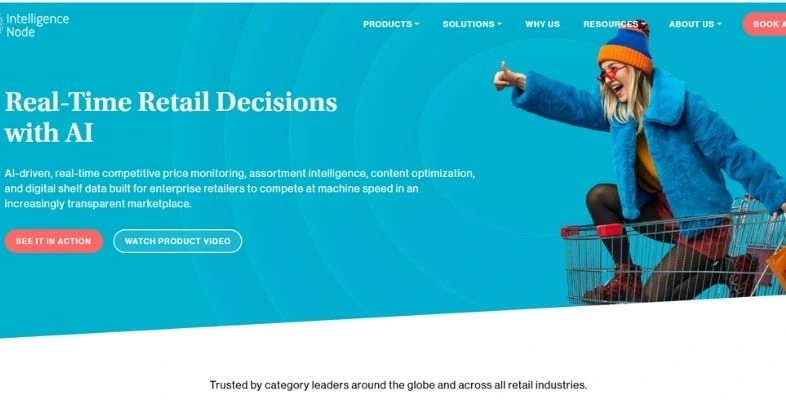
Intelligence Node is designed for large retailers and brands that would like to know not only the price that they should set, but where they are on the digital shelf. It says its AI product-matching-engine is as accurate as 99%, and that it can update competitor data every 10 seconds or less for items that are tracked. If there are frequent price changes by competitors, or during flash sales, you should look into frequent data updates.
In addition to price tracking, Intelligence Node also provides content and assortment intelligence that allows brands to view their listings against competition in more than price—such as reviews, image quality and stock. These features make it applicable for bigger merchants who have a number of marketplaces.
Key Features:
- Near-instant price refresh
- Digital shelf analytics
- AI-based product matching
- Assortment benchmarking
Pros:
- Extremely fast data refresh
- High matching accuracy
- Strong marketplace coverage
Cons:
- No public pricing
- Best suited to large brands
- Learning curve for new users
Pricing: Custom quote, demo required
Best For: Enterprise brands and retailers
Omnia Retail — Best Rule + AI Hybrid Pricing
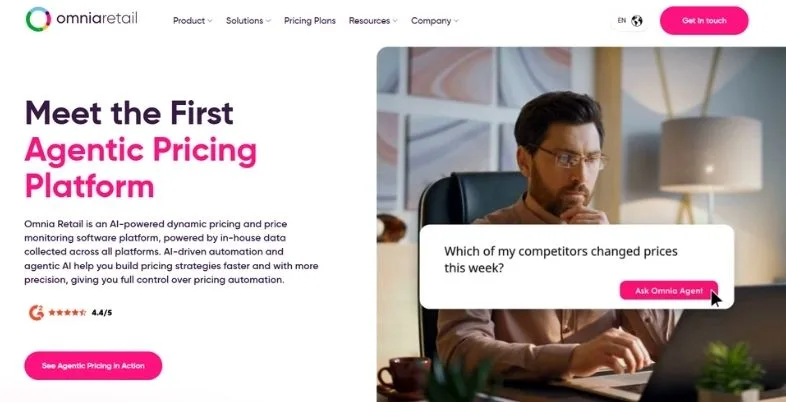
Omnia Retail’s approach is a combination of rule-based pricing and an AI layer, named Omnia Agent in Europe and offers a combination of transparent rule-based logic and an AI layer that is conversational, called Omnia Agent, for 2026. Pricing teams can ask questions of the algorithm, such as “how am I under or overpriced relative to my margin objectives this week?” and ask open-ended questions, which the algorithm will answer.
This ‘hybrid’ approach is suitable for retailers who are looking for a speed advantage from AI but also appreciate the final call to be checked and adjusted by a human. Omnia Retail has a particular strength in grocery and convenience retail, where the pressure to mark down and forecast demand must be met within a tight timeframe, while maintaining a sense of control over the strategy. It has an entry level offering which begins at around €399 per month, which is more user friendly than some enterprise-only players on this list.
Key Features:
- Omnia Agent AI assistant
- Rule-based pricing builder
- Markdown optimization
- Demand forecasting
Pros:
- More transparent pricing
- Easier setup than rivals
- Strong customer support scores
Cons:
- Mid-market focus limits scale
- Fewer B2B features
- Still requires demo for full quote
Pricing: €399/month
Best For: Retailers wanting AI plus manual control
PROS — Best for B2B/Airline Dynamic Pricing
For decades, PROS has been in the pricing technology business and continues to be PROS has been developing pricing technology for decades and focuses heavily on industries such as airlines, distribution and manufacturing. Its AI can quickly produce quote-level price guidance in less than a second—key for sales teams who are juggling hundreds of quotes a day or for airlines who need to change fares on-the-fly.
The platform’s dynamic pricing science is actually a set of years of data science efforts for B2B and travel pricing – a different problem than retail ecommerce. But PROS is truly enterprise-level, and reviewers found that it takes longer to set up and onboard, as well as that mobile support isn’t as developed as newer competitors.
Key Features:
- Sub-second price guidance
- Deal scoring for sales reps
- Dynamic airline fare pricing
- Deep CRM/CPQ integration
Pros:
- Proven at massive scale
- Strong B2B pricing science
- Real-time quote pricing
Cons:
- Long implementation time
- Weak mobile experience
- Expensive for smaller firms
Pricing: Custom, enterprise-only
Best For: Airlines and large B2B sellers
Buynomics — Best for Revenue-Growth-Management Simulation
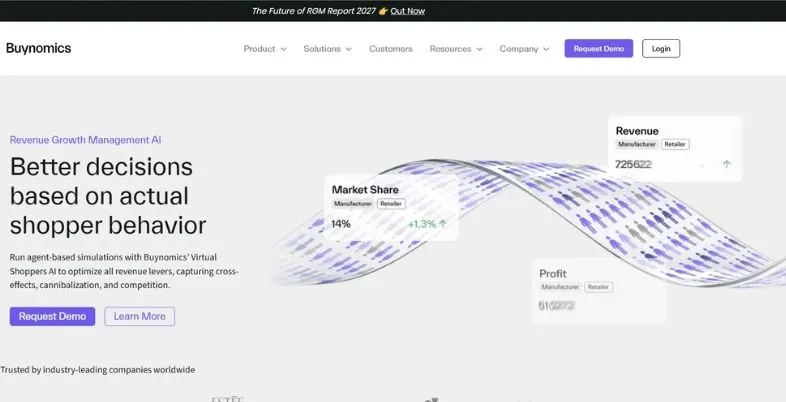
Unlike most of the other AI pricing optimization tools here, Buynomics is a research-driven approach to AI pricing optimization. It does not simply respond to competitor prices, but it also creates a “Virtual Shopper” model of your actual customers based on surveys and transaction data, and simulates what they will do if you change the price, promotion, or assortment, before you make the change “live.
This means that Buynomics is particularly valuable for CPCs and retailers’ revenue growth management teams that must experiment with “what if?” pricing scenarios without putting their actual sales at risk. Teams can model a price increase at category level and view the expected impact of price increase on volume and margin before applying the change. Therefore the platform is more geared towards the scenario planning and pricing decisions rather than to repricing on a daily basis.
Key Features:
- Virtual Shopper simulation
- Scenario and what-if testing
- Category-level price modeling
- Promotion impact forecasting
Pros:
- Powerful scenario planning
- Backed by real behavior data
- Useful for strategic pricing
Cons:
- Not built for daily repricing
- Requires demo for pricing
- Better fit for larger teams
Pricing: Custom quote, demo required
Best For: RGM and category pricing teams
Zilliant — Best for B2B Price Guidance & Deal Scoring
Zilliant is designed specifically for B2B companies that sell via a large sales team and extensive product line, and not ecommerce or retail storefronts. It orchestrates the entire pricing lifecycle—from pricing strategy all the way to sales execution—on a single cloud-based platform, and brings pricing strategy to the rep on a call, not stuck in a spreadsheet. This is one of the AI pricing optimization tools that sales and pricing teams tend to use side by side because it provides real-time information for guardrails and integrates into the quoting process.
The ability to use Zilliant’s deal scoring is what makes it useful day to day. Using AI that’s been trained by past sales and customer segments, Zilliant lets the sales rep know immediately if its discount will preserve the margin or if it will be too much of a giveaway. It’s fully cloud-native SaaS, which keeps rollout lightweight, compared to the previous on-premise pricing engines, and has a strong 4.4 “out of 5” rating from real B2B users who appreciate its contribution to profitable growth on G2.
Key Features:
- Deal scoring engine
- Price guidance for reps
- Full pricing lifecycle tools
- Cloud-native SaaS platform
Pros:
- Strong G2 user ratings
- Built for large sales teams
- Connects pricing to execution
Cons:
- No published pricing
- Best suited to big B2B firms
- Needs sales team buy-in
Pricing: Custom quote, demo required
Best For: B2B enterprises with a large sales force
Repricer.com — Best for Amazon & Marketplace Sellers
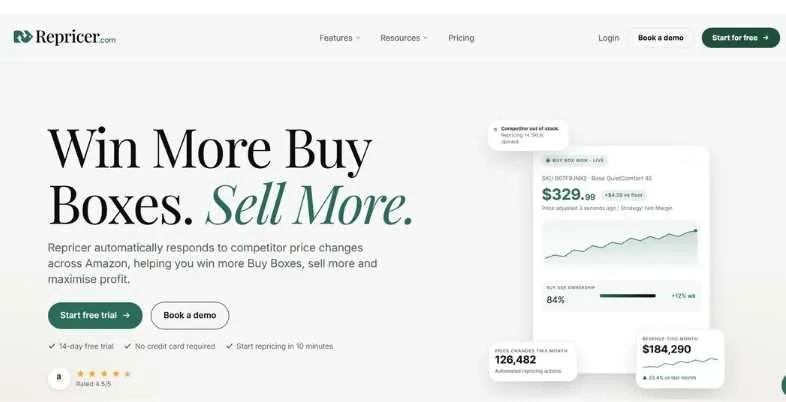
Repricer.com is designed particularly for Amazon sellers who live and breathe by the Buy Box and describe itself as the quickest repricer on the marketplace, which can quickly reprice prices within seconds of the competitor’s change. While some of the earlier AI Based pricing optimization enterprise tools on this list are focused on winning the Buy Box through enterprise tools, Repricer.com is dedicated to one task – winning the Buy Box without compromising the actual profit after Amazon fees, just the headline price.
Its AI Buy Box Optimizer takes into account the stock availability of its competitors, how it will be fulfilled, and the seller feedback score to foresee performance prior to the price change going live. While minimum price floors are by a flat number, they are also worked out according to your net margin after fees, so that you don’t sell at a loss. There are no credit cards required, a free 14-day trial, tiered plans beginning at $99 per month and setup is guided and free.
Key Features:
- AI Buy Box Optimizer
- Net-margin price floors
- Second-by-second repricing
- Free managed setup
Pros:
- Fastest repricing speed
- Transparent tiered pricing
- No-card free trial
Cons:
- Amazon-only, not multichannel
- Less suited to non-marketplace sellers
- Large catalogs may cost more
Pricing: $99/month
Best For: Amazon FBA and marketplace sellers
How Much Does AI Pricing Software Cost? (The Transparency Gap Explained)
- Other small ecommerce tools such as Prisync or Repricer.com have straightforward pricing structures that are typically between $50 and $400 per month and depend on the size of the catalog.
- AI pricing optimization tools for enterprises are rare to find in the market that openly disclose their pricing and almost all of them don’t.AI pricing optimization tools for enterprises such as Competera, Wiser, Intelligence Node, PROS and Pricefx hardly ever publicize the pricing.
- Enterprise deals begin at $20,000 – $30,000 per year and can go beyond $100,000 per year for larger catalogs or for a complex B2B environment.
- The prices are typically based on the number of SKUs, markets to track, refresh frequency, and the number of AI models and integrations required.
- In between are mid-market options such as Omnia Retail, which can be quoted at the outset from around €399 per month, but with custom quotes for larger volumes.
- Don’t agree to an enterprise subscription before requesting a pilot or proof of concept – usage fees can add up quickly.
Real ROI Data — What Retailers Actually Gain
- On average, retailers with dynamic pricing report capturing 20% closer to their sales target with the use of Prisync’s dynamic pricing.
- Competera’s key metrics for customers in the retail sector include predictable revenue growth, improved brand perception, and increased customer lifetime value.
- Intelligence Node’s very fast update of data means that brands can respond to competitor price reductions in seconds, as opposed to hours, and maintain their margin during sales periods.
- Omnia Retail customers say they have quicker time-to-decision because pricing teams receive direct answers from Omnia Agent rather than having to manually search through the dashboards.
- Buynomics’ simulation methodology helps teams steer clear of pricing pitfalls and the associated costs before rollout, and minimises risk in the event of an impactful price change across the category.
- In general, companies implementing AI pricing optimisation tools tend to see a reduction in the number of hours spent on manual pricing and improved margin protection.When it comes to the results, businesses can expect reduced manual pricing time each week and better margin protection across the board.
How to Choose the Right AI Pricing Optimization Tool for Your Business (Checklist)
- Determine the number of SKUs first and for under 1,000 products, you can use SMB tools, such as Prisync; for larger catalogs, enterprise solutions are required.
- Determine whether you require retail pricing, B2B quote pricing or a combination of both: Tools such as Pricefx and PROS differ from Competera and Wiser.
- See if they offer pricing or need a demo and allow for extra time on enterprise sales calls.
- If you want to update your data for festivals and sales, get the answer about how quickly the data will be refreshed: flash sales and festival pricing require quicker data updates than once a day.
- For your team, find explainable AI and not automated numbers, to understand why a price has changed.
- Check if it is integrated with your current ecommerce system, ERP or CRM before committing.
- Wherever possible, ask to run a trial or pilot program to see how it works in your catalog.
- Check out user reviews from G2 and Capterra for unbiased user ratings of support and additional costs.
Conclusion
Selecting the best AI pricing optimization tools for 2026 essentially means matching the pricing and nature of the platform to your business. While Pricefx offers extensive CPQ capabilities, a small ecommerce company doesn’t require that level of sophistication and a large omnichannel retailer will soon outgrow a simple repricing app. You need to begin by considering how many catalogs you are going to require, your budget, and if you are purchasing retail shelf prices or negotiated B2B rates.
In all of what we’ve compared, Competera is a player for the mid-market and enterprise retailers who want to actually be able to set prices based on demand, and Prisync is the most affordable and transparent option for smaller retailers. While Pricefx and PROS are the leaders of the B2B and quote-based space, Omnia Retail offers a good middle-ground solution featuring a conversational AI Agent and simple pricing.
Regardless of what you choose, consider it a trial, rather than a sale. The superior AI pricing optimization software justify the cost by saving your team time each week and by ensuring you don’t lose money on the day-to-day, like at festivals or when a competitor suddenly lowers their price point.
Frequently Asked Questions
So, what does AI pricing optimization software mean?
It is a piece of software that is able to learn about competitor pricing, demand for products and customers’ behaviour and then suggest or even automatically determine the optimal price for a product to boost sales and profit.
What is the price of AI pricing software?
Depending on the size of the catalog and the features, costs vary from approximately $99/month for small ecommerce solutions, such as Prisync to $30,000+/year for enterprise solutions like Wiser, Competera or PROS.
Which of the below AI pricing tools is the best for small ecommerce stores?
However, Prisync offers the best pricing model for small and mid-size online stores, as it is on a transparent monthly basis, is easy to set up, and has a 14-day free trial.
Will AI-based dynamic pricing be legal?
Dynamic pricing on a market-driven basis is not illegal in most countries provided it is not collusion with competitors or discrimination against protected characteristics such as race, gender etc.
What ROI are the businesses expecting from AI pricing tools?
Retailers report a 15–20% increase in sales, improved margin protection and fewer manual pricing hours, though these are dependent on the number of catalogs and how they are used.
Are there any AI pricing tools that have a free trial?
Yes, both Prisync and Repricer.com have free trials and most enterprise tools, such as Competera, Wiser, and PROS will need a demo call before you can test the platform.
So, how do price monitoring differ from price optimization software?
Price monitoring tools will monitor and report competitor prices, whereas price optimization tools will utilize AI to make suggestions or optimize the maximum price based on demand and margin targets.
What are some ways that AI pricing differs from just monitoring competitors’ prices?
Simple tracking only provides you with a competitor price while AI pricing studies require elasticity, inventory, seasonality, and customer behavior to recommend a price that cannot be determined from competitor tracking.